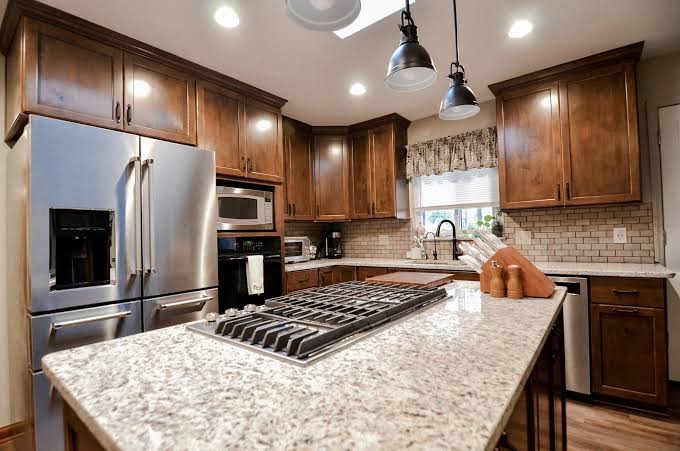
Countertop replacement costs between $2,000 and $10,000 for a typical kitchen with 30 to 40 square feet of countertop surface, depending on the material, the edge profile, and the complexity of the installation. Laminate is the cheapest at $25 to $50 per square foot installed — $750 to $2,000 total. Quartz is the most popular mid-range choice at $60 to $120 per square foot — $1,800 to $4,800. Marble and granite occupy the high end at $50 to $200 per square foot — $1,500 to $8,000. The countertop material is the single largest variable. The fabrication — cutting the slab to size, cutting the sink opening, polishing the edges — and the installation, removing the old countertop, placing the new one, making the plumbing connections, are the secondary variables. The material is the choice. The fabrication and installation are the consequence of the choice.
The countertop is the most-used surface in the kitchen. It is the surface you touch every time you cook, every time you set down a grocery bag, every time you lean against the island with a cup of coffee. The countertop is the work surface, the display surface, and the visual anchor of the kitchen. Replacing it transforms the room. The cost is driven by the material. The experience of using it every day is the return. Here is what each material costs and why.
Countertop Replacement Costs by Material
Countertop replacement costs range from $750 for a laminate kitchen to $8,000 for marble, with quartz as the most popular mid-range choice. Here is the complete cost comparison across nine materials for both 30-square-foot and 40-square-foot kitchens.
| Material | Cost Per Sq Ft (Installed) | 30 Sq Ft Total | 40 Sq Ft Total |
| Laminate | $25 – $50 | $750 – $1,500 | $1,000 – $2,000 |
| Tile (ceramic or porcelain) | $30 – $60 | $900 – $1,800 | $1,200 – $2,400 |
| Butcher block (wood) | $40 – $80 | $1,200 – $2,400 | $1,600 – $3,200 |
| Solid surface (Corian) | $50 – $100 | $1,500 – $3,000 | $2,000 – $4,000 |
| Granite | $50 – $100 | $1,500 – $3,000 | $2,000 – $4,000 |
| Quartz | $60 – $120 | $1,800 – $3,600 | $2,400 – $4,800 |
| Marble | $70 – $200 | $2,100 – $6,000 | $2,800 – $8,000 |
| Porcelain slab | $70 – $150 | $2,100 – $4,500 | $2,800 – $6,000 |
| Concrete | $70 – $140 | $2,100 – $4,200 | $2,800 – $5,600 |
What Drives the Cost of Countertop Replacement
The material is the largest variable. The price difference between laminate and marble is $45 to $150 per square foot, $1,350 to $6,000 for a 40-square-foot kitchen. The material determines the cost, the durability, the maintenance, and the appearance. The material is the choice that drives every other decision. The edge profile, the backsplash, and the installation complexity follow from the material. Choose the material first. Every other number on the estimate flows from it.
The edge profile adds cost. A simple eased edge, a flat face with a slightly softened corner, is included in the base fabrication price. A bullnose edge, fully rounded, adds $10 to $20 per linear foot. An ogee edge, an S-shaped curve, adds $20 to $40 per linear foot. A waterfall edge, the stone continues down the sides of the island to the floor, adds $2,000 to $5,000 for the additional stone and the mitered-edge fabrication. A kitchen with 20 linear feet of countertop edge and an ogee profile adds $400 to $800. The edge profile is the detail that signals custom fabrication. The eased edge is standard. The ogee edge is premium. The premium is visible in profile. The premium is felt at the corner where the horizontal surface meets the vertical edge. The eased edge is adequate. The ogee edge is a pleasure. The pleasure costs $500. The pleasure is felt every time you run your hand along the edge of the countertop. The hand notices the difference. The eye does not. The hand is the judge.
Removing the old countertop costs $200 to $500. The installer removes the old countertop, disconnects the sink, and sets the old material aside for disposal. The disposal is included in the price. If the old countertop is tile and the tile was set in a mortar bed, the removal is more labor-intensive and costs $500 to $800. The mortar bed adds time and weight. The tile comes off in pieces. The mortar must be chiseled off the cabinets. The removal is the dirty work. The installation is the clean work. The removal is the part of the project that happens before the new countertop arrives. The removal is necessary. The price is the cost of making the cabinets ready for the new surface.
Sink and faucet replacement add cost. The old sink may or may not be reusable. A drop-in sink can be lifted out of the old countertop and reinstalled in the new one. An undermount sink is epoxied to the underside of the countertop and cannot easily be reused, the epoxy bond must be broken, which risks damaging the sink. Most countertop replacements include a new undermount sink. The sink costs $100 to $500 for a stainless steel model. The sink installation is included in the countertop fabrication, the fabricator cuts the sink opening from the template. The faucet replacement costs $50 to $500 for the faucet plus $100 to $200 for plumbing labor if the plumber is already on site. The sink and the faucet are the jewelry of the countertop. The old jewelry on the new countertop looks like an afterthought. The new jewelry completes the transformation.
The National Association of Home Builders (NAHB) identifies kitchen countertops as one of the most scrutinized surfaces by home buyers. Quartz and granite countertops are considered standard in mid-range to upscale homes in most markets. Laminate countertops are considered a budget finish and are frequently upgraded by buyers. The countertop is the first surface a buyer touches during a showing. The surface tells the buyer whether the kitchen was built or designed. The designed kitchen has quartz or stone. The built kitchen has laminate. The difference is visible. The difference is tactile. The difference is in the offer price.
Frequently Asked Questions
How much does it cost to replace kitchen countertops?
Countertop replacement costs $2,000 to $10,000 for a typical kitchen depending on the material. Laminate costs $750 to $2,000. Quartz costs $1,800 to $4,800. Marble costs $2,100 to $8,000. The national average is around $3,000 to $4,000 for quartz countertops in a 30- to 40-square-foot kitchen.
Can I replace countertops without replacing the cabinets?
Yes. Countertop replacement is independent of cabinet replacement. The old countertop is removed from the existing cabinets. The new countertop is installed on the same cabinets. The cabinets must be structurally sound and level. If the cabinets are sagging or the boxes are water-damaged, the cabinets should be replaced before or during the countertop replacement. The new countertop will not make old cabinets look new. It will make old cabinets look like old cabinets with a new countertop.
How long does countertop replacement take?
The process takes two to four weeks from template to installation. The fabricator measures the cabinets, using a laser or a physical template, after the old countertop is removed. The fabrication takes one to two weeks. The installation takes one day. The sink is disconnected before removal and reconnected after installation. The kitchen is without a sink for one to two days, the day of removal and the day of installation.
What countertop material is best for resale value?
Quartz is the best countertop for resale value in most markets. It is perceived as premium and requires no maintenance, a selling point for buyers who do not want to seal stone annually. Granite remains popular in traditional markets. Marble is popular in high-end homes. The countertop material should match the home’s price point. Quartz in a starter home is an upgrade that will not fully return at resale. Laminate in a luxury home is a downgrade that will reduce the sale price.
What edge profile should I choose for my countertop?
An eased edge, a flat face with slightly softened corners, is the modern standard and is included in the base price. A bullnose edge, fully rounded, is soft and traditional. An ogee edge, S-shaped, is formal and traditional. The eased edge reads as modern and costs nothing extra. The eased edge is the default choice for a kitchen with flat-panel cabinets, simple lines, and a modern aesthetic.
Should I replace the backsplash when replacing the countertop?
Yes, if the budget allows. The old backsplash was installed to meet the old countertop. The new countertop will have a slightly different thickness, a different overhang, and a different color. The old backsplash may not meet the new countertop cleanly. Replacing the backsplash at the same time as the countertop costs $600 to $1,800 for tile and ensures a seamless fit. The old backsplash on the new countertop is a visible seam. The new backsplash with the new countertop is a single composition.
The Countertop That Transforms the Kitchen
A 40-square-foot kitchen with quartz countertops, an eased edge, a new undermount sink, and professional installation costs $2,400 to $4,800. The old countertop is removed. The new countertop is installed. The sink is reconnected. The kitchen is transformed. The cost is $3,500 on average. The transformation is the most impactful single-surface change in the kitchen. The countertop is the surface you touch more than any other. The laminate countertop that was there for 20 years felt like plastic. The quartz countertop feels like stone. The quartz is cool to the touch. The quartz does not stain. The quartz does not scratch. The quartz will look the same in 15 years as it does on installation day.
The countertop is the work surface, the display surface, and the visual anchor. The material determines the cost and the experience. Laminate costs less and wears less. Quartz costs more and lasts longer. The quartz is worth the premium if you plan to live in the house for more than 5 years. The laminate is adequate if you are selling within 2 years and the existing countertop is damaged. The buyer will replace the laminate with quartz after the purchase. The quartz is the countertop the buyer wants. The laminate is the countertop the seller provides. The quartz is the countertop the homeowner enjoys for the years between purchase and sale. The enjoyment is the return on the premium. The premium is $1,500. The enjoyment is 10 years of daily use. The daily cost of the enjoyment is $0.41. The daily cost is less than a cup of coffee. The coffee lasts five minutes. The quartz lasts all day. Ever run your hand across a quartz countertop in a kitchen showroom — the surface cool, smooth, and perfectly flat — and thought “this is what a kitchen should feel like”? The countertop at home was warm and textured and slightly uneven. The countertop at home was laminate. The laminate had been there for 15 years. It was not damaged. It was not failing. It was just not quartz. The quartz felt like quality. The laminate felt like a placeholder. The $3,500 was the cost of upgrading from a placeholder to the real thing. The real thing feels like quality every time you touch it. The placeholder feels like something you will eventually replace. The quartz is not something you will eventually replace. The quartz is the end of the countertop journey. The journey costs $3,500. The destination is a surface that feels like quality for 25 years.