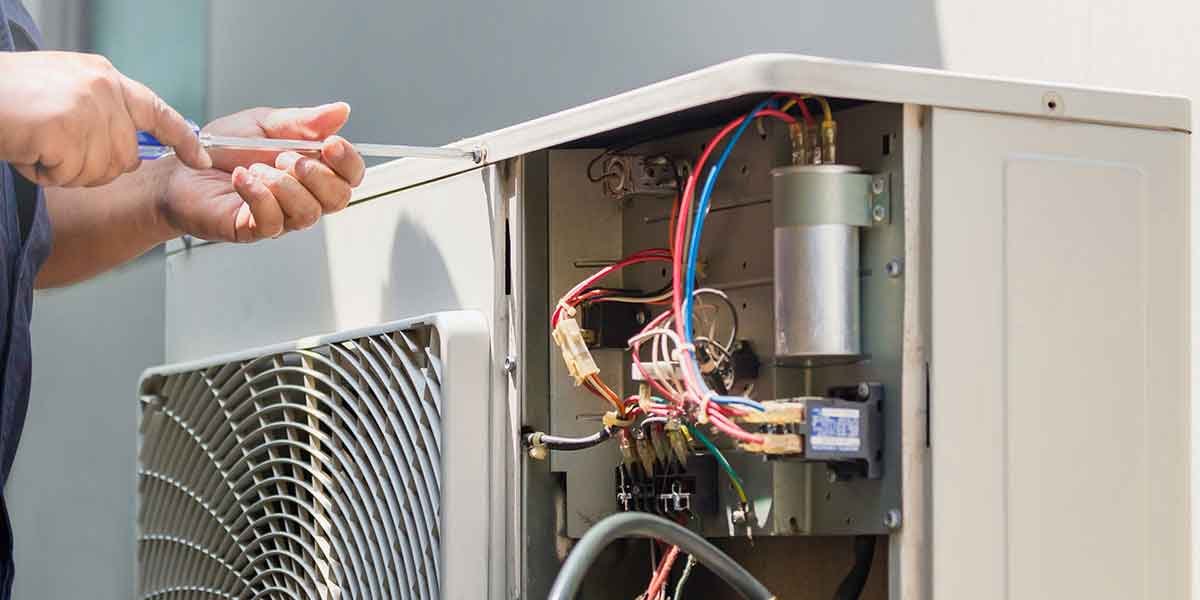
An AC repair is the process of diagnosing and fixing a specific failure that keeps an air conditioner from cooling, moving air, or running safely. It covers the parts and labor needed to restore a working system, and it is different from maintenance, a tune-up, or a full replacement. A repair starts with a diagnosis, continues only after the homeowner approves an estimate, and ends with performance testing.
A practical ac repair description for a typical split-system central air conditioner in a U.S. home covers the service, its boundaries, and the decision path around it. It does not cover automotive AC, duct cleaning, or full system installation. If you are comparing repair quotes or deciding whether to fix an older unit, the scope and the decision rules below tell you what belongs in the work and what does not.
A repair is a bounded transaction. The technician finds the failure, you agree on the scope, the fix happens, and the system gets tested before the job is called done.
AC Repair Description: What It Actually Is
An AC repair restores a failed or failing system to working condition by replacing or fixing the specific component that broke, and it is priced around that one failure rather than as a blanket service. The most common repairs are refrigerant leaks, dirty or clogged air filters restricting airflow, failed capacitors, thermostat malfunctions, frozen evaporator coils, and blocked drain lines.
Repair sits between two other services it is often confused with. Maintenance is preventive and scheduled, covering filter changes, coil cleaning, and system checks before problems appear. A tune-up is a maintenance visit under another name. Replacement is a different decision entirely: the whole system comes out and a new one goes in. A repair fixes what you have; maintenance protects it; replacement retires it.
The distinction matters because each service has a different scope, price, and approval process. A repair estimate should name the failed component and the fix. A maintenance contract covers periodic checks. A replacement quote covers a new system plus installation labor. When a company sells you a “repair” that includes a full tune-up, a coil cleaning, and a new thermostat without your asking, it has quietly expanded the scope. Carrier’s air conditioner repair guide draws the same line between homeowner maintenance and professional repair, and it is a useful reference when a quote blurs the two.
What an AC Repair Includes and Excludes
A repair includes the diagnosis, the failed part and its replacement, the labor to install it, and a performance test that confirms the fix. It excludes preventive work, unrelated parts, and code upgrades unless you approve them separately.
| Included in a typical repair | Not included (separate service or approval) |
|---|---|
| Diagnosis of the reported failure, with the cause named | Preventive maintenance or a seasonal tune-up |
| The failed component and its replacement (capacitor, fan motor, contactor, thermostat, drain line) | Coil cleaning or filter replacement beyond what the repair requires |
| Labor to install the part and restore operation | Duct cleaning, duct sealing, or insulation work |
| Refrigerant handling by an EPA-certified technician if a leak is repaired | Whole-system replacement or new installation |
| Performance testing: temperature split, airflow, safety controls | Electrical panel upgrades or code-mandated changes |
Refrigerant deserves a special line. Only EPA-certified technicians may handle refrigerant under Section 608 of the Clean Air Act, so a refrigerant leak is never a DIY repair and never part of a general handyman job. The EPA’s Section 608 certification requirements are federal, not a company preference. If a leak is repaired, the same visit should confirm the system is recharged to spec and holding pressure.
Parts pricing is where scopes drift. A capacitor that fails costs a modest amount and takes under two hours to replace, while a compressor failure can run into the thousands. The same observable symptom can sit at either end of that range, which is why the estimate must name the component before the work starts. For a closer look at the components and choices involved, the ac repair materials and options page breaks down what each repair typically involves.
The Homeowner Decision Path
The decision path runs in order: check what you can safely check yourself, call a professional for anything involving refrigerant, high-voltage electricity, or the compressor, and only then weigh repair against replacement using the system’s age and the repair cost. Most service calls start with the first two steps already done by the homeowner.
Four checks are safe for any homeowner and resolve a surprising share of “not cooling” calls. Change the air filter if it is dirty, confirm the thermostat is set to cool with fresh batteries, reset a tripped circuit breaker once, and clear leaves or debris away from the condenser cabinet outside. Each takes minutes, and each removes a common cause before a technician is involved.
Stop there. Refrigerant handling, high-voltage electrical work, and compressor or motor replacement are not homeowner jobs. Attempting them risks injury, damages the system, and can void the warranty. The safety line is not about skill level; it is about the voltage and the federal refrigerant rules.
When a professional is involved, the repair-versus-replace question comes down to age and cost. The $5,000 rule is a practical guideline from HVAC manufacturers: multiply the system’s age in years by the estimated repair cost. If the product exceeds $5,000, replacement is usually the smarter investment. A 12-year-old unit with a $450 repair gives 12 x 450 = 5,400, which crosses the threshold and starts the replacement conversation; a 5-year-old unit with the same $450 repair gives 2,250, and repair is the clear call.
How an AC Repair Unfolds
Most repairs run four stages: inspection and diagnosis, an approved estimate, the repair itself, and performance testing. Carrier describes a typical appointment at one to two hours, with complex jobs running longer.
The first stage is diagnosis. The technician checks the compressor, coils, electrical connections, and airflow to find the root cause, whether that is a leak, a worn part, or a restriction. This is the stage that separates a named failure from a guess, and it is where the observable facts and the assumptions part ways.
The second stage is the estimate. You get a clear explanation of the issue, the part needed, and the price, and nothing is installed until you approve it. A reputable repair stops at approval; a scope that keeps growing without your sign-off is the sign to pause and ask what changed. Repair pricing in 2026 generally lands between $150 and $1,500 for common fixes, with major component replacements running higher, and the spread comes from the part, the system age, and whether the work is urgent.
The third stage is the fix. The technician installs the approved part and completes the repair, and any refrigerant work follows EPA Section 608 rules. The fourth stage is verification: temperature split, airflow, and safety controls get tested so the system is confirmed working, not just assumed to be.
Timing depends on the failure. The how long does ac repair take guide breaks down typical durations by repair type if you need the details before scheduling.
Observable Facts vs Assumptions
The single most useful skill in an AC repair conversation is telling what you can observe from what only a diagnosis can confirm. “The house is warm and the condenser outside is running” is observable. “It needs refrigerant” is a hypothesis until a certified technician measures the pressures.
Homeowners can observe: whether the air is cold, whether the unit runs, whether the filter is dirty, whether the breaker tripped, and whether ice is forming on the copper lines. Technicians can observe the rest: refrigerant charge, electrical values, compressor health, and airflow measurements.
Every estimate should rest on the second list. If a quote names a failed component and the test that found it, the diagnosis is visible. If a quote says only “repair” with no component named, the assumption is doing the pricing, and that is a reason to ask for the diagnosis before approving anything.
AC Repair Description FAQ
What is the most common AC repair?
The most frequent AC repairs are refrigerant leaks, restricted airflow from dirty filters, failed capacitors, and thermostat malfunctions. Frozen evaporator coils and blocked drain lines are also common service calls.
What is AC repair called?
AC repair is also called air conditioning repair, HVAC repair, or air conditioner service. A tune-up or maintenance visit is a different service, so “service” can be ambiguous; ask whether the visit is diagnostic and repair or scheduled maintenance.
What does an AC service include?
An AC service visit can mean either maintenance or repair depending on the company. A repair service includes diagnosis, the approved part and labor, and performance testing. A maintenance service includes filter changes, coil checks, and a system inspection. Confirm which one you are booking before the visit.
Home improvement projects run on the same discipline: know the scope before the quote. More guides live under the Home Improvement guides hub.
A repair is a named failure, an approved scope, and a tested fix. Ask for the diagnosis, keep the scope visible, and let the age-and-cost math decide whether repair still makes sense.