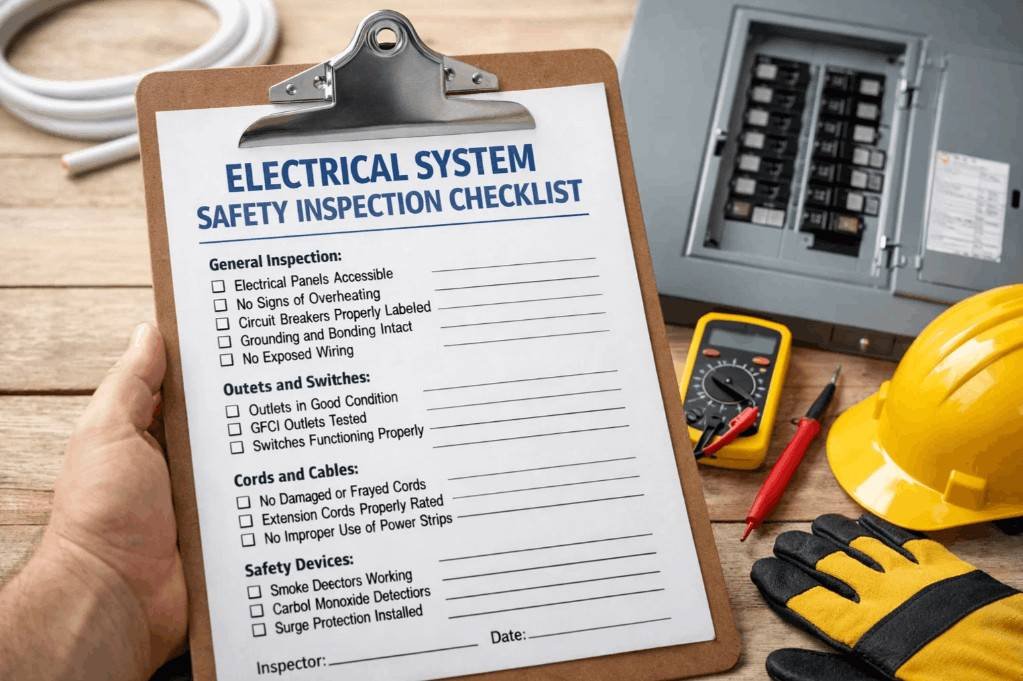
This circuit breakers safety checklist walks you through every breaker in your electrical panel. It takes 20 minutes. It costs nothing. It identifies the breakers that are failing, overloaded, or obsolete — the breakers that are supposed to protect your wiring from overheating and your house from fire. A breaker that fails to trip during an overload is a fire waiting for the wrong combination of load and time. The checklist finds the breakers that are likely to fail before they fail. The checklist is the prevention. The fire is the consequence of not checking.
Circuit breakers are the last line of defense between a wiring fault and a fire. They are simple electromechanical devices. They wear out. They corrode. They trip hundreds of times over decades and eventually trip at the wrong current — too low, causing nuisance trips, or too high, failing to protect the wiring. A breaker that is hot, buzzing, tripping repeatedly, or labeled with an obsolete brand name is a breaker that needs attention. The attention is either replacement of the breaker — $150 to $300 — or replacement of the entire panel — $1,500 to $3,500. The attention costs money. The inattention costs more. Here is what to check.
Check Every Breaker in the Panel
Touch each breaker. Place the back of your finger gently against each breaker in the panel. A breaker that is warm to the touch, warmer than the surrounding breakers, has a loose internal connection or a loose connection to the bus bar. The heat is generated by electrical resistance at the loose connection. The heat degrades the connection further. The feedback loop ends with a melted breaker or a damaged bus bar. Turn off the circuit controlled by that breaker. Call an electrician. The breaker must be replaced. If the bus bar is damaged, the entire panel may need replacement. The warm breaker is the first warning. The melted bus bar is the last warning. The fire is the consequence of ignoring both.
Listen at the panel. A faint 60-hertz hum is normal, the sound of alternating current flowing through the bus bars. A buzzing, crackling, or sizzling sound is not normal. Buzzing indicates a loose connection vibrating at the line frequency. Crackling or sizzling indicates arcing, electricity jumping across a gap inside the breaker or at the bus bar connection. Arcing inside a panel is a fire in progress. Turn off the main breaker if you can do so safely. Call an electrician immediately. Do not open the panel cover. The arcing fault may be directly behind the cover. The electrician has insulated tools and arc-flash protective equipment. The homeowner does not.
Smell the panel. A burning plastic or fishy odor coming from the electrical panel is the smell of overheating electrical components. The plastic housing of the breakers and the insulation on the wiring release a distinctive acrid odor when they overheat. The smell may come and go, present when a particular circuit is under heavy load, absent when the load is removed. The intermittent smell is not less urgent. It confirms that the overheating is load-dependent. The loose connection generates heat only when current flows. The smell is the evidence that the connection is loose. Call an electrician. The smell is the warning. The fire does not have a smell until it has already started.
The U.S. Consumer Product Safety Commission (CPSC) has investigated breaker failure rates in certain older panel brands, notably Federal Pacific Electric (FPE) Stab-Lok and Zinsco panels. Breakers in these panels have been found to fail to trip under overload conditions at significantly higher rates than modern breakers. A panel with these brands should be replaced regardless of the condition of individual breakers. The systemic failure rate makes individual breaker replacement a gamble. The panel is the problem. The breakers are the symptom.
Check the Panel as a Whole
These eight checks assess the overall condition of the electrical panel — the enclosure, the bus bar, the breakers as a system — rather than individual breakers. Several indicate emergencies requiring immediate action.
| Check | What to Look For | Action If Found |
| Panel manufacturer | Label says FPE Stab-Lok, Zinsco, Sylvania | Replace entire panel ($1,500–$3,500) |
| Panel age | More than 25 years old; breakers are obsolete | Professional inspection; likely replacement |
| Rust or corrosion inside panel | Rust on panel box, breakers, or bus bar | Electrician must assess; moisture source must be found |
| Panel is hot to the touch | Cover is warmer than room temperature | Emergency, turn off main; call electrician |
| Buzzing, crackling, or sizzling | Sound from inside the panel | Emergency, turn off main; call electrician |
| Scorch marks or burning smell | Visible discoloration or odor | Emergency, turn off main; call electrician |
| Panel is full, no empty slots | All breaker positions occupied | Subpanel ($800–$2,000) or panel upgrade |
| Double-tapped breakers | Two wires connected to one breaker terminal | Electrician must add breaker or correct wiring |
Diagnosing Breakers That Trip Frequently
A breaker that trips occasionally under heavy load is doing its job. The circuit is overloaded. The breaker is protecting the wiring from overheating. The solution is to redistribute the load, move one appliance to a different circuit. The breaker does not need to be replaced. The circuit needs fewer appliances on it.
A breaker that trips repeatedly under light load is failing. The breaker is tripping at a current lower than its rating. The internal mechanism has worn out from age, corrosion, or repeated tripping. Replace the breaker. The replacement costs $150 to $300. The failing breaker is a nuisance. The failing breaker is also a warning, if the mechanism that causes it to trip early is worn, the mechanism that causes it to trip at the right current may also be compromised. The breaker is not protecting the wiring reliably. Replace it.
A breaker that trips instantly when reset, the handle moves to ON and immediately snaps back, indicates a short circuit. The hot wire is touching the neutral wire or a ground wire somewhere in the circuit. This is not a breaker problem. This is a wiring problem. The breaker is doing its job. Do not keep resetting it. Each reset sends a surge of current through the short, generating heat at the fault location. Call an electrician. The short must be located and repaired before the breaker will hold. The electrician costs $200 to $800. The short is a fire hazard. The electrician is the solution.
A breaker that is hot is an emergency. Turn off the circuit. Call an electrician. The hot breaker has a loose connection to the bus bar. The loose connection generates heat. The heat degrades the bus bar. A degraded bus bar cannot make a reliable connection with a new breaker. The panel may need replacement. The $200 breaker replacement is the best-case scenario. The $3,000 panel replacement is the scenario the hot breaker is pointing toward. The longer the hot breaker stays in service, the more likely the bus bar is damaged. The hot breaker is not waiting. Neither should you.
Check the Panel Labeling
Every breaker should be labeled. The label tells you which circuit each breaker controls, “kitchen outlets,” “master bedroom,” “furnace.” A panel with unlabeled breakers is a panel where no one knows which breaker controls which circuit. In an emergency, the unlabeled panel costs time. The time is spent flipping breakers randomly while water pours from a burst pipe or smoke fills a room. Label the breakers. The labeling takes 30 minutes with two people, one at the panel, one walking through the house with a lamp or a radio, shouting when the power goes off. The label is the map of the electrical system. The map is essential in an emergency. The emergency does not schedule itself. The labeling must be done before the emergency. Do it now.
Frequently Asked Questions
How often should circuit breakers be inspected?
Perform this visual and tactile checklist annually. Have a professional electrician inspect the panel and test the breakers with a load tester every 5 to 10 years. A panel older than 25 years should be professionally inspected every 3 to 5 years. Breakers in panels of unsafe brands, FPE, Zinsco, should be considered unreliable and the panel should be replaced.
How do I know if a circuit breaker is bad?
A breaker is bad if it trips repeatedly under light load, feels hot to the touch, emits a burning smell, makes a buzzing or crackling sound, or will not reset, the handle moves to ON but the circuit remains dead. An electrician can confirm with a load tester. A breaker that trips below 80% of its rated current has failed.
Can I replace a circuit breaker myself?
A homeowner can replace a standard breaker by turning off the main breaker, removing the panel cover, unscrewing the wire, snapping out the old breaker, snapping in the new one, reconnecting the wire, and replacing the cover. The main breaker does not de-energize the service entrance cables, they remain live. If you are not confident, hire an electrician. The $150 labor charge is insurance against a shock or a loose connection.
How much does it cost to replace a circuit breaker?
Replacing a standard circuit breaker costs $150 to $300 installed. An AFCI or GFCI breaker costs $250 to $500. A panel replacement costs $1,500 to $3,500. The breaker itself costs $5 to $15 for a standard breaker, $40 to $80 for an AFCI or GFCI.
What is a double-tapped breaker and why is it dangerous?
A double-tapped breaker has two wires connected to a single terminal designed for one wire. The second wire may not be securely fastened. The loose connection generates heat. The heat can damage the breaker and the wire. An electrician must correct the double-tap by adding a breaker, installing a tandem breaker, or pigtailing the wires to a single conductor. The correction costs $150 to $300.
Should I upgrade my electrical panel or just replace the breakers?
Replace individual breakers if the panel is a safe brand, less than 25 years old, and the bus bar is undamaged. Replace the entire panel if it is an FPE, Zinsco, or Sylvania brand; if the bus bar is damaged by a hot breaker; if the panel is full and you need more circuits than tandem breakers can provide; or if you are upgrading from 100 amps to 200 amps for additional capacity. The electrician can assess the panel and recommend replacement or repair.
The Breakers That Protect Your House
Touch every breaker. Listen at the panel. Smell the panel. Read the manufacturer label. Check for rust. Identify double-tapped breakers. Label every breaker. The checklist takes 20 minutes. The checklist costs nothing. The checklist identifies the breakers that are failing, the hot one, the buzzing one, the one that trips repeatedly, and the panels that are unsafe, the FPE, the Zinsco, the rusted one, the one that is 30 years old.
Each finding has a fix. The hot breaker costs $200 to replace. The failing breaker costs the same. The unsafe panel costs $1,500 to $3,500 to replace. The fire that any one of these findings can cause costs the house. The checklist is the bridge between the finding and the fix. Cross the bridge. Fix what it finds. The breakers are the last line of defense. The checklist confirms they are still defending. The defense costs nothing to verify. The failure of the defense costs everything. Ever stood in front of your electrical panel, about to reset a breaker that tripped for the third time this week, and paused — hand hovering over the handle — because something about the frequency of the tripping felt wrong? That pause was your intuition recognizing a pattern. The breaker had tripped twice before. The first time was the microwave and the toaster. The second time was just the microwave. The third time was nothing — the breaker tripped with nothing plugged in. The breaker was failing. Your hand knew before your brain did. The pause was the checklist working from memory. The breaker was replaced the next day. The fire did not happen. The pause saved the house. The checklist formalizes the pause. The checklist ensures the pause happens before the fire, not during it.