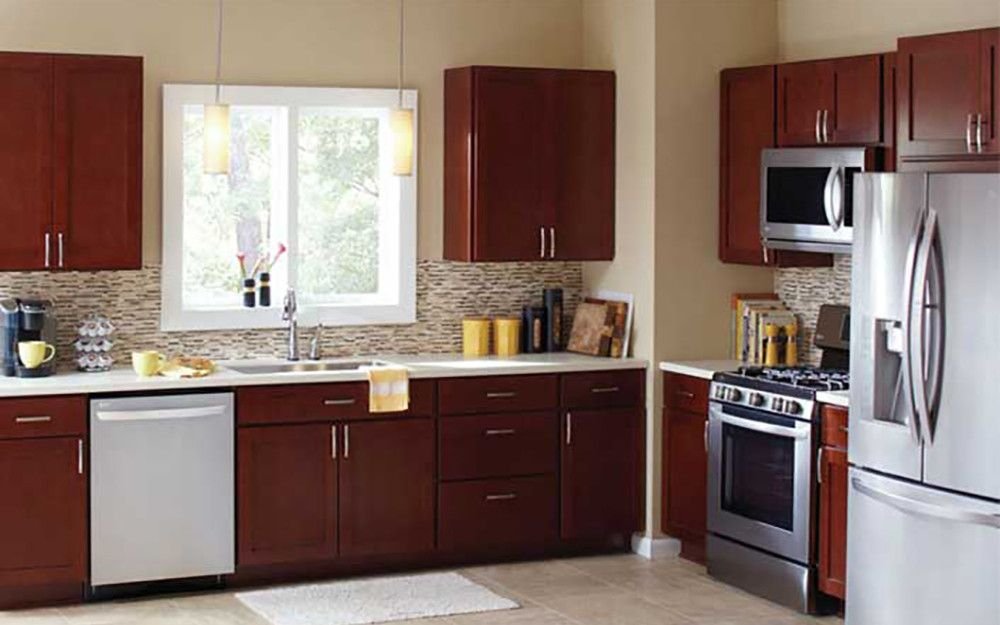
This guide covers budget-friendly kitchen cabinets options — from painting to RTA. The most budget-friendly kitchen cabinet option is ready-to-assemble cabinets — RTA — which cost $100 to $300 per linear foot and ship flat-packed to your door for assembly and installation. RTA cabinets are the same material as stock cabinets — particleboard boxes with melamine interiors — but the labor of assembly is shifted from the factory to the homeowner. The shifted labor is the savings. The savings are 30% to 50% compared to pre-assembled stock cabinets. A kitchen that requires 25 linear feet of cabinets costs $2,500 to $7,500 in RTA versus $5,000 to $12,000 in pre-assembled stock. The RTA cabinets arrive in boxes. The boxes contain the panels, the hardware, the drawer slides, and the instructions. The assembly is repetitive. The assembly is within the reach of anyone who can use a screwdriver and follow pictorial instructions. The assembly takes 30 to 60 minutes per cabinet — one long weekend for a full kitchen. The weekend of assembly saves $2,500 to $5,000. The weekend is the savings. The savings are the budget. Here are the budget-friendly cabinet options, ordered from lowest cost to highest.
Budget Cabinet Options, Cost Comparison
| Option | Cost Per Linear Foot | 25 Linear Feet Total | Labor Required |
| Paint existing cabinets (DIY) | $5 – $10 (materials only) | $125 – $250 | High, 40 to 80 hours |
| Reface existing cabinets (professional) | $100 – $200 | $2,500 – $5,000 | None, professional installation |
| Ready-to-assemble (RTA) cabinets | $100 – $300 | $2,500 – $7,500 | Moderate, assembly required |
| Stock cabinets (big-box store) | $200 – $500 | $5,000 – $12,500 | None, pre-assembled |
| Semi-custom cabinets (entry-level) | $300 – $600 | $7,500 – $15,000 | None, pre-assembled |
Option 1: Paint Your Existing Cabinets, $125 to $250
Painting existing cabinets is the lowest-cost cabinet upgrade. The cabinets are the same cabinets that were there before. The paint is the only thing that changes. The paint changes everything. The paint costs $125 to $250 for primer, paint, brushes, rollers, sandpaper, and masking materials. The labor is the homeowner’s time, 40 to 80 hours over two to three weekends. The labor is removing the doors and hardware, cleaning and degreasing every surface, sanding to scuff the finish, priming, painting two coats with light sanding between each, and reinstalling the hardware and the doors. The labor is substantial. The result is a kitchen that looks updated for the cost of paint and weekends. The painted cabinets will not look like factory-finished cabinets. They will look like cabinets that were painted by a homeowner who cared enough to spend three weekends doing it. The paint is the budget. The weekends are the currency. The currency is time. The time is free if you have it. The time is expensive if you do not. The paint is the cheapest cabinet option. The paint is also the most labor-intensive. The paint is the best option for the homeowner with more time than money.
The National Association of Home Builders (NAHB) identifies kitchen updates as one of the highest-return cosmetic home improvements. Painting existing cabinets is specifically noted as a cost-effective alternative to replacement. Painted cabinets in a modern color, white, off-white, light gray, navy, or deep green, update the kitchen for a fraction of the cost of new cabinets. The painted cabinets signal to buyers that the kitchen was maintained and updated with intention. The intention is the value. The paint is the cost. The paint is the lowest-cost option. The paint delivers the highest percentage return.
Option 2: Ready-to-Assemble Cabinets, $2,500 to $7,500
Ready-to-assemble cabinets are the best value for a full cabinet replacement on a budget. The cabinets are manufactured in the same factories as stock cabinets, using the same materials and the same hardware. The difference is that the cabinets are not assembled at the factory, they are flat-packed in boxes, shipped to the homeowner, and assembled on site. The assembly is the homeowner’s work. The savings are the factory labor. The trade-off is the weekend of assembly.
RTA cabinets are available in the same styles as stock cabinets, shaker doors, flat-panel doors, raised-panel doors, and in the same materials, particleboard boxes with melamine interiors, some with plywood box options for a premium. The hardware, drawer slides, hinges, shelf pins, is included. The cabinets are assembled with a screwdriver or a drill with a clutch set to low torque, overtightening the cam-lock fasteners can strip the particleboard. The assembly requires a flat, clean work surface, the garage floor or a folding table, and patience. The instructions are pictorial. The instructions require no reading. The cabinets are assembled in order: base cabinets first, wall cabinets second, trim and filler panels last. The assembly is repetitive. The repetition becomes efficient. The first cabinet takes an hour. The tenth cabinet takes 20 minutes. The learning curve is steep and fast. The learning curve is the efficiency. The efficiency is the speed. The speed is the weekend.
Option 3: Stock Cabinets from Big-Box Stores, $5,000 to $12,500
Stock cabinets are pre-assembled cabinets available in fixed widths, 3-inch increments from 9 to 48 inches, from home improvement stores and cabinet wholesalers. They are in stock or available for delivery within one to four weeks. They are the fastest path to new cabinets. The cabinets come assembled. The installation is the only labor, mounting the cabinets to the wall, leveling them, and connecting them together. The stock cabinets cost $200 to $500 per linear foot, $5,000 to $12,500 for 25 linear feet. The cost includes the cabinets only. Installation adds $150 to $300 per linear foot or $3,750 to $7,500 for a 25-linear-foot kitchen. The total installed cost is $8,750 to $20,000.
The limitation of stock cabinets is the fixed widths. The space between the last cabinet and the wall is filled with a filler strip, a piece of trim that bridges the gap. The filler strip is visible. The filler strip is the evidence that the cabinets were not made to fit the kitchen. The filler strip is not a flaw. The filler strip is the compromise. The compromise is the budget. The budget is the stock cabinet. The stock cabinet is the compromise. The compromise is acceptable for a kitchen where the budget is fixed and the aesthetic expectation is good-enough. The good-enough kitchen has stock cabinets. The good-enough kitchen has been upgraded from the old kitchen. The upgrade is the goal. The stock cabinets achieve the goal. The filler strip is the detail. The detail is the evidence of the budget. The budget is visible in the filler strip. The filler strip is not visible to anyone who is not looking for it. Most people are not looking for it.
Option 4: Professional Cabinet Refacing, $2,500 to $5,000
Cabinet refacing replaces the doors, drawer fronts, and hardware on the existing cabinet boxes. The boxes remain in place. The doors are replaced with new doors in the style and finish of the homeowner’s choice. The cabinet face frames and the exposed sides are covered with a matching wood veneer or a rigid thermofoil. The result is cabinets that look new, the doors and drawer fronts are new, the finish is uniform, and the hardware is new. The boxes are the same boxes that were there before. The refacing costs $100 to $200 per linear foot, $2,500 to $5,000 for 25 linear feet. The refacing is the middle ground between painting and replacing. The refacing costs more than painting and less than new cabinets. The refacing looks newer than painting and less new than replacement. The refacing is the option for cabinets that are structurally sound, plywood boxes in good condition, but aesthetically dated. The cabinet boxes that are particleboard and water-damaged cannot be refaced. The boxes must be replaced. The refacing is only possible when the boxes are worth saving. The boxes are the foundation. The foundation must be solid. The doors are the surface. The surface is replaced. The foundation remains.
Frequently Asked Questions
What is the cheapest way to get new kitchen cabinets?
Painting existing cabinets is the cheapest option at $125 to $250 in materials plus 40 to 80 hours of labor. Ready-to-assemble cabinets are the cheapest way to get entirely new cabinets at $2,500 to $7,500 for 25 linear feet, 30% to 50% less than pre-assembled stock cabinets. Stock cabinets from a big-box store are the fastest new-cabinet option at $5,000 to $12,500.
Are ready-to-assemble cabinets good quality compared to stock cabinets?
RTA cabinets are the same materials, particleboard boxes with melamine interiors, and the same hardware, drawer slides, hinges, as stock cabinets. The quality is equivalent. The assembly quality depends on the assembler. A carefully assembled RTA cabinet is identical to a factory-assembled stock cabinet. A rushed assembly with overtightened cam-locks can strip the particleboard and weaken the cabinet. The assembler is the variable. The variable is patience. The patience is the quality.
Can I install kitchen cabinets myself to save money?
Yes, cabinet installation is a moderately DIY-friendly project. The cabinets must be mounted to the wall studs, leveled in all three dimensions, and connected together with screws through the face frames or the side panels. The installation requires a level, a drill, shims, and patience. The installation is not complicated. The installation is physically demanding, upper cabinets are heavy and must be held in place while being screwed to the wall. A second person is strongly recommended. The DIY installation saves $150 to $300 per linear foot, $3,750 to $7,500 for a 25-linear-foot kitchen.
How much does cabinet refacing cost compared to full replacement?
Cabinet refacing costs $100 to $200 per linear foot, $2,500 to $5,000 for 25 linear feet. Full replacement with stock cabinets costs $200 to $500 per linear foot for the cabinets plus $150 to $300 for installation, $8,750 to $20,000 total. Refacing is roughly one-third to one-half the cost of replacement. Refacing requires structurally sound cabinet boxes. Damaged boxes must be replaced.
What cabinet material is best on a budget?
Particleboard boxes with melamine interiors are the standard for budget cabinets, RTA and stock. The particleboard is heavy, dimensionally stable, and adequate for a kitchen that will not experience major water events. Plywood boxes are the premium upgrade, $50 to $150 per cabinet more, and are worth the cost for the sink base cabinet, which is the cabinet most likely to get wet. A single plywood sink base cabinet surrounded by particleboard cabinets is a strategic upgrade. The strategic upgrade costs $100 and protects against the most common kitchen leak. The water from the sink supply line drips into a particleboard box and destroys it. The water drips into a plywood box and is wiped up. The plywood sink base is the $100 insurance policy.
How long do budget kitchen cabinets last?
Budget cabinets, particleboard boxes with thermofoil or painted MDF doors, last 15 to 25 years with normal use. The doors and drawer fronts will show wear along the edges within 10 to 15 years. The boxes will last the full life of the cabinets unless they get wet. The finish on the doors determines the aesthetic lifespan. The boxes determine the structural lifespan. The boxes that stay dry last 25 years. The boxes that get wet last until the first major leak. The dry boxes are the survivors. The wet boxes are the victims. The survival is the maintenance. The maintenance is the protection from water. The protection is the vigilance. The vigilance is the leak that is noticed and fixed. The leak that is noticed and fixed spares the cabinet. The leak that is ignored destroys it.
The Cabinets That Fit the Budget
Paint the existing cabinets if the boxes are sound and the budget is under $500, the paint costs $125 to $250 and the labor is your weekends. Refacing the existing cabinets if the boxes are sound and the budget is $2,500 to $5,000, the doors and hardware are new, the boxes remain. Install RTA cabinets if the boxes are not sound and the budget is $2,500 to $7,500, the cabinets are new, the assembly is yours, the savings are 30% to 50%. Install stock cabinets if the budget is $5,000 to $12,500 and you want someone else to do the assembly, the cabinets are pre-assembled, the filler strips are the compromise.
The budget determines the option. The option determines the labor. The labor is either yours or the factory’s. The factory’s labor costs money. Your labor costs time. The time is the currency of the budget kitchen. The time is weekends of painting, weekends of assembling RTA cabinets, or weekends of installing stock cabinets. The time trades for money. The money saved is the budget. The budget is the constraint. The constraint is the kitchen. The kitchen is the room where the day starts. The cabinets are the storage in the room. The storage holds the plates and the pots and the glasses. The storage is functional. The appearance of the storage is the aesthetic. The budget determines the aesthetic. The aesthetic is the paint, the new doors, or the new cabinets. The budget chooses the option. The option delivers the kitchen. The kitchen is the result. The result is the room where the day starts. The day starts better in a kitchen where the cabinets were upgraded. The upgrade is the paint, the refacing, or the new cabinets. The upgrade is the budget. The budget is the decision. The decision is the option. The option is the cabinets. The cabinets are the kitchen. The kitchen is the start of the day. Ever stood in your kitchen on a Saturday morning, coffee in hand, staring at the cabinet doors that you have been meaning to replace for three years, and thought “this is the weekend I finally do something about them”? The thought was the start. The paint was the budget. The weekends were the currency. The cabinets were the same cabinets that had been there since the house was built. The paint transformed them. The white paint cost $60. The gray paint cost $60. The hardware cost $120. The transformation cost $240 and three weekends. The transformation looked like a $10,000 cabinet replacement. The $10,000 was still in the bank. The cabinets were new. The new cabinets were the same cabinets. The same cabinets were transformed. The transformation was the paint. The paint was the budget. The budget was $240. The weekends were the labor. The labor was free. The free labor was the key. The key was the willingness to spend three weekends painting cabinets. The willingness is the budget. The budget is the willingness. The willingness is the difference between the kitchen that was and the kitchen that is.