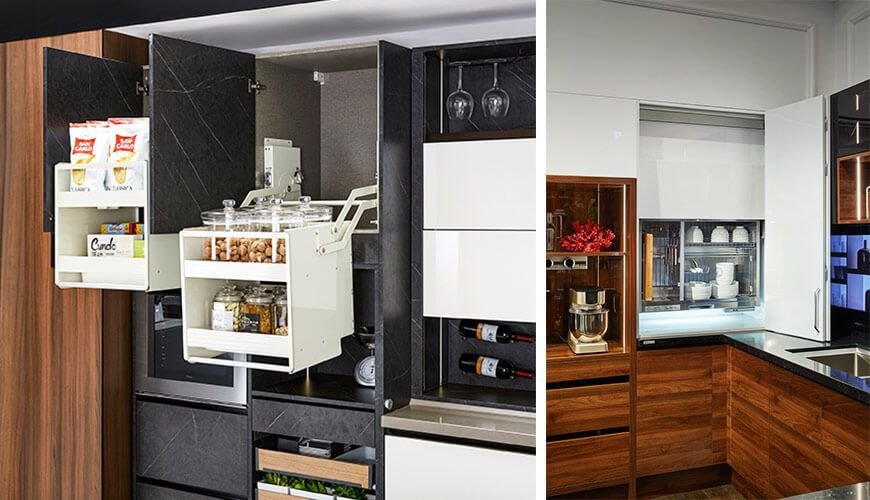
The best kitchen storage ideas for modern homes maximize every cubic inch of space without making the kitchen feel cluttered or overbuilt, notes TPG Management team. The modern kitchen is defined by clean lines, uncluttered countertops, and the sense that everything has a place — and the place is hidden from view until needed. Achieving that aesthetic requires storage solutions that work behind closed doors: pull-out shelves that bring the contents of deep cabinets to the front, toe-kick drawers that use the empty space under the base cabinets, and appliance garages that hide the toaster and the coffee maker when they are not in use.
The difference between a kitchen that looks modern and a kitchen that functions modern is the storage. The countertops are clear because everything has a designated, accessible home inside a cabinet or a drawer. The kitchen is not empty. It is organized. The organization is the design. Here are the storage ideas that make a modern kitchen work.
Idea 1: Pull-Out Shelves in Every Base Cabinet
Pull-out shelves are the single most impactful storage upgrade in any kitchen, modern or otherwise. A fixed shelf in a base cabinet stores items in two dimensions — front to back, left to right. The items at the back are accessible only by kneeling on the floor and reaching into the dark. A pull-out shelf adds the third dimension — the shelf comes to you. Full-extension ball-bearing slides bring the entire shelf out of the cabinet. Nothing is lost at the back. The cabinet that used to hold four pots now holds eight because the entire depth is usable.
In a modern kitchen, pull-out shelves eliminate the visual clutter of items stacked on open shelves or piled in cabinets with the doors left ajar because closing the door requires shoving everything back into place. The pull-out shelf extends. The item is retrieved. The shelf retracts. The door closes. The kitchen looks empty. The storage is full. The contradiction is the defining characteristic of a well-designed modern kitchen.
Idea 2: Toe-Kick Drawers — the Space Under Your Feet
The toe kick — the recessed space at the bottom of base cabinets where your feet go when you stand at the counter, is typically a void covered by a decorative panel. A toe-kick drawer reclaims that space as a shallow drawer that slides out from the base of the cabinet. It is accessed by pressing the panel with a toe, a touch-latch mechanism releases the drawer, and it stores flat items: baking sheets, cutting boards, serving platters, table linens, and pet food bowls. The drawer is invisible when closed. The toe kick looks like a toe kick. The storage is a secret.
Toe-kick drawers cost $200 to $500 per drawer installed. They are a custom cabinet feature, stock cabinet lines do not offer them. The cost is in the cabinetry, not the hardware. The drawer is a box on slides with a touch-latch mechanism. The value is the storage space that did not previously exist. A 24-inch toe-kick drawer adds 1.5 to 2 square feet of storage, roughly the same as a small upper cabinet, in a location that would otherwise be empty. In a small kitchen, toe-kick drawers are the storage equivalent of finding money in a coat pocket you have not worn in a year. The space was always there. The drawer just makes it accessible.
The National Association of Home Builders (NAHB) identifies kitchen storage and organization as a top buyer priority in new home construction. Features like pull-out shelves and hidden storage, including toe-kick drawers, are consistently ranked among the most desirable kitchen features by home buyers. The storage is functional. The design is modern. The two are the same thing.
Idea 3: Appliance Garages That Disappear When Closed
An appliance garage is a cabinet or a covered section of countertop that houses small appliances, toaster, coffee maker, blender, stand mixer, behind doors that close flush with the countertop or the upper cabinets. The appliances are plugged in, ready to use, and invisible when the doors are closed. The modern kitchen aesthetic demands clear countertops. The modern kitchen reality requires a coffee maker within arm’s reach of the sink. An appliance garage reconciles the aesthetic with the reality.
An appliance garage costs $500 to $2,000 depending on the size, the door mechanism, tambour doors that roll up like a roll-top desk, bi-fold doors that fold flat, or pocket doors that slide into the cabinet, and whether it is a custom-built cabinet or a retrofit kit. A tambour door garage is the most space-efficient because the door does not swing out into the room. A pocket door garage is the most modern-looking because the door disappears completely into the cabinet when open. The mechanism determines the cost. The function is the same regardless: small appliances, accessible and hidden.
Idea 4: Vertical Dividers for Baking Sheets, Cutting Boards, and Trays
A vertical divider in a base cabinet or a tall pantry cabinet stores baking sheets, cutting boards, cooling racks, and serving trays on edge, like books on a shelf, instead of stacked on top of each other. The stacked method requires removing every tray above the one you need and restacking them when you are done. The vertical method requires pulling out the tray you need. The rest stay in place. The divider costs $100 to $250 installed and transforms a cabinet that was previously a chaotic pile of metal sheets into an organized, accessible storage zone.
In a modern kitchen, vertical dividers are typically installed in a cabinet next to the oven or the cooktop, the cooking zone, where baking sheets and cutting boards are used. The divider is made of plywood or metal rods spaced 3 to 4 inches apart, mounted to the cabinet floor and the underside of the cabinet opening. The installation is simple. The organization is transformative. The cabinet that used to hold a jumbled stack of baking sheets now holds six sheets, three cutting boards, and two cooling racks, each in its own slot, each accessible without moving any of the others.
Idea 5: Custom-Fit Drawer Organizers for Every Drawer
The utensil drawer in a modern kitchen is not a single container where everything migrates toward the front. It is a grid of custom-fit compartments, each sized for a specific category of utensil. Spatulas in one compartment. Tongs in another. Whisks in a third. The drawer opens. The utensil is where it was the last time the drawer closed. Nothing has moved. The compartments hold everything in place.
Custom-fit drawer organizers cost $50 to $150 per drawer and are worth the investment for any drawer that is opened more than once a day. The utensil drawer. The knife drawer. The spice drawer. The junk drawer, which, in a modern kitchen, is not a junk drawer. It is a utility drawer with compartments for batteries, twist ties, rubber bands, and the small items that every kitchen needs and no kitchen wants to display. The drawer organizer does not just organize the contents. It limits them to what fits in the compartments. The junk drawer becomes a utility drawer because the compartments will not accommodate junk.
Idea 6: Under-Cabinet Storage That Uses the Empty Space
The space between the upper cabinets and the countertop is prime real estate in a small kitchen. Under-cabinet storage, a pull-down spice rack, a stemware rack, a knife strip, a paper towel holder, mounts to the underside of the upper cabinets and uses the vertical space that would otherwise be empty. A pull-down spice rack costs $100 to $400 and stores 20 to 30 spice jars in two tiers that pull down to countertop height. The spices are accessible. The countertop is clear. The rack retracts flush with the cabinet when not in use.
A magnetic knife strip mounted under the upper cabinets costs $20 to $60 and keeps knives visible, accessible, and off the countertop. A paper towel holder mounted under the cabinet costs $15 to $40 and frees up the countertop space that a standing paper towel holder occupies. These are $50 upgrades that make a $50,000 kitchen feel more functional. The storage is overhead, out of the way, and exactly where you need it when you are working at the counter below.
Frequently Asked Questions
What is the single best kitchen storage upgrade?
Pull-out shelves in every base cabinet are the single most impactful storage upgrade. They cost $100 to $300 per shelf installed, $1,500 to $4,000 for a typical kitchen, and make the entire depth of every base cabinet accessible. Nothing is lost at the back. The storage space that already exists becomes usable. No other upgrade adds as much functional storage for the cost.
How can I maximize storage in a small modern kitchen?
Use pull-out shelves in every base cabinet, install toe-kick drawers if the cabinets are custom, add an appliance garage to hide small appliances, use vertical dividers for baking sheets and trays, and mount under-cabinet storage for spices, knives, and paper towels. The combination costs $3,000 to $8,000 and makes a small kitchen function like a larger one by using space that was previously empty, the backs of cabinets, the toe kicks, the area under the upper cabinets.
Are toe-kick drawers worth the cost?
They are worth it in a small kitchen where every square inch of storage is valuable. They cost $200 to $500 per drawer and add storage in a space that would otherwise be empty. In a large kitchen with ample cabinet storage, the cost may not justify the added storage. In a small kitchen, toe-kick drawers are one of the few ways to add storage without adding cabinets.
What is an appliance garage and how much does it cost?
An appliance garage is a cabinet or covered countertop section that houses small appliances behind doors that close flush. It costs $500 to $2,000 depending on the size and the door mechanism. Tambour doors, rolling up like a desk, are the most space-efficient. Pocket doors that slide into the cabinet are the most modern-looking. The garage hides the toaster and the coffee maker while keeping them plugged in and ready to use.
How do I keep countertops clear in a modern kitchen?
Give everything a designated, accessible home inside a cabinet or a drawer. An appliance garage for the coffee maker and toaster. A pull-out shelf for the stand mixer. A vertical divider for cutting boards. A drawer organizer for utensils. The countertop is clear because everything has somewhere else to be. The storage is the design. The clear countertop is the result.
Do kitchen storage upgrades increase home value?
Storage upgrades improve buyer perception more than appraised value. A kitchen with pull-out shelves, drawer organizers, and hidden storage feels larger, more functional, and more modern than a kitchen with standard fixed shelves and cluttered countertops. The buyer notices the storage. The buyer does not calculate the cost of the pull-out shelves. The buyer calculates how the kitchen would feel to cook in every day. The storage makes it feel organized. The organization sells the kitchen.
The Kitchen That Stores Everything
A modern kitchen with pull-out shelves in every base cabinet, toe-kick drawers for flat items, an appliance garage for the coffee maker and toaster, vertical dividers for baking sheets, custom drawer organizers, and under-cabinet storage for spices and knives costs $5,000 to $12,000 in storage upgrades. The countertops are clear. The cabinets are full but accessible. The kitchen looks empty because everything has a designated, hidden home.
The modern kitchen aesthetic is defined by what is not visible. The storage is what makes the invisibility possible. The pull-out shelf hides the pots. The appliance garage hides the toaster. The toe-kick drawer hides the baking sheets. The drawer organizer hides the clutter. The kitchen looks like a minimalist design statement. It functions like a working kitchen. The contradiction is intentional. The storage is the design. Ever walked into a model kitchen and wondered why it felt so calm — no appliances on the counter, no clutter around the sink, nothing out of place? The kitchen was staged. But it was staged using the storage that should have been built into it from the beginning. The coffee maker was in an appliance garage. The baking sheets were in a vertical divider. The spices were under the cabinet. The kitchen was not staged. It was designed. The design hid the clutter. The storage made the design possible. The same storage can make your kitchen feel like the model home. The difference is not the countertops. It is what is behind the cabinet doors.