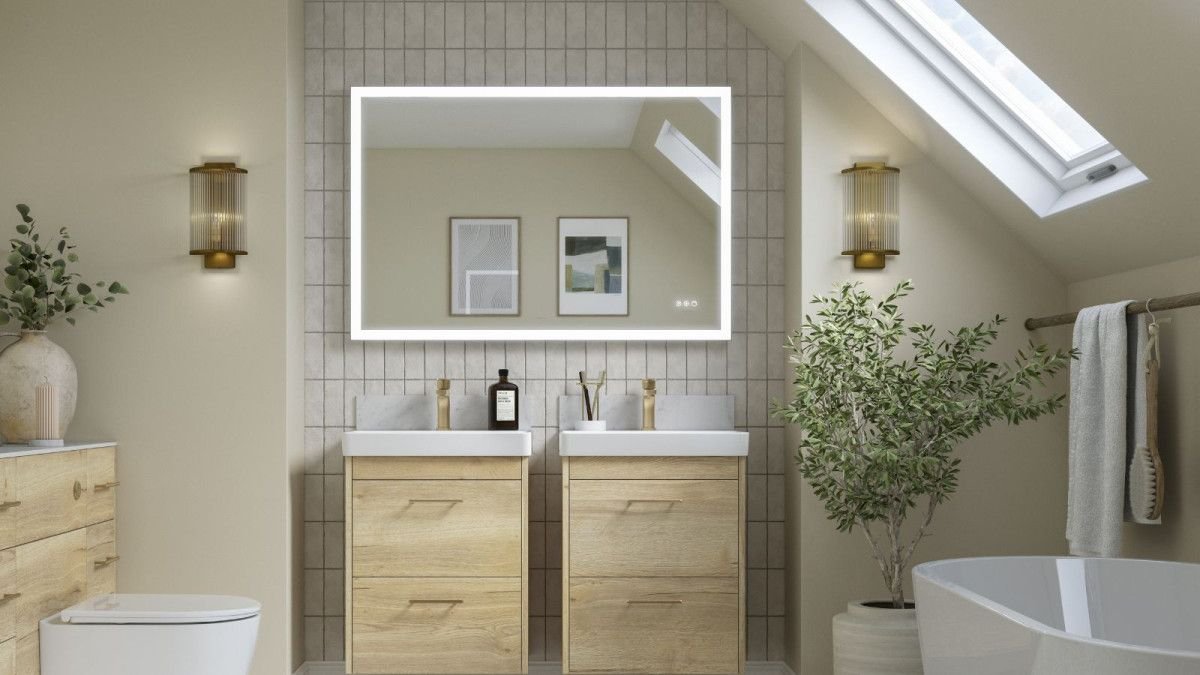
This guide covers the bathroom lighting mistakes to avoid — from single overhead fixtures to the wrong color temperature. The most common bathroom lighting mistake is installing a single ceiling fixture in the center of the room and calling it done. The single ceiling fixture casts shadows directly down onto the face of anyone standing at the mirror. The forehead is illuminated. The eyes are in shadow. The chin is in shadow. The face that looks back from the mirror is the face of someone standing under an interrogation lamp. The bathroom is the one room in the house where you need to see your face clearly — to shave, to apply makeup, to inspect your skin. The single ceiling fixture makes that impossible. The fix is layered lighting: wall sconces at face height on either side of the mirror, a separate overhead light for general illumination, and a dimmer on every circuit. The layered lighting costs $500 to $1,500. The single ceiling fixture was free — it came with the house. The layered lighting is the upgrade that makes the bathroom functional. The single fixture makes the bathroom adequate for finding the toilet. The layered lighting makes the bathroom adequate for everything else.
Bathroom lighting mistakes are visible every morning. The lighting is the first thing you turn on when you enter the bathroom. The lighting determines whether you see yourself clearly or whether you are guessing at the razor line, the foundation blend, or the eyebrow shape. The mistakes are visible in the mirror. The mirror does not lie. The mirror reflects the lighting, not your face. Bad lighting makes a good face look bad. Good lighting makes every face look like itself. Here are the mistakes to avoid.
Mistake 1: A Single Overhead Fixture with No Task Lighting
Overhead light alone is the enemy of good bathroom lighting. Light from directly above creates shadows under the eyes, the nose, and the chin. The face in the mirror looks gaunt, tired, and shadowed. The lighting is accurate. The face looks the way it looks under a single overhead light. The lighting is the problem. The face is not. The face looks different under proper lighting. The proper lighting comes from the sides, not from above.
The solution is vertical task lighting on either side of the mirror. Wall sconces mounted 60 to 70 inches from the floor — roughly eye level for the average adult — one on each side of the mirror, 36 to 40 inches apart. The light from the sides washes across the face evenly. No shadows under the eyes. No shadows under the chin. The face in the mirror looks the way it looks in daylight. The sconces cost $50 to $300 each plus $150 to $300 per sconce for the electrical rough-in. The total cost for two sconces is $400 to $1,200. The return is a face in the mirror that looks like you. The single overhead light gave you a face that looked like a suspect. The sconces give you a face that looks like you. The return is worth the cost.
If side sconces are not possible — a narrow mirror, a small wall, a single horizontal fixture mounted above the mirror at 75 to 80 inches from the floor and extending 24 to 30 inches wide is the second-best option. The light bar above the mirror is better than a ceiling light alone and worse than side sconces. The light still comes from above, creating some shadow. The wide light bar reduces the shadow. The side sconces eliminate it. The side sconces are the best option. The light bar is the acceptable alternative. The ceiling light alone is the mistake.
The National Association of Home Builders (NAHB) identifies bathroom lighting as a key satisfaction factor for homeowners. The bathroom is the room where people spend the most time looking at themselves. The lighting determines the quality of the view. Good lighting makes the mirror a friend. Bad lighting makes the mirror an adversary. The mirror is the same. The lighting is the difference.
Mistake 2: Choosing the Wrong Color Temperature
The color temperature of bathroom lighting should be 3000K to 3500K, warm white to neutral white. Light at 2700K, the color of an incandescent bulb, is too warm. It makes skin look yellow. It hides redness but also hides detail. Light at 4000K or above, cool white or daylight, is too cold. It makes skin look pale and clinical. It reveals every blemish and casts a harsh, unflattering light that makes everyone look tired. Light at 3000K to 3500K is the Goldilocks zone, warm enough to be flattering, cool enough to be accurate. The light in this range approximates morning daylight. The face in the mirror looks like itself at its best.
The color temperature of every bulb in the bathroom should be the same. Mixing a 2700K bulb in the ceiling with a 4000K bulb in the sconces creates a color clash that makes the room feel unsettled. The eye notices the difference. The brain registers the inconsistency. The lighting feels off. The fix is simple: buy the same color temperature for every bulb. The package is labeled. The label says 3000K. Buy all 3000K. The consistency is the key. The consistency is free. The inconsistency is the mistake.
Mistake 3: No Dimmer Switch
A bathroom without a dimmer is a bathroom that has two settings: off and blinding. The blinding setting is the one that greets you at 3 a.m. when you stumble into the bathroom and flip the switch. The light is harsh. The transition from darkness to full brightness is jarring. The jarring wakes you up further. The dimmer would have allowed a gentle transition from darkness to a soft glow. The dimmer costs $20 to $50 for the switch plus $100 to $200 for electrical labor if you are not comfortable replacing a switch yourself. The dimmer is the cheapest bathroom upgrade with the highest quality-of-life return. The dimmer is the difference between a bathroom that attacks you at 3 a.m. and a bathroom that welcomes you. The welcome is the glow. The attack is the glare. The glow costs $150. The glare is free. The glare is included with the standard switch. The glow is the upgrade. The upgrade is worth it for the 3 a.m. trips alone.
Mistake 4: No Light in the Shower
A shower without a dedicated light is a dark box. The bathroom ceiling light is outside the shower. The shower curtain or the glass door blocks some of the light. The person in the shower is in semi-darkness. The shower needs its own light, a recessed LED rated for wet locations, centered in the shower ceiling. The shower light costs $200 to $500 installed. The shower light illuminates the inside of the shower. The person in the shower can see. The shower that was a dark box is now a bright, safe space. The shower light is the most commonly omitted bathroom light. The omission is invisible until the first time you use the shower and realize you cannot see the soap. The omission is then extremely visible. The shower light corrects the omission. The correction costs $300. The correction is visible every morning.
Mistake 5: Wiring Everything on One Switch
A bathroom where every light turns on from a single switch is a bathroom where you cannot control the mood, the brightness, or the zones. The sconces, the overhead light, and the shower light should be on separate switches or on a multi-gang switch plate. The sconces come on in the morning for grooming. The overhead light comes on for cleaning. The shower light comes on when you shower. Each light has a purpose. Each purpose has a switch. The multi-switch configuration costs $200 to $500 more than a single switch in new construction, three switches instead of one, three runs of wire instead of one. In a remodel, the cost is $500 to $1,500 because the walls may need to be opened to run the additional wire. The multi-switch configuration is the control. The single switch is the absence of control. The control is worth the premium. The control is felt every time you choose which light to turn on. The choice is the luxury. The single switch gives you no choice. The choice is on or off. The multi-switch gives you the choice of which zone to illuminate. The zone is the function. The function is grooming, showering, or cleaning. Each function wants its own light. Each light wants its own switch.
Frequently Asked Questions
What is the best lighting setup for a bathroom?
Wall sconces at eye level on either side of the mirror for task lighting, a dimmable overhead recessed light for general illumination, a wet-rated recessed light in the shower, and separate switches for each zone. The color temperature should be 3000K to 3500K across all bulbs. This setup costs $800 to $2,000 in a remodel and makes the bathroom functional at every time of day and night.
How much does bathroom lighting installation cost?
Installing new bathroom lighting costs $500 to $2,000 depending on the number of fixtures and whether the walls need to be opened for wiring. Two wall sconces cost $400 to $1,200. A shower light costs $200 to $500. A dimmer switch costs $150 to $250 per circuit. A multi-switch configuration adds $200 to $1,500 depending on the existing wiring.
Can I add wall sconces to an existing bathroom without major demolition?
Yes, if there is an accessible attic above the bathroom or an unfinished basement below. The electrician can fish the wire through the wall cavity from above or below without cutting large holes. If the bathroom is on the first floor with a finished ceiling below and no attic access above, the drywall may need to be opened. The drywall repair adds $300 to $800 to the cost.
What light bulb color temperature is best for a bathroom?
3000K to 3500K, warm white to neutral white, is the best color temperature for a bathroom. It is warm enough to be flattering and cool enough to be accurate for grooming. Avoid 2700K, too warm, makes skin look yellow. Avoid 4000K and above, too cold, makes skin look pale and clinical. All bulbs in the bathroom should be the same color temperature.
Do I need a dedicated light in the shower?
Yes. A recessed LED light rated for wet locations, centered in the shower ceiling, illuminates the interior of the shower. The bathroom ceiling light does not adequately light the shower. The shower light costs $200 to $500 installed. The shower light is the most commonly omitted bathroom fixture and one of the most useful.
Are LED bulbs better for bathroom lighting than incandescent?
Yes. LED bulbs are more energy-efficient, last 15 to 25 years, produce less heat, and are available in precise color temperatures. Choose LEDs with a Color Rendering Index of 90 or above for the most accurate skin tones. High-CRI LEDs cost $5 to $15 per bulb, 2 to 3 times more than standard LEDs, and are worth the premium for the bathroom where color accuracy matters most.
The Lighting That Makes the Mirror a Friend
Two wall sconces at eye level on either side of the mirror. A dimmable overhead recessed light. A wet-rated shower light. Dimmers on every circuit. All bulbs at 3000K. Separate switches for each zone. The lighting costs $1,000 to $2,500 for a typical bathroom remodel. The lighting transforms the room from a place where you tolerate your reflection to a place where you see yourself clearly.
The single ceiling fixture was the builder’s default. The sconces are the upgrade. The dimmer is the upgrade. The shower light is the upgrade. Each upgrade adds a layer of control. The control is the ability to light the room for the task, grooming, showering, cleaning, or a 3 a.m. visit that does not wake you up more than necessary. The control is the luxury. The luxury costs $1,500. The luxury is felt every morning. The morning is when you see your face for the first time each day. The lighting determines whether the face looks like you or like a shadowed version of you. The sconces give you your face. The ceiling light gives you a shadow. Choose the sconces. Go online. Choose your face. Ever stood in a hotel bathroom, face evenly lit from both sides by wall sconces, and thought “I look good in this mirror” — then gone home to your bathroom with the single ceiling light and thought “I look tired in this mirror”? The mirrors are the same. The face is the same. The lighting is the difference. The hotel spent $500 on sconces. Your bathroom has a $15 ceiling fixture. The $15 fixture makes you look tired. The $500 sconces make you look like yourself. The sconces are the upgrade your bathroom needs. The ceiling fixture is the builder’s default. The builder does not use the bathroom. You do. Upgrade the lighting. The mirror will thank you. The mirror will show you your face, not a shadow of it.