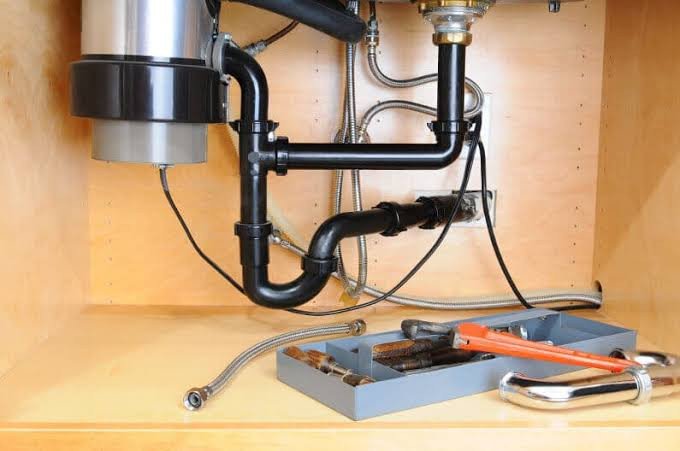
The line between a DIY garbage disposal repair and calling a plumber is drawn by whether the disposal is humming but not spinning, or whether it is leaking, dead silent, or needs to be replaced. A disposal that hums but does not spin has a jammed impeller. The fix is a hex key in the socket on the bottom of the unit — a 30-second DIY job that costs nothing. A disposal that leaks from the body, will not turn on at all, or needs to be replaced with a new unit where no disposal previously existed crosses the line into professional territory. The jam is a DIY fix. The leak is a plumber’s job. The silence is also a plumber’s job — an electrical problem inside the disposal or at the switch. Here is how to tell which one you are dealing with.
A garbage disposal costs $150 to $900 installed by a plumber. The disposal itself costs $50 to $500. The labor costs $100 to $300 for a replacement, $250 to $500 for a new installation where none existed. The DIY savings are the labor cost — $100 to $500 depending on the job. The risk is a leak under the sink that goes unnoticed for months and damages the cabinet floor, the subfloor, and the ceiling below. The plumber’s labor is insurance against that leak. The insurance costs $200. The leak damage costs $2,000 to $5,000. Here is what you can fix yourself and what requires a plumber.
Garbage Disposal Fixes You Can Do Yourself
These five disposal problems can be fixed by a homeowner with basic tools — a hex key, a plunger, and household items. The DIY cost is minimal.
| Problem | DIY Fix | DIY Cost | Plumber Cost |
| Humming but not spinning | Use hex key in bottom socket to free jam | $0 (key came with disposal) | $100 – $200 |
| Clogged or slow-draining disposal | Plunge with sink plunger; clear trap | $10 (plunger) | $150 – $300 |
| Bad odor from disposal | Grind ice cubes + rock salt, then lemon | $2 | $100 – $150 |
| Disposal trips its reset button | Press red reset button on bottom of unit | $0 | $100 – $150 |
| Disposal replacement (like-for-like swap) | Remove old, install new; plug-in connection | $50 – $300 (disposal) | $250 – $500 |
Disposal Jobs That Require a Plumber
These five disposal problems should be handled by a licensed plumber or electrician due to internal seal failure, electrical hazards, or code requirements.
| Problem | Plumber Cost | Why DIY Is Not Recommended |
| Water leaking from disposal body | $250 – $500 (replacement) | Internal seal failure; disposal must be replaced |
| Disposal is dead silent (no hum, no power) | $150 – $400 | Electrical problem in disposal, switch, or circuit |
| Installing disposal where none existed before | $350 – $800 | Requires new electrical outlet, switch, and possibly circuit |
| Disposal leaking at sink flange | $150 – $300 | Requires removing and reseating disposal; plumber’s putty and gasket |
| Disposal connected to a dishwasher drain | $250 – $500 | Dishwasher drain connection must be properly air-gapped |
The Humming Disposal — the Most Common DIY Fix
A disposal that hums when you flip the switch but does not spin has a jammed impeller. Something is wedged between the spinning plate and the grinding ring — a bone, a fruit pit, a piece of metal, a wad of fibrous vegetable. The motor is trying to spin. The impeller is stuck. The hum is the motor straining against the jam. Turn off the disposal. Unplug it or turn off the circuit breaker. Do not reach into the disposal with your hand, the blades are not sharp, but the impeller can trap fingers. Use the hex key that came with the disposal, or a 1/4-inch Allen wrench if the original is lost. Insert the key into the socket on the bottom center of the disposal unit. Work the key back and forth. The impeller will free. Remove whatever was jamming it with tongs or pliers, not your fingers. Press the red reset button on the bottom of the unit, the disposal’s internal circuit breaker may have tripped. Turn the power back on. Run cold water. Turn on the disposal. It should spin freely. The fix cost nothing. The plumber would have charged $150. The hex key was under the sink the whole time.
The Environmental Protection Agency (EPA) notes that garbage disposals, when used with a properly functioning wastewater treatment system, can be an environmentally responsible way to manage food waste. However, disposals should not be used with septic systems unless the system is specifically designed to handle the additional organic load. A disposal connected to a standard septic system can overwhelm the bacteria in the tank and accelerate solids buildup.
When to Replace Instead of Repair
A disposal that leaks from the body, water dripping from the housing, not from the plumbing connections, has a failed internal seal. The seal cannot be replaced. The disposal must be replaced. A disposal that is more than 8 to 12 years old and has stopped working, dead silent, will not turn on, is at the end of its service life. The repair may be a simple electrical fix. The unit is old. The next component will fail soon. Replacement is the better long-term decision. A disposal that has jammed repeatedly, three or more times in a year, is undersized or worn out. The impellers are dull. The motor is weak. The jams will continue. Replace it with a higher-horsepower unit. The upgrade from 1/3 HP to 1/2 HP or 3/4 HP costs $50 to $150 more for the unit. The upgrade eliminates the jams. The jams cost time and frustration. The upgrade is worth the premium.
A like-for-like disposal replacement, the new unit is the same brand and mounting system as the old one, is the most DIY-friendly disposal project. The new disposal twists onto the existing mounting flange. The plumbing connections, dishwasher drain hose and sink drain, are hand-tightened or use basic hose clamps. The electrical connection is a standard plug-in cord under the sink. The entire replacement takes one to two hours. The DIY savings are $100 to $200 in labor. The risk is a leak at the drain connections or the mounting flange. The risk is mitigated by running water and checking for leaks before closing the cabinet doors. A leak that appears immediately is fixed immediately. A leak that appears days later, from a connection that was not quite tight enough, is the risk. Tighten the connections. Check for leaks. Check again an hour later. Check again the next day. The third check catches the slow leak before it becomes water damage. The third check costs five seconds. The water damage costs $2,000. The third check is the cheapest insurance in plumbing.
Frequently Asked Questions
Can I install a garbage disposal myself?
A like-for-like replacement, swapping an old disposal for a new one using the same mounting system, is a moderately DIY-friendly project. The disposal twists onto the existing flange. The connections are hand-tightened. A first-time installation where no disposal existed requires running a new electrical outlet and switch and should be done by an electrician and a plumber.
How much does garbage disposal replacement cost with a plumber?
A plumber charges $250 to $500 for a disposal replacement including the disposal and the labor. The disposal costs $100 to $300. The labor costs $150 to $200. A new installation where none existed costs $350 to $800 due to the electrical work required.
Why does my garbage disposal hum but not spin?
The impeller is jammed. Use the hex key in the socket on the bottom of the disposal to manually turn the motor shaft and free the jam. Turn off the power first. Remove the object with tongs. Press the reset button. The fix is free and takes 30 seconds.
Can I use chemical drain cleaner in a garbage disposal?
No. Chemical drain cleaners can damage the disposal’s seals, gaskets, and plastic components. They also create a hazard for the plumber who eventually opens the line. Use a plunger, a hex key, or a plumber’s snake. Never pour drain cleaner into a disposal.
What should I never put in a garbage disposal?
Grease, oil, and fat, they congeal in the drain. Fibrous vegetables, celery, asparagus, corn husks, they wrap around the impeller. Starchy foods, pasta, rice, potato peels, they expand in water and clog the drain. Coffee grounds, they settle in the trap. Bones, fruit pits, and seafood shells, they are too hard for standard disposals. The disposal is a grinder, not a trash can. The things that damage it are predictable. Avoid them.
How long does a garbage disposal last?
A garbage disposal lasts 8 to 15 years. A 1/3 HP budget disposal lasts 5 to 8 years. A 1 HP premium disposal lasts 12 to 15 years. The motor is the limiting component. Once the motor bearings wear out, the disposal is not repairable, it must be replaced. A disposal that is more than 10 years old and has stopped working should be replaced, not repaired.
The Disposal You Can Fix vs. the One You Cannot
The humming disposal with a jammed impeller: hex key, 30 seconds, free. The stinky disposal: ice, rock salt, lemon, $2. The disposal that will not turn on: check the reset button, check the circuit breaker, check the switch. If none of those work, the disposal has an internal electrical failure. Replace it, DIY if it is a like-for-like swap, plumber if the mounting system is different or if you are not comfortable with electrical and plumbing work.
The disposal that leaks from the body: turn it off, unplug it, and replace it. The internal seal has failed. The leak will not stop. The water will damage the cabinet floor. The $200 plumber installation is cheaper than the water damage. The disposal that needs to be installed where none existed before: hire a plumber and an electrician. The new circuit, the new switch, and the new outlet are not DIY projects. The electrical work requires a permit. The permit requires an inspection. The inspection requires the work to be done correctly. The plumber and the electrician do the work correctly. The DIY homeowner might. The might is the risk. The risk is not worth the savings on a first-time installation.
The hex key is under the sink. The plumber’s number is in your phone. Use the hex key first. Call the plumber if the hex key does not solve the problem. The hex key fixes the jam. The plumber fixes everything else. The jam is the most common problem. The hex key is the most common solution. The hex key is free. The plumber is not. Try the free solution first. Ever flipped the disposal switch and heard that low, straining hum — the sound of a motor trying to spin against something that will not move — and thought “I should just call someone”? You did not need to call someone. You needed a hex key. The hex key was taped to the bottom of the disposal when it was installed. It has been there for years, waiting for this exact moment. The hum is not a call for help. The hum is a call for the hex key. Try it before you call.