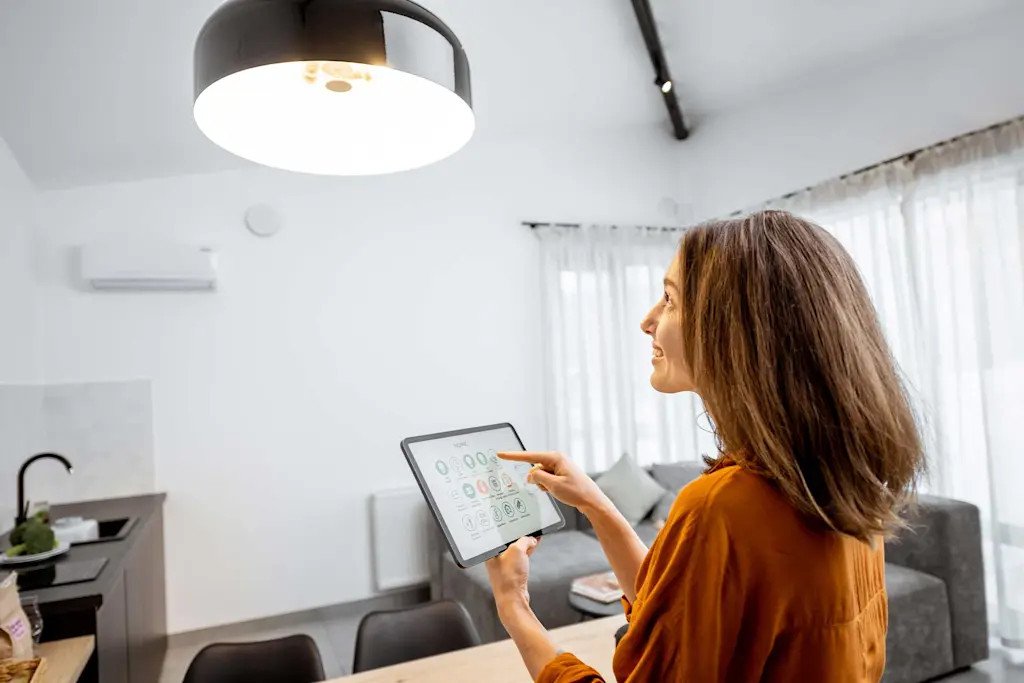
This smart lighting cost guide for homeowners covers what you will pay in 2026. Smart lighting costs between \$50 and \$500 per room depending on the number of bulbs, switches, and fixtures being upgraded, with a whole-home retrofit for a typical 2,000-square-foot house running \$1,000 to \$4,000. A single smart LED bulb costs \$15 to \$50, says Real Property Management Ignite team.
Smart lighting is the entry-level smart home upgrade. It installs in minutes. It requires no wiring changes beyond replacing an existing switch — a task a homeowner can do in 15 minutes with a screwdriver. It delivers immediate, tangible benefits: lights that turn on when you arrive home, turn off when you leave, dim to a warm glow at sunset, and respond to voice commands from the couch. The cost is modest. The convenience is addictive. The only downside is that once you have smart lighting in one room, the other rooms start to feel like they are ignoring you.
Smart Lighting Costs by Device Type
Smart lighting devices range from a $15 smart plug to a $250 integrated smart fixture, with a whole-home retrofit costing $1,000 to $4,000 depending on the mix of bulbs, switches, plugs, and fixtures. Here is how the seven main device types compare on per-unit cost and whole-home total.
| Device | Cost Per Unit | Rooms Per House | Whole-Home Total |
| Smart LED bulb (white, dimmable) | $15 – $30 | 20–40 bulbs | $300 – $1,200 |
| Smart LED bulb (color-changing) | $30 – $50 | 5–10 bulbs (accent) | $150 – $500 |
| Smart light switch (dimmer) | $30 – $60 | 10–15 switches | $300 – $900 |
| Smart light switch (on/off, no dimmer) | $20 – $40 | 5–10 switches | $100 – $400 |
| Smart plug (indoor) | $15 – $25 | 3–6 plugs | $45 – $150 |
| Smart plug (outdoor) | $25 – $40 | 2–4 plugs | $50 – $160 |
| Smart fixture (pre-built, integrated LED) | $80 – $250 | 3–5 fixtures | $240 – $1,250 |
Smart Bulbs vs. Smart Switches — the Choice That Defines the System
A smart bulb is the simplest entry point. Screw it into an existing fixture, pair it with the app, and the light is smart. No wiring. No tools beyond the hands that screw in the bulb. The limitation: the wall switch that controls the fixture must remain in the ON position for the smart bulb to receive power and respond to commands. If someone flips the switch to OFF — and someone always does, the smart bulb goes offline and becomes a $30 dumb bulb. Smart bulbs work best in lamps that are not controlled by a wall switch, or in fixtures where the household agrees to leave the switch alone.
A smart switch replaces the wall switch that controls a circuit of standard bulbs. It costs $30 to $60 for a dimmer model and controls every bulb on that circuit, typically 2 to 6 bulbs, with a single smart device. The economics favor smart switches in rooms with multiple bulbs on a single switch: a kitchen with 6 recessed lights costs $180 to $300 to retrofit with individual smart bulbs versus $30 to $60 for a single smart dimmer that controls all of them. The switch approach also eliminates the “someone turned off the switch” problem because the switch is the smart device. It is always connected to power. The physical switch still functions as a switch, press it to turn the lights on and off, and the smart functions operate independently.
The best approach for most homes is a mix: smart switches in rooms with multiple bulbs on a single circuit, kitchens, living rooms, hallways, outdoor lights, and smart bulbs in lamps and accent fixtures where a single bulb provides the effect. Smart plugs turn floor and table lamps into smart lamps without replacing a bulb or a switch. The combination covers every light in the house at the lowest total cost.
The U.S. Department of Energy notes that LED bulbs use at least 75% less energy than incandescent bulbs and last 25 times longer. Smart LEDs add scheduling and occupancy-based automation that further reduces energy consumption by turning lights off when rooms are empty and dimming them when full brightness is unnecessary. The energy savings from smart lighting are modest, $30 to $80 per year for a typical home, and are not the primary reason to install it. The convenience is. The energy savings are a bonus.
Smart Lighting Ecosystems, Hub vs. Wi-Fi vs. Hub-Free
Smart lighting devices connect to your home network through one of three paths. A hub-based system, Philips Hue, Lutron Caséta, IKEA Trådfri, uses a dedicated hub that plugs into your router and communicates with the bulbs and switches using Zigbee or a proprietary radio protocol. The hub costs $30 to $80 and is required for the system to function. Hub-based systems are the most reliable, the most responsive, and the most capable, they support larger networks of devices, integrate more deeply with home automation platforms, and do not congest your Wi-Fi network. Philips Hue is the market leader and the most expensive. Lutron Caséta is the gold standard for switches.
A Wi-Fi system, TP-Link Kasa, Wiz, Cync, Feit Electric, connects each bulb or switch directly to your Wi-Fi network with no hub required. The advantage is lower upfront cost and simpler setup. The disadvantage is that each device is a Wi-Fi client, and a house with 30 to 40 Wi-Fi smart bulbs can strain a consumer-grade router to the point where the lights respond slowly or drop offline. Wi-Fi devices are best for small installations, 10 devices or fewer, or homes with a high-quality mesh Wi-Fi system that can handle the client load.
A hub-free system using Thread or Matter, the newer smart home protocols, does not require a dedicated hub but may use a Thread border router built into a device you already have: an Apple HomePod, a Google Nest Hub, or an Amazon Echo. Matter is an industry-wide standard that allows devices from different manufacturers to work together across platforms, an Eve smart plug controlled by an Apple HomeKit setup works with an Amazon Alexa setup in the same home. Matter devices are newer, fewer in selection, and the most future-proof choice for a system that will still be supported in 10 years.
Professional Installation, When to Hire an Electrician
Replacing a smart bulb or plugging in a smart plug requires no tools and no electrician. Replacing a standard wall switch with a smart switch requires a screwdriver, a voltage tester, and the ability to identify line, load, neutral, and ground wires in the switch box. A smart switch that requires a neutral wire, most do, cannot be installed in a switch box that lacks one without running a new wire, which requires an electrician at a cost of $150 to $400 per switch location.
A homeowner who is comfortable replacing a standard light switch, turn off the breaker, verify with a voltage tester, remove the old switch, connect the same wires to the new switch, replace the cover, turn the breaker back on, can install a smart switch. It is the same procedure with slightly more wires because the smart switch needs power for its radio and processor. A homeowner who has never opened a switch box should hire an electrician. Smart switch installation costs $75 to $150 per switch in labor. A whole-home installation of 10 to 15 smart switches costs $750 to $2,250 in labor.
Frequently Asked Questions
How much does smart lighting cost for a whole house?
A whole-home smart lighting retrofit costs $1,000 to $4,000 for a typical 2,000-square-foot home. Smart bulbs cost $300 to $1,200 for 20 to 40 bulbs. Smart switches cost $400 to $1,300 for 15 to 25 switches. Smart plugs cost $100 to $300. Smart fixtures cost $250 to $1,250. The total depends on the mix of devices and whether installation is DIY or professional.
Do smart bulbs use electricity when the lights are off?
Yes. A smart bulb draws a small amount of power, typically 0.2 to 0.5 watts, to keep its radio and processor active and responsive to commands. At $0.15 per kilowatt-hour, a smart bulb that draws 0.3 watts in standby costs about $0.40 per year in electricity, negligible. The LED efficiency savings compared to the incandescent bulb it replaced, $5 to $15 per year, far outweigh the standby consumption.
What is the best smart lighting system for a whole house?
Lutron Caséta is the best smart switch system for reliability and integration. Philips Hue is the best smart bulb system for color quality and ecosystem breadth. Both use dedicated hubs, which provide the most reliable performance. For a budget-friendly, hub-free option, TP-Link Kasa smart switches and bulbs connect directly to Wi-Fi and work well in smaller installations.
Can I install smart light switches myself?
Yes, if you are comfortable replacing a standard light switch, turn off the breaker, verify with a voltage tester, and connect line, load, neutral, and ground wires. Most smart switches require a neutral wire in the switch box. Homes built before 1980 may not have neutral wires in switch boxes, requiring an electrician to run one at $150 to $400 per switch location. If you have never opened a switch box before, hire an electrician.
Will smart lighting work if the internet goes down?
Most smart lighting systems continue to function locally, the physical switch still turns the lights on and off, but lose remote control, voice control, and automation until internet service is restored. Hub-based systems with local processing, Lutron Caséta, Philips Hue with a Hue Bridge, retain more functionality during an internet outage than Wi-Fi-based systems that rely on cloud servers. The lights still work. The smart features are temporarily unavailable.
Do smart lights work with Alexa, Google Home, or Apple HomeKit?
Most smart lighting products work with at least two of the three major platforms. Check the product packaging or website for the “Works with Alexa,” “Works with Google,” or “Apple HomeKit” logo. Matter-certified devices work with all three platforms simultaneously. If you use voice control for your lights, and most people do, because saying “turn off the kitchen” is faster than finding the app, confirm the device is compatible with your platform before buying.
What Smart Lighting Costs
Smart switches on every major lighting circuit, kitchens, living rooms, hallways, outdoor lights, bedrooms, combined with smart plugs on a few lamps costs $600 to $1,500 for a typical home and delivers the core smart lighting experience: voice control, schedules, remote access, and occupancy automation. Add color-changing bulbs in a few accent locations and the total reaches $1,000 to $2,000. Add a few smart fixtures and the total reaches $1,500 to $4,000.
The smart switch is the better value per light controlled. The smart bulb is the better value for a single lamp where a switch replacement is unnecessary. Use both. The switches control the circuits. The bulbs handle the accents. The smart plugs fill the gaps. The lights turn on when you arrive home and turn off when you leave. The dimmer sets the living room to warm amber at sunset. The voice assistant turns off every light in the house when you say goodnight. The cost is modest. The experience, once you have it, is hard to live without. Ever walked into a dark house carrying groceries, fumbling for a light switch you cannot find because your hands are full, and wished the lights would just turn on by themselves? That wish is what smart lighting sells. The cost is $1,000 to $4,000 for the whole house. The grocery bags are free. The convenience is cumulative — every day you use it, the cost per use drops. After a year, it costs cents per day. After five years, you forget what it cost. You only notice that the lights turn on when you need them and turn off when you do not. The money is gone. The lights are still smart.