This roof ventilation cost guide for homeowners covers what you will pay in 2026. Roof ventilation installation costs between \$300 and \$1,500 for most homes, depending on the vent type, the number of vents needed, and whether the installation is new construction or a retrofit into an existing finished roof, explains Clark County property management. Adding ridge and soffit vents to a typical 2,000-square-foot home costs \$500 to \$1,200.
Roof ventilation is the most overlooked system in the house and one of the most important. A properly vented attic extends the life of the roof by 5 to 10 years by preventing the heat and moisture buildup that cooks shingles from underneath and rots the roof deck from above. The cost of adding ventilation is a fraction of the cost of replacing a roof that failed early because the attic was an oven every summer and a sauna every winter.
Roof Ventilation Types and Costs
Roof ventilation options range from $3 per linear foot for soffit vent material to $1,200 for a solar attic fan, with most homes needing a combination of intake and exhaust vents for a balanced system. Here is how the seven most common vent types compare on installed cost.
| Vent Type | Cost Per Vent (Installed) | Number Needed | Total Cost Range |
| Soffit vent (continuous or individual) | $3 – $10 per linear ft (material only) | N/A (perimeter) | $300 – $800 |
| Ridge vent (continuous) | $10 – $15 per linear ft | Length of ridge | $400 – $900 |
| Box vent (static, roof-mounted) | $80 – $200 each | 3 – 6 per roof | $300 – $800 |
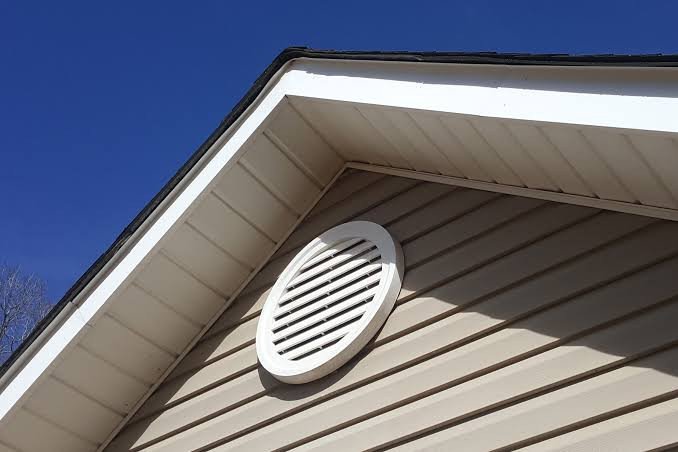
| Gable vent (wall-mounted) | $150 – $400 each | 1 – 2 per attic | $200 – $600 |
| Turbine vent (wind-driven) | $100 – $250 each | 2 – 4 per roof | $300 – $700 |
| Powered attic fan (electric) | $300 – $600 each | 1 – 2 per attic | $400 – $900 |
| Solar attic fan | $500 – $900 each | 1 – 2 per attic | $600 – $1,200 |
How Roof Ventilation Works — Intake and Exhaust
Roof ventilation works on a simple principle: cool air enters at the bottom of the roof — through soffit vents at the eaves — and hot air exits at the top, through ridge vents, box vents, or gable vents at the peak. The temperature difference between the attic and the outside air drives the airflow. The larger the temperature difference, the stronger the airflow. This is passive ventilation. It requires no electricity, no moving parts, and no maintenance beyond keeping the soffit vents clear of insulation and debris.
A properly balanced ventilation system has roughly equal intake area at the eaves and exhaust area at the ridge. The industry standard is 1 square foot of net free vent area for every 150 square feet of attic floor space, split equally between intake and exhaust. A 1,500-square-foot attic needs 10 square feet of net free vent area, 5 square feet at the eaves and 5 square feet at the ridge. The math is straightforward. The execution, ensuring that insulation is not blocking the soffit vents, that the ridge vent is continuous and unobstructed, and that the gable vents are not fighting against the ridge vent, is where most installations go wrong.
The National Roofing Contractors Association (NRCA) recommends balanced intake and exhaust ventilation for all steep-slope roof assemblies. An attic with exhaust vents but no intake vents, ridge vents with blocked soffits, will pull conditioned air from the living space below through ceiling penetrations, increasing heating and cooling costs. An attic with intake vents but no exhaust vents, soffit vents with no ridge or box vents, will not circulate air effectively because there is no pressure difference to drive the flow. Both intake and exhaust must be present and unobstructed for the system to work.
Powered vs. Passive Ventilation
Passive ventilation, ridge vents, soffit vents, box vents, gable vents, relies on natural convection and wind to move air through the attic. It costs the least to install, costs nothing to operate, and has no mechanical components to fail. Passive ventilation is adequate for the vast majority of residential attics in the vast majority of climates. If the attic has adequate intake at the eaves and adequate exhaust at the ridge, passive ventilation will keep the attic within 10 to 15 degrees of the outside air temperature, the gold standard for attic temperature management.
Powered ventilation, electric or solar attic fans, actively pulls air through the attic and exhausts it to the outside. It is necessary when the attic cannot be adequately vented passively: low-slope roofs with insufficient vertical distance between the eaves and the ridge, attics with complex geometry that blocks natural airflow, or homes in extremely hot climates where passive ventilation cannot keep up with the heat load. A powered fan costs more to install, costs money to operate if it is electric, and will eventually fail and need replacement. A passive ventilation system, properly designed, will work for the life of the roof with no operating cost and no maintenance.
The most common ventilation mistake is mixing powered and passive exhaust on the same roof. An electric attic fan installed on a roof that also has ridge or box vents will pull air in through the nearest exhaust vent, the ridge vent, instead of through the soffit vents at the eaves. The fan short-circuits the passive system. The attic near the fan is cooled. The rest of the attic is stagnant. If a powered fan is installed, all other exhaust vents in the attic must be sealed. The fan becomes the sole exhaust. The soffit vents remain the intake.
Signs Your Roof Ventilation Is Inadequate
The attic is the diagnostic center for roof ventilation problems. Go into the attic on a summer afternoon. If the temperature is significantly hotter than the outside air, more than 15 to 20 degrees, ventilation is inadequate. If the attic is humid, smells musty, or shows condensation on the underside of the roof deck, ventilation is inadequate. If there is frost on the underside of the roof sheathing in winter, warm, moist air from the living space is leaking into the attic and condensing on the cold sheathing, a combination of inadequate ventilation and inadequate air sealing between the living space and the attic.
Exterior signs include: curling shingles, which indicate excessive heat buildup in the attic cooking the shingles from underneath; ice dams at the eaves in winter, which indicate warm attic air melting snow on the upper roof and the meltwater refreezing at the cold eaves; and rust on exposed nail heads in the attic, which indicates chronic high humidity. Each of these problems has a root cause. Inadequate ventilation is usually part of it.
Frequently Asked Questions
How much does roof ventilation cost?
Roof ventilation costs $300 to $3,000 depending on the vent type and the size of the roof. Soffit vents cost $300 to $800. Ridge vents cost $400 to $900. A combination of intake and exhaust vents for a typical 2,000-square-foot home costs $500 to $1,200. A powered attic fan costs $400 to $1,200. A full ventilation upgrade costs $1,000 to $3,000.
How do I know if my attic needs more ventilation?
Check the attic temperature on a summer afternoon. If it is more than 15 degrees above the outside air, ventilation is inadequate. Look for curling shingles, a sign of heat buildup from below. Check for ice dams in winter, a sign of warm attic air melting snow on the roof. Check for condensation, frost, or rust on the underside of the roof deck, signs of chronic moisture. Any of these symptoms indicates inadequate ventilation.
Can a roof have too much ventilation?
Not in terms of airflow, more ventilation is generally better. A roof can have unbalanced ventilation: excess exhaust without adequate intake, or excess intake without adequate exhaust. Unbalanced ventilation creates dead zones in the attic where air does not circulate. The solution is to balance intake and exhaust, not to reduce the amount of ventilation.
Should I add a powered attic fan to improve ventilation?
Only if passive ventilation is inadequate and cannot be improved, a low-slope roof, a complex attic with blocked airflow, or an extremely hot climate. A powered fan must be the sole exhaust for the attic; all passive exhaust vents must be sealed. An attic fan running alongside passive vents short-circuits the passive system and wastes energy. Solar attic fans eliminate the operating cost but share the same installation and compatibility requirements.
Does roof ventilation reduce energy bills?
Yes. A properly vented attic reduces the temperature in the attic by 20 to 40 degrees in summer, which reduces the heat that radiates down into the living space below. The air conditioner runs less. The energy savings are $50 to $150 per year depending on climate, attic insulation levels, and electricity rates. The primary benefit of ventilation is extending the life of the roof. The energy savings are a bonus.
Can I install roof vents myself?
Installing soffit vents is moderately DIY-friendly, it involves cutting holes in the soffit material and installing vent covers. Installing ridge vents requires cutting a slot along the entire ridge of the roof, a structural modification that should be done by a roofing professional. Installing a powered attic fan requires running electrical wiring and should be done by a licensed electrician or a contractor who coordinates with one. Cutting into a finished roof is not a DIY project.
What Good Ventilation Costs
Continuous soffit vents and a continuous ridge vent on a typical 2,000-square-foot home cost $500 to $1,200 installed. They require no electricity. They have no moving parts. They work for the life of the roof. They extend the life of the shingles by 5 to 10 years. They reduce the attic temperature by 20 to 40 degrees in summer. They prevent the ice dams that tear off gutters and leak into the soffits every winter. They are the cheapest money you will ever spend on your roof, cheaper than a single major repair, cheaper than the energy they save, cheaper than the roof replacement they delay.
The attic should be roughly the same temperature as the outside air. If it is not, the ventilation is not working. Fix the intake first, clear the soffit vents, add more if there are not enough. Then fix the exhaust, add ridge vents or box vents at the peak. Balance the two. Let physics do the rest. The roof will last longer. The attic will stay cooler. The ice dams will stop. The ventilation does not ask for thanks. It asks for air. Ever walked into an attic in August and felt the heat hit your face like opening an oven door? That attic is not hot because the sun is shining. It is hot because the heat has nowhere to go. The roof is baking from above. The attic is baking from within. The ventilation that should be carrying the heat away is missing, blocked, or never installed. The attic has been cooking for twenty summers. The shingles have paid the price. The roof is halfway through its life, but the clock has been running at double speed.