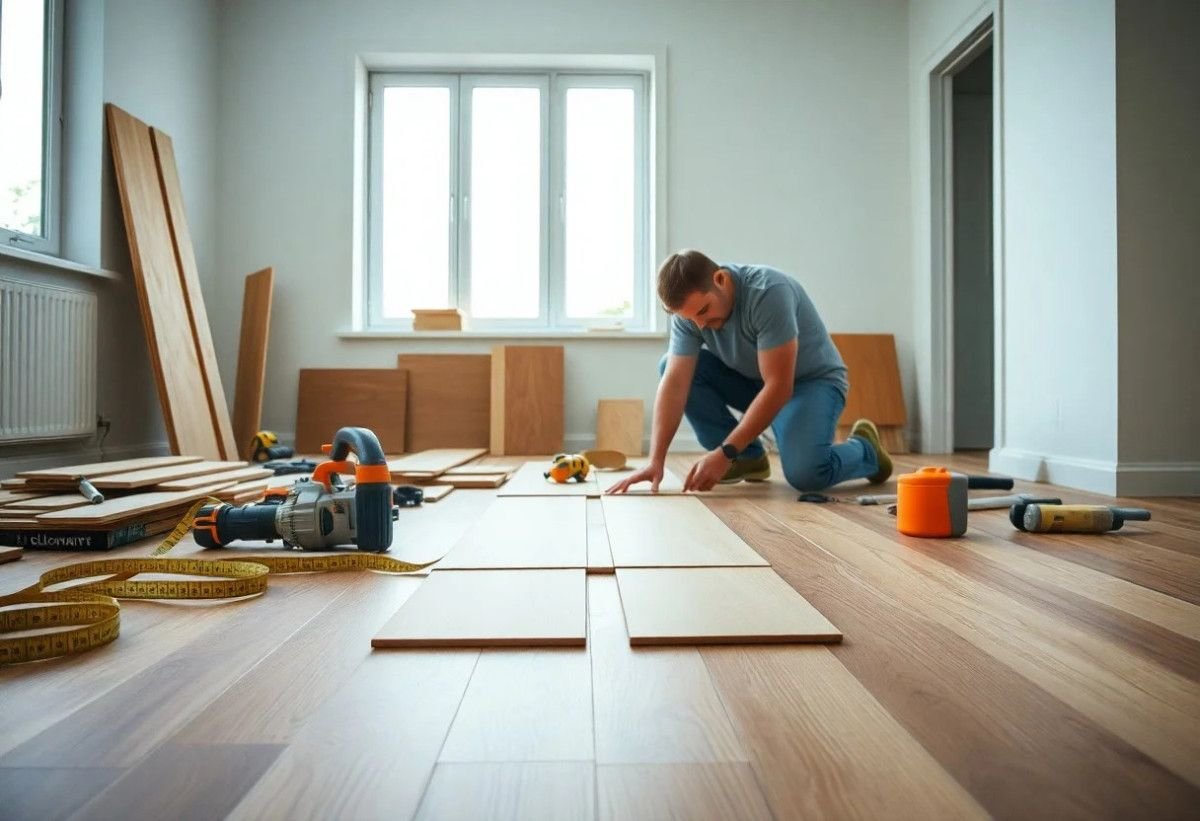
You walked through the flooring aisle and stopped at a display that looked exactly like white oak, adds best areas for investment. The grain pattern caught the light. The color variation between planks was subtle and convincing. You bent down, touched it, and realized it was laminate. Not wood at all. A photograph of wood under a clear wear layer. The price tag was one-third of the engineered hardwood two aisles over.
Hardwood laminate flooring, meaning laminate designed to replicate the look of real hardwood, has reached a point where guests will not know it is not wood unless you tell them. But the realism depends entirely on two things: choosing the right product and installing it in a way that does not betray the illusion. A high-end laminate plank installed in a repeating staircase pattern looks fake. A mid-range plank installed with randomized layout and proper transitions can pass for site-finished hardwood.
This guide focuses on the visual and aesthetic decisions that make laminate read as hardwood: plank selection, pattern layout, avoiding the repeating-pattern trap, and the finishing details that separate a convincing floor from an obvious impersonation. The mechanical steps of click-lock installation are straightforward. Making it look like real wood is where the craftsmanship lives.
Choosing Planks That Actually Look Like Wood
Not all wood-look laminate is created equal. The difference between a floor that reads as wood and one that reads as a photograph of wood comes down to four features you can evaluate in the store.
Embossed-in-Register Texture
Cheap laminate is smooth. The wood grain is a flat image under a glossy plastic layer. Your eye registers the lack of texture before your brain can articulate why it looks wrong. Better laminate uses embossed-in-register (EIR) technology, where the surface texture is pressed into the wear layer in alignment with the printed wood grain. A knot on the image feels like a knot. The grain lines have physical ridges that match the visual pattern. Run your fingernail across the display plank. If the texture does not match the image, keep looking.
Plank Width
Real hardwood flooring is typically 3 to 5 inches wide. Many budget laminates use 6 to 8-inch wide planks because wider planks mean fewer seams and faster installation. The problem is that real wood in those widths is expensive and uncommon. A floor made of 8-inch wide “oak” planks announces itself as fake to anyone who has ever looked at a real wood floor. Stick to widths between 4 and 5.5 inches for the most convincing hardwood appearance.
Beveled Edges and Micro-Bevels
Real hardwood planks have slight gaps and shadow lines at the seams because wood expands and contracts. Laminate with perfectly square, seamless edges looks like a single printed sheet. A micro-bevel on all four edges of each plank creates a subtle V-shaped groove that catches light the way real wood joints do. Painted-bevel edges, where the bevel is colored to match the plank surface rather than showing the dark HDF core, are worth the extra cost. An unpainted bevel reveals the dark core material at every seam and is the single biggest visual giveaway of laminate.
Pattern Repeat Rate
Laminate planks are printed from photographs. The manufacturer has a limited number of photographic masters, usually between 5 and 12 unique plank faces per product line. In cheap laminate with only 4 or 5 patterns, you will find identical planks within the same room. Once your eye notices the repeating knot pattern, you cannot unsee it. Before buying, lay out six planks from different boxes side by side and look for duplicate grain patterns. A product with 8 or more unique plank faces, packaged randomly across boxes, is the minimum for a convincing hardwood look. Premium laminate offers 12 to 15 unique faces.
| Feature | Looks Fake | Looks Real |
| Surface texture | Smooth, glossy, flat image | Embossed-in-register, matte or satin |
| Plank width | 7-8 inches wide | 4-5.5 inches wide |
| Edge bevel | Square, no gap, dark exposed core | Micro-bevel, painted bevel |
| Pattern variety | 4-5 repeating faces | 8-15 unique faces, random box packaging |
| Gloss level | High-gloss, plastic sheen | Matte or low-satin |
Layout That Makes Laminate Read as Wood
Plank Direction
Run planks parallel to the longest wall in the room. For a hallway, run them parallel to the hallway length. This is the standard orientation for hardwood and your eye expects it. If the room has a primary natural light source, such as large windows on one wall, running planks perpendicular to the light source minimizes the visibility of end-joint seams. Light raking across joints accentuates every slight gap. Light running parallel to joints hides them.
Randomizing the Layout: Avoiding the Staircase Pattern
The staircase pattern, also called H-pattern, is the single biggest installation mistake that makes laminate look fake. It occurs when every other row starts at exactly the same point, creating a repeating step pattern that no real wood floor would ever have. Real hardwood installers randomize end-joint positions deliberately.
To randomize: start the first row with a full plank. Start the second row with a plank cut to roughly two-thirds length. Start the third row with a plank cut to roughly one-third length. For subsequent rows, use the off-cut from the previous row as the starter if it is at least 12 inches long. If not, cut a new starter to a length that does not align with any joint within two rows above or below. After the first four rows, step back and scan for any visual pattern. Adjust the next starter length if you see one forming.
A rule that helps: no two end joints should be closer than 6 inches to each other in adjacent rows, and no joint should align vertically with a joint two rows away. This takes an extra 30 seconds per row and is the difference between a floor that looks installed and one that looks designed.
Mixing from Multiple Boxes
Laminate planks within a single box are often sequential off the production line and share the same dye lot but may have similar pattern placement. Open three or four boxes at once and pull planks randomly from all of them as you work. This distributes any slight color variation across the entire floor instead of concentrating it in one area. A floor with a visible color shift halfway across the room is a laminate tell that cannot be fixed after installation.
Installation Basics for Hardwood-Look Laminate
The mechanical installation of laminate is the same regardless of the visual pattern. The floor is a floating system: planks click together over an underlayment, held in place by their own weight and the expansion gap at the walls. Nothing is nailed or glued to the subfloor.
Underlayment matters for sound, not just moisture. Real hardwood has a solid, dense sound when walked on. Laminate over thin foam underlayment produces a hollow, plasticky footfall that is immediately noticeable. Cork underlayment or premium acoustic foam absorbs impact noise and makes the floor sound more like wood underfoot. If the room is above a living space, spend the extra $0.30 per square foot on better underlayment. The sound is part of the illusion.
Expansion gap discipline. Laminate expands and contracts with humidity changes. The 3/8-inch gap around the entire perimeter is not a suggestion. Without it, the floor will buckle at the seams, and the resulting peaks at every joint are impossible to ignore. Use actual spacers, not folded cardboard or scraps. Spacers are $5 for a bag of twenty. Use them.
Undercut door casings. The laminate must slide under the door casing, not be cut around it. Jigsaw cuts around door trim look exactly like what they are: a workaround. Undercutting the casing with a flush-cut saw lets the laminate disappear underneath, the same way a hardwood installer would do it. This single detail elevates the entire installation.
Finishing Details That Sell the Hardwood Illusion
Quarter-Round and Baseboards
The expansion gap at the wall must be covered. The cheapest approach is quarter-round molding nailed to the baseboard. A better approach is to remove the existing baseboards before installation, lay the laminate, and reinstall the baseboards over the gap. This eliminates the quarter-round entirely and replicates how hardwood is installed. Removing baseboards adds an hour of work and risks cracking old painted trim, but the result is a floor that looks original to the house rather than a floor that was laid over an existing one.
Transitions Between Rooms
Laminate should not run continuously through doorways without a transition strip, even in an open floor plan. A T-molding at the doorway allows each room’s floor to expand independently. Without it, a long uninterrupted run of laminate can buckle at a doorway pinch point. The T-molding should match the laminate color as closely as possible. A poorly matched transition strip draws the eye to the one place you do not want attention.
Stagger End Joints in Doorways
Never place an end joint directly in the center of a doorway. Doorways are high-traffic pinch points where two planks meeting end-to-end will flex and eventually separate. Plan your layout so a continuous plank spans the full width of every doorway. This requires some math during layout and may waste a plank or two. The alternative is a gap at the most visible transition in the room.
What You Save vs. Real Hardwood
| Hardwood Laminate | Engineered Hardwood | Solid Hardwood | |
| Material cost/sq ft | $2.00-4.00 | $4.00-10.00 | $6.00-15.00 |
| Installation | DIY (floating) | DIY or pro (floating/nail/glue) | Pro only (nail-down) |
| Refinishable | No | 1-2 times (thin veneer) | 4-6 times |
| Water resistance | Moderate (spills only) | Poor | Poor |
| 200 sq ft room (materials) | $400-800 | $800-2,000 | $1,200-3,000 |
The price gap between laminate and real wood is wide enough to pay for the underlayment, the tools, the transition strips, and a weekend of your time, with thousands left over. What laminate does not give you is the ability to sand and refinish when it wears. A scratched laminate plank is replaced, not refinished. This is the tradeoff you make at the point of purchase.
When Hardwood Laminate Is the Wrong Choice
Laminate is a visual product. It looks like wood. It does not behave like wood, and it does not tolerate water like vinyl. Do not install it in bathrooms, laundry rooms, or below-grade basements where moisture is a risk. For those spaces, luxury vinyl plank (LVP) gives a similar wood look with full waterproofing.
If the subfloor has significant height variation, more than 3/16 inch over 10 feet, laminate joints will flex and eventually fail. The floor will develop a clicking sound when walked on that no amount of underlayment will fix. Address the subfloor first or choose a different flooring type.
If you want a floor that will still look current in 20 years and can be sanded and restained when trends change, buy engineered hardwood. It costs twice as much but lasts twice as long and can change color. Laminate is what it is forever. Choose the color carefully because you will be looking at it until you replace it.
Frequently Asked Questions
Can people really tell the difference between laminate and real hardwood?
From a standing position on a well-chosen, properly installed laminate floor with painted bevels and randomized layout, most people cannot tell the difference without touching it. The giveaway is usually sound and feel underfoot, not appearance. Laminate sounds slightly hollow compared to nailed-down hardwood. Walking barefoot reveals the difference: wood has a slight warmth and texture variation that laminate, even textured laminate, does not fully replicate. For visual appearance alone, a high-quality laminate with 10 or more unique plank faces installed with randomized joints passes the eye test with most guests.
Can I mix laminate with real hardwood in the same house?
Yes, but do it at a natural transition point such as a doorway or a step. Do not install laminate and hardwood in the same open room. The difference in thickness, sound, and expansion behavior will be obvious at the seam. A T-molding at a doorway creates a clean visual break where the transition makes architectural sense. Match the colors as closely as possible. A near-match looks intentional. A mismatch looks like a mistake.
Should I glue laminate joints for a more realistic wood feel?
No. Modern click-lock laminate is designed to float. Gluing the joints prevents the floor from expanding and contracting as a unit and will cause buckling. The only exception is laminate installed in high-moisture areas, where some manufacturers offer a glue-assisted locking system. For standard residential installation, the click-lock mechanism is sufficient. If you want a floor that feels more solid, upgrade the underlayment, not the joint connection.
What if I already installed the floor and the pattern repeats are visible?
Once the floor is installed, you cannot swap individual planks without disassembling from the nearest wall to reach the offending piece. The fix is disruptive. Area rugs strategically placed over the most obvious repeating planks are the practical solution for an already-installed floor. For a floor not yet installed, the prevention is opening multiple boxes and discarding or relocating duplicate patterns before they become a problem. Lay out the first 50 square feet of planks dry, without clicking them together, and scan for repeats before committing to installation.
The Details Make the Floor
A laminate floor that looks like real hardwood does not happen by accident. It happens because someone spent an extra hour choosing the right plank width, opened three boxes at once, randomized the starter lengths row by row, and undercut the door casings. None of these steps require skill. They require patience and the willingness to treat the floor as something people will look at, not just walk on.
Keep at least one full plank from the installation. Store it flat in a closet. If a plank chips or scratches beyond repair five years from now, and the product has been discontinued, the spare plank is the only way to fix it without replacing the entire floor. The spare plank costs nothing to keep and everything to not have.