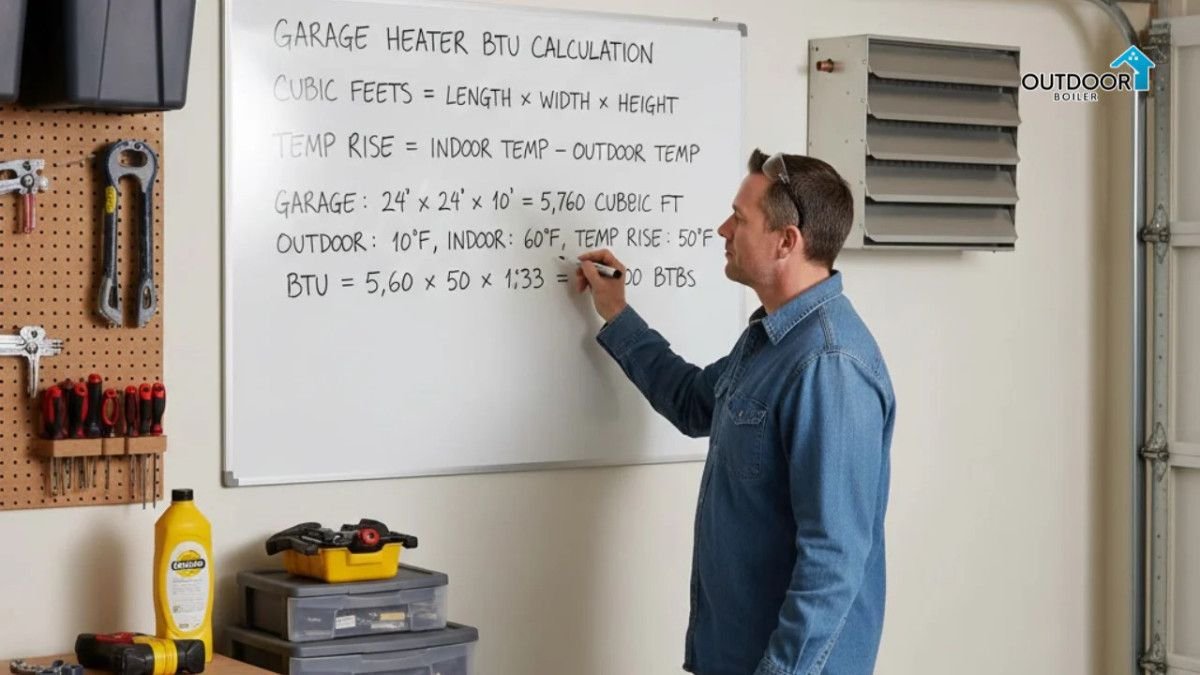
A two-car garage is roughly 20 feet wide, 20 feet deep, and 10 feet high. That is 4,000 cubic feet of air that needs to be warmed. The question of how many BTUs it takes to heat that space depends on three things: the insulation level of the garage, the outside temperature on the coldest day you expect to use the garage, and how warm you want it to be. An uninsulated two-car garage in Minnesota on a minus-10-degree day needs roughly 60,000 BTUs to reach 65 degrees. The same garage fully insulated needs 25,000 BTUs. The insulation cuts the heater size by more than half. The cost of the insulation is less than the cost difference between a 60,000 BTU heater and a 25,000 BTU heater, before accounting for the ongoing fuel savings, adds Keyrenter Overland Park solutions.
According to wikiHow’s garage heating guide, insulating the garage is the first and most important step before installing any heater. A heater in an uninsulated garage represents a tremendous waste of energy. This guide provides specific BTU numbers for a standard two-car garage at different insulation levels and climate zones.
The BTU Formula for a Two-Car Garage
The formula is the same for any space: BTUs equal cubic feet times desired temperature rise times an insulation factor. For a two-car garage, the cubic feet are fixed at roughly 4,000. The temperature rise is how many degrees warmer than outside you want the garage to be. The insulation factor is how well the garage holds heat.
A standard two-car garage is 20 feet by 20 feet with a 10-foot ceiling. Some are 22 by 22 with 12-foot ceilings, which is 5,808 cubic feet. Some are 18 by 20 with 8-foot ceilings, which is 2,880 cubic feet. Measure your actual garage. The 4,000-cubic-foot number is the baseline from which all the BTU examples in this guide are calculated.
The temperature rise is the difference between the outside design temperature and the target temperature. The design temperature is the coldest day you expect to use the garage, not the coldest day in recorded history. If you do not use the garage on days below zero, use zero as the design temperature. If the garage must be warm every day regardless of conditions, use the historical low for your area. A design temperature of 10 degrees with a target of 65 degrees gives a 55-degree rise. A design temperature of minus 10 with a target of 65 gives a 75-degree rise.
The insulation factor is a multiplier based on how well the garage resists heat loss. A fully insulated garage with R-13 walls, R-30 ceiling, and an insulated garage door has a factor of 1.0 to 1.5. A moderately insulated garage with R-13 walls but an uninsulated ceiling and door has a factor of 2.0 to 2.5. An uninsulated garage with exposed studs, no ceiling insulation, and a bare metal door has a factor of 3.0 to 4.0. The insulation factor is not a precise number. It is an estimate that accounts for air leakage, window area, and the number of exterior walls. An attached garage sharing one or two walls with the house is easier to heat than a detached garage with four exposed walls.
BTU Requirements for a 4,000-Cubic-Foot Two-Car Garage
| Insulation Level | Moderate Climate (40°F Rise) | Cold Climate (55°F Rise) | Very Cold Climate (75°F Rise) |
| Well-insulated (factor 1.5) | 18,000-25,000 BTU | 25,000-35,000 BTU | 35,000-45,000 BTU |
| Moderately insulated (factor 2.5) | 30,000-40,000 BTU | 40,000-55,000 BTU | 55,000-75,000 BTU |
| Uninsulated (factor 3.5) | 40,000-55,000 BTU | 55,000-75,000 BTU | 75,000-100,000 BTU |
The table shows the range of BTU requirements for the most common two-car garage size. The values are for a garage that is heated continuously to maintain a steady temperature. If the garage is heated only when occupied and the heater is turned off otherwise, add 20 to 30 percent to the BTU requirement to account for the energy needed to raise the temperature of the cold thermal mass, the concrete floor, the vehicles, the tools, from the outside temperature to the target temperature each time the heater is turned on.
Heater Sizing: Bigger Is Not Better
An oversized heater cycles on and off frequently. Each startup has a delay before the heater reaches full output. Frequent cycling reduces efficiency, increases wear on the components, and produces uneven temperatures. The garage is hot near the heater and cold at the far end because the heater shuts off before the warm air has time to circulate. A properly sized heater runs for longer cycles at steady state, which is more efficient, quieter, and produces a more uniform temperature throughout the garage.
Size the heater to the calculated BTU requirement. Do not add a margin for safety by buying the next larger size. The calculation already includes a safety margin in the insulation factor. If the calculation says 25,000 to 35,000 BTUs, a 30,000 BTU heater is correct. A 45,000 BTU heater is oversized. The only exception is if the garage door will be opened frequently, such as for a workshop where cars move in and out multiple times per day. Each door opening dumps the heated air and the heater must bring the garage back to temperature. In that case, add 15 to 20 percent to the BTU requirement to compensate for the door cycling loss.
Heater Types for Different BTU Ranges
| Heater Type | BTU Range | Best For | Fuel Cost per 100K BTU |
| Electric space heater, 120V portable | 5,000 | Spot heating while working, not whole-garage | $3.00-4.00 |
| Electric heater, 240V hardwired | 7,500-25,000 | Insulated two-car in moderate climate | $3.00-4.00 |
| Natural gas forced-air, vented | 25,000-100,000 | Insulated or moderately insulated two-car | $1.00-1.50 |
| Natural gas infrared tube, vented | 30,000-100,000 | High-ceiling or uninsulated garages | $1.00-1.50 |
| Propane forced-air, vented | 30,000-80,000 | Detached garages without natural gas | $2.50-3.50 |
Natural gas costs roughly one-third as much per BTU as electric resistance heat in most of the United States. For a two-car garage heated regularly, the lower operating cost of natural gas pays back the higher equipment and installation cost within one to two heating seasons. Electric heat is appropriate for a garage heated occasionally, a few hours on weekends. Natural gas is the correct choice for a garage heated daily or used as a full-time workshop. Propane is the alternative where natural gas is not available. Propane costs more than natural gas but less than electricity in most regions.
Common BTU Sizing Mistakes for Two-Car Garages
- Guessing instead of calculating. A 4,000-cubic-foot two-car garage in a cold climate needs somewhere between 25,000 and 75,000 BTUs depending on insulation. That is a 3x range. Guessing buys the wrong heater. Calculate.
- Ignoring the garage door. An uninsulated metal garage door has an R-value of less than 1 and represents 20 to 30 percent of the wall area. Insulating the door raises it to R-6 to R-9 and reduces the BTU requirement by 5,000 to 10,000. A $50 to $150 door insulation kit is the single most cost-effective BTU reduction in a two-car garage.
- Sizing for the coldest day in history. If the garage is not used on days below zero, do not size the heater for minus-20-degree conditions. Size it for the design temperature that matches actual use. A heater sized for a minus-20-degree day is oversized for 99 percent of the operating hours. It cycles inefficiently and costs more to buy and install.
- Heating an uninsulated garage with an oversized heater. The air temperature rises while the heater runs, but the surfaces stay cold. The heater shuts off. The cold walls, floor, and ceiling immediately absorb the heat from the air. The heater restarts. The cycle repeats. The garage never feels warm because the surfaces are cold. The fuel bill is enormous. Insulate first, then size the heater for the insulated space.
- Ignoring ceiling height. A two-car garage with 12-foot ceilings is 4,800 cubic feet, not 4,000. That is a 20 percent increase in volume over a standard 10-foot ceiling. The heater must be sized for the actual volume. Use cubic feet, not square feet, in the calculation.
Frequently Asked Questions
Can I just set the thermostat lower and use a smaller heater?
Yes, within limits. Lowering the target temperature from 65 degrees to 50 degrees reduces the temperature rise by 15 degrees, which reduces the BTU requirement by roughly 25 to 35 percent for a typical two-car garage. A garage heated to 50 degrees is comfortable for working in a jacket. It is not comfortable for sitting still. The lower target temperature is appropriate for a workshop or storage garage. It is not appropriate for a garage used as a living space or for activities that involve sitting still, such as a home gym rest period or a workshop with detailed hand work.
Does a detached two-car garage need more BTUs than an attached one?
Yes. An attached garage shares one or two walls with the conditioned house. Those walls are warmer than the outside air, which reduces heat loss through them. A detached garage has four walls, a ceiling, and a floor all exposed to outside conditions. The insulation factor for a detached garage is 0.5 to 1.0 higher than for an attached garage of the same size and insulation level. A well-insulated attached garage uses a factor of 1.0 to 1.5. The same insulation in a detached garage uses a factor of 1.5 to 2.0. The BTU difference is roughly 5,000 to 15,000 BTUs for a two-car garage depending on climate.
The Right-Sized Heater for the Garage You Have
The correct BTU number for a two-car garage is not a single answer. It is an answer that depends on the cubic feet, the insulation level, the climate, and the target temperature. A 4,000-cubic-foot two-car garage needs 18,000 to 100,000 BTUs depending on those variables. An insulated garage in a moderate climate is at the low end. An uninsulated garage in a very cold climate is at the high end. The insulation cuts the BTU requirement by more than half. The insulation costs $550 to $1,350 in materials for a two-car garage. The heater cost savings from the smaller unit are $200 to $500. The fuel savings over the life of the garage are thousands. The insulation is not an expense. It is the foundation that makes the heater affordable to run. Calculate the BTUs. Insulate first. Size the heater second. The garage will be warm, the fuel bill will be reasonable, and the heater will run efficiently for years.