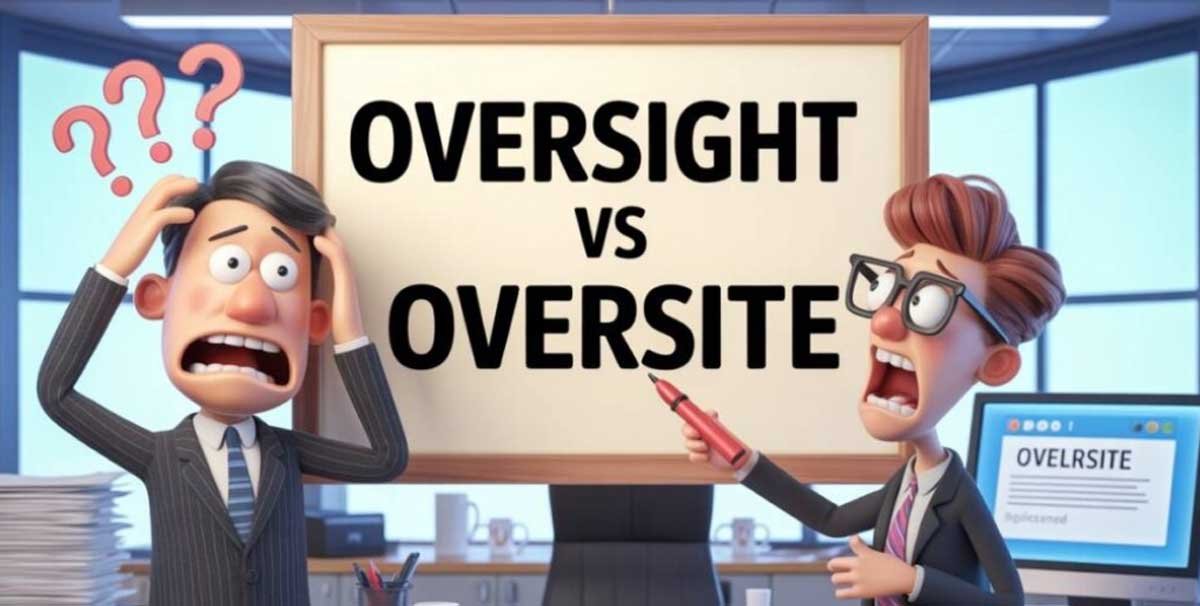
“Oversight” is the correct spelling in modern English, carrying two distinct meanings: supervision and monitoring on one hand, an unintentional mistake or omission on the other. “Oversite” is overwhelmingly a misspelling, though it survives in exactly one narrow construction-industry context where it refers to a concrete base layer poured over a building site. In professional, academic, and everyday writing, the word you want is “oversight” virtually every time.
Mixing these two up is more common than most people admit. They’re perfect homophones, identical when spoken aloud. “Site” is a legitimate English word that appears everywhere from web addresses to construction signage, which makes “oversite” look plausible on the page.
Spellcheck doesn’t always catch it, especially in documents where the word “site” appears legitimately in other sentences. The gap between “looks right” and “is right” is where credibility gets damaged, sometimes in ways you won’t notice until someone else points it out.
What Oversight Actually Means
Oversight is a noun with two accepted definitions, and which one applies depends entirely on context. The first, and older, meaning is the act of watching over, supervising, or monitoring something.
Congressional oversight of federal agencies. Regulatory oversight of financial markets. A senior editor providing oversight on a manuscript before it goes to print. Merriam-Webster dates this sense to the 15th century, rooted in the Old English concept of “looking over” something with authority and responsibility.
The second meaning is almost the opposite: an unintentional failure to notice or do something. A missing footnote in a legal brief. A deadline that slipped through the cracks without anyone flagging it. “The double-booking was an oversight, not malice.” The word has carried this dual identity for centuries, split between watching carefully and failing to watch at all. Only context tells you which one is in play.
Both meanings appear constantly in professional environments. A compliance officer exercises oversight (supervision) over quarterly filings. That same officer realizing they forgot to submit one of those filings is an oversight (mistake). Same word, same spelling, same pronunciation. The tension between the two meanings is one of the reasons the word feels slippery to non-native speakers and, occasionally, to native ones too.
Is “Oversite” a Real Word?
In modern standard English, “oversite” is not a correct alternative to “oversight.” No major dictionary (Merriam-Webster, Oxford English Dictionary, Cambridge, Collins) lists “oversite” as a recognized spelling. Grammar-checking tools flag it. Professional editors strike it on sight. In the overwhelming majority of cases where you see “oversite” in print, it’s an error.
There is one specialized context where “oversite” appears legitimately: construction and civil engineering. In British and Commonwealth building terminology, “oversite concrete” refers to a layer of concrete poured over the ground within a building’s foundation footprint. It’s the base slab that sits beneath the finished floor.
A site supervisor might discuss “laying the oversite” or “checking the oversite before the screed goes down.” This usage derives from “over” plus “site” (literally the concrete that goes over the building site) and has no etymological relationship to “oversight.”
Some grammar websites stretch this construction term into a broader claim that “oversite” means “on-site physical observation.” That’s not accurate. No architect says “I’m doing oversite on the project.” They say “I’m providing oversight” or “I’m doing a site inspection.” Unless you’re a British civil engineer writing specifications for foundation concrete, “oversite” has no place in your document.
Oversight vs Oversite: Side-by-Side Comparison
| Feature | Oversight | Oversite |
|---|---|---|
| Dictionary recognition | Yes, listed in all major English dictionaries | No, absent from standard dictionaries |
| Primary meaning | Supervision and monitoring; also an unintentional mistake | Concrete base layer in foundation work (construction niche only) |
| Professional acceptance | Universal across legal, business, academic, government, and journalism | Narrow: British construction specifications |
| Common phrases | Regulatory oversight, congressional oversight, editorial oversight, an unfortunate oversight | Oversite concrete, laying the oversite (rare, technical) |
| Grammar and spellcheck | Accepted without flagging | Flagged as misspelling in nearly all contexts |
| Etymology | Old English “ofersīon” (to look over, supervise, inspect) | Compound of “over” + “site” (physical location, 20th-century construction jargon) |
| Should you use it in writing? | Yes, always for supervision or error | Only in UK construction specs about foundation concrete |
Why People Confuse These Two Words
The confusion between “oversight” and “oversite” isn’t about ignorance. It’s about how English processes sound. Both words are pronounced identically as /ˈəʊvəsaɪt/ in standard British and American English. When you hear the word spoken, your brain maps it to whichever spelling you’ve seen more recently. For most people, “site” (as in website, construction site, on-site) is a far more frequent visual pattern than “sight” (as in eyesight, insight, oversight).
Spellcheck doesn’t reliably catch this particular error. If you type “oversite” into a document about building inspections or workplace safety, where “site” appears naturally in other contexts, the algorithm may assume you meant what you typed.
Once a misspelling gets published online, it starts propagating. Someone writes “oversite” by mistake. Google indexes the page. Another writer sees it in search results, assumes it’s valid, and uses it themselves. Over months and years, the error spreads across blog posts, forum threads, and social media captions, not because it’s correct but because it’s visible.
Language evolves through usage. But “oversite” hasn’t crossed the threshold from common error to accepted variant. It remains firmly in the misspelling category, and using it in any document where your credibility matters carries a real risk.
“Unfortunate oversight may cost my job – what to do?”
— r/careerguidance, 29 upvotes, 16 comments (2022), source
When the Wrong Spelling Has Real Consequences
The stakes of this mistake scale with the context. In a casual text message, “oversite” might go unnoticed. In a job application, a grant proposal, or a compliance report, it signals something the writer almost certainly didn’t intend: inattention to detail at the sentence level.
Consider the legal field. A contract that references “regulatory oversite” instead of “regulatory oversight” introduces ambiguity. Is the drafter describing a supervision framework, or accidentally inventing a phrase that doesn’t appear in any statute or precedent? Courts interpret contracts based on plain meaning and standard usage.
A word unrecognized by any legal dictionary doesn’t just look unpolished. It creates a foothold for dispute. The same principle applies in regulatory filings, insurance policies, and any document where precision of language has enforceable consequences.
In business communications, the damage is subtler but cumulative. One misspelling doesn’t tank a deal. But a pattern of small errors (an “oversite” in a proposal, a mangled homophone in a follow-up email, an unchecked autocorrect in a client-facing report) erodes the perception of competence.
Readers may not consciously flag each individual mistake, but they absorb the aggregate signal: this person doesn’t proofread. This company doesn’t have an editorial process. This document wasn’t reviewed before it reached me.
“I completely forgot to renew one of the wildcard certs […] Expired on Saturday and I only just renewed it now. No one has noticed or said anything as of yet. Annoying oversight.”
— r/sysadmin, 98 upvotes, 52 comments (2024), source
How to Never Get It Wrong Again
The cleanest mnemonic is a one-word anchor: “sight.” Oversight contains “sight” (as in seeing, watching, looking over), which connects directly to both of its meanings. Supervision requires watching over something. A mistake is something you failed to see coming. “Site” means a physical place. Unless you’re literally writing about concrete poured over a building site, “oversite” has no reason to appear in your writing.
Three practical habits eliminate this error entirely:
- Run a find-and-replace sweep. Before finalizing any important document, search for “oversite” and verify every instance. Is it a typo? Fix it. Is it genuinely about foundation concrete? Leave it. In 99% of cases, the answer is the first one.
- Add “oversite” to your spellchecker as a flagged word. Most word processors support custom flagged terms. Adding “oversite” means it gets a red underline every time it appears, forcing you to pause and confirm whether you actually meant to type it.
- Substitute “over-look” as a mental test. Read the sentence aloud with “over-look” in place of the disputed word. If you meant supervision, it should feel natural: “The committee provides over-look of department spending.” If you meant a mistake: “The missing attachment was an over-look.” If neither works, you might need a different word entirely.
Frequently Asked Questions
Is “oversite” ever correct?
In standard modern English, “oversite” is not a correct spelling of “oversight.” The one legitimate use exists in British construction terminology, where “oversite concrete” refers to a base layer of concrete poured over the ground within a building’s foundation footprint. Outside that narrow technical context, “oversite” is a misspelling and should be replaced with “oversight.”
Why do people confuse oversight and oversite?
The two words are perfect homophones: they sound identical when spoken. The word “site” (as in website or construction site) is far more common in daily writing than the “sight” in “oversight,” leading the brain to default to the more familiar spelling pattern. Spellcheck doesn’t always catch the error, especially in documents where “site” appears legitimately in other contexts.
What does oversight mean in business and legal contexts?
In business and legal contexts, “oversight” typically refers to supervisory review and monitoring: financial oversight, regulatory oversight, board oversight, management oversight. It can also describe an unintentional error or omission, such as an oversight in a budget projection or a missing signature on a contract. Context alone determines which meaning applies, and the distinction is critical in binding documents.
Does Google recognize “oversite” as a word?
Google’s search algorithms treat “oversite” as a variant of “oversight” in most queries, meaning searches for “oversite” typically return results about “oversight.” This algorithmic accommodation should not be confused with linguistic correctness. The fact that a search engine can interpret a misspelling does not make that spelling acceptable in professional, academic, or legal writing.
How can I remember the difference between them?
Link “oversight” to “sight.” Both involve seeing or failing to see. Oversight means either watching over something with authority (supervision) or failing to notice something important (a mistake). “Oversite” with “site” refers to a physical location. Unless you’re specifying foundation concrete on a British construction project, the word you want ends with “sight.”
The Final Word
“Oversite” is not a word you need in your vocabulary unless you pour concrete slabs for a living. “Oversight” is the correct spelling for both of its meanings, careful supervision and careless error alike, in every standard English context from casual email to Supreme Court brief.
The confusion between the two words is understandable given their identical pronunciation, but the fix is straightforward. Sight, not site. Oversight is about what you see, what you watch, and what you miss. Run a five-second find-and-replace before you hit send, and you’ll never hand someone an easy reason to question whether you paid attention to the details that matter.