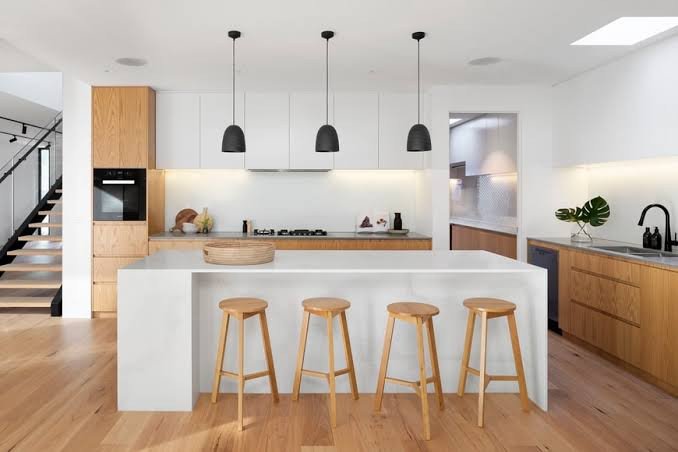
A waterfall kitchen island is the single most photographed feature in luxury kitchen design for the past five years. The look is unmistakable: the countertop material does not stop at the edge of the island. It turns 90 degrees and continues vertically down to the floor, creating a continuous slab of stone that looks like it was poured in place. The effect is dramatic, modern, and expensive — adding $2,000 to $5,000 to the cost of a standard island countertop.
But the waterfall edge is not purely cosmetic. It protects the cabinet side from scuffs, hides the seam where countertop meets cabinet, and makes an island the focal point of the kitchen in a way that no other design element can. It also eliminates seating on the waterfall side, makes electrical outlet placement awkward, and costs enough to fund several other kitchen upgrades. The decision comes down to four variables: budget, kitchen size, design style, and how your household actually uses the island day to day.
“Kitchen with waterfall or no waterfall. We already bought the slabs. Now we’re second-guessing whether the waterfall will make our small kitchen feel even smaller. The stone is gorgeous but we don’t want the room to feel like a cave.”
— r/KitchenDesigns, July 2026 (58 upvotes, 284 comments), source
This question — bought the slabs, now unsure — is exactly the point where most waterfall decisions go wrong. The stone is already paid for. The emotional investment has been made. But a waterfall island in a small kitchen can indeed make the room feel heavier, not grander. The waterfall draws the eye down to the floor, which visually lowers the ceiling and shrinks the perceived volume of the space. In a kitchen under 150 square feet, the waterfall that looked breathtaking in the showroom often becomes the thing that makes the room feel cramped.
What a Waterfall Kitchen Island Actually Is — and What It Replaces
A standard kitchen island has a countertop that sits on top of cabinet boxes. The sides of the island are cabinet panels — typically wood or painted MDF, that match the rest of the kitchen cabinetry. A waterfall island replaces one or both end panels with the same stone material as the countertop, continuing vertically from the horizontal surface down to the floor. The stone is mitered at the corner so the joint is nearly invisible, creating the illusion that the slab bends rather than being two separate pieces joined together.
The waterfall can go on one end of the island or both. A single-sided waterfall, typically on the end facing the living room or entry, gives the dramatic look without doubling the cost. A double-sided waterfall wraps both ends and creates a monolithic appearance, but also doubles the stone cost and eliminates seating or storage on both ends. Most homeowners who choose waterfall do a single side facing the most visible angle.
The Pros, Why Waterfall Islands Command the Premium
Unmatched visual impact. No other kitchen design element creates the same reaction when someone walks into the room. A waterfall island makes the stone the star of the kitchen. The vertical surface shows off the veining, color variation, and depth of the material at eye level in a way that the horizontal countertop surface does not. Light hits the vertical slab differently than the horizontal one, and the visual continuity from countertop to floor is what makes the kitchen photograph like a magazine spread.
Protection for the cabinet ends. The end panels of a kitchen island take abuse. Chair backs bang into them. Shoes scuff them. Vacuum cleaners, mops, and kids’ toys leave marks. A painted cabinet end panel shows wear within a few years in a busy household. A stone waterfall end is essentially indestructible in normal use. It does not scratch, does not show water marks, and wipes clean with a damp cloth. For families with young children or pets, the durability argument is as practical as the aesthetic one.
Seam hiding. On a standard island, the countertop sits on top of the cabinet and a visible seam runs around the perimeter where stone meets wood. That seam collects crumbs and is impossible to clean completely. The waterfall edge eliminates the end seam entirely, the stone flows down to the floor with no horizontal joint to trap debris.
Higher perceived home value. A waterfall island signals to buyers that the kitchen was renovated at a high level. Whether it actually increases appraisal value is debatable, appraisers count square footage and bedroom count, not countertop edge profiles. But in a competitive market, a kitchen with a waterfall island photographs better, shows better, and generates more offers than an identical kitchen without one. The return comes from selling faster, not necessarily selling higher. According to ENERGY STAR, pairing stone upgrades with energy-efficient kitchen appliances can amplify a kitchen’s appeal to buyers who prioritize both aesthetics and long-term utility cost savings.
The Cons, What Nobody Mentions in the Showroom
Cost. The waterfall edge adds $2,000 to $5,000 to the countertop cost depending on the stone and the fabricator. The additional material itself, roughly 10 to 15 square feet of extra slab, accounts for part of it. The bigger cost driver is the fabrication labor. The mitered corner where the horizontal and vertical slabs meet requires a perfectly precise 45-degree cut on both pieces, and the joint is typically reinforced with a metal bracket embedded in the stone. Not every fabricator is willing or able to execute this. The ones who can charge accordingly.
Seating elimination. The waterfall side cannot accommodate bar stools. If the island is designed for seating on three sides, the waterfall reduces it to two. In a kitchen where the island is the primary eating area, losing a seating position to a stone panel is a functional downgrade that costs money instead of saving it.
Electrical outlet challenges. Building code requires outlets on kitchen islands. On a standard island, outlets mount on the cabinet end panels. On a waterfall island, the end panels are stone. Drilling through a waterfall slab to install an outlet box is possible but expensive and irreversible. The alternative is pop-up outlets mounted in the countertop surface, which cost $100 to $300 each versus $5 for a standard outlet and take up usable counter space. If your jurisdiction requires island outlets and your fabricator cannot or will not drill through the waterfall slab, you are looking at pop-ups whether you want them or not.
Permanence. Cabinet end panels can be repainted when tastes change. A waterfall slab cannot. If waterfall islands go out of style in 10 years, and every kitchen trend eventually cycles, removing the waterfall means replacing the entire countertop. There is no painting over it, no refacing it, no budget fix. The commitment is structural.
Flooring conflicts. The waterfall slab sits directly on the finished floor. If the floor is even slightly uneven, the gap between stone and floor will vary across the slab width. A skilled installer can scribe the stone to match the floor contour or fill the gap with color-matched caulk, but this is additional labor. If you plan to replace the flooring in the future, the waterfall slab must either be undercut to accommodate the new floor thickness or the new flooring must stop at the slab edge with a transition strip. Neither is ideal. The waterfall essentially locks in the flooring decision for the life of the countertop.
Material Choice, Which Stones Work and Which Do Not
Quartz is the most common waterfall material and the most practical. It is engineered for consistency, which means the vertical and horizontal pieces match without the variation lottery of natural stone. It is non-porous and requires no sealing. Quartzite, a natural stone that is harder than granite, produces stunning waterfall islands with dramatic veining, but the material cost is higher and the fabrication more demanding. Granite works but the pattern on the horizontal surface rarely matches the vertical cut convincingly unless the slab is selected specifically for waterfall use, the fabricator needs enough continuous material to cut the waterfall piece from the same section of the slab as the island top. Marble is the riskiest choice for a waterfall island. It etches from acidic spills and scratches more easily than quartz or granite. A vertical marble surface near the floor will collect scuff marks from shoes and cleaning tools that a horizontal countertop would never encounter.
| Material | Waterfall Suitability | Cost per Sq Ft (Installed) | Durability on Vertical Surface |
| Quartz (Engineered) | Excellent, best color match | $60–$120 | Very high, non-porous |
| Quartzite (Natural) | Excellent, dramatic veining | $80–$150 | High, harder than granite |
| Granite | Good, pattern matching harder | $50–$100 | High, needs sealing |
| Marble | Risky, etches and scratches | $70–$140 | Low on vertical, scuffs easily |
| Porcelain Slab | Good, lightweight, consistent | $50–$90 | Very high, non-porous |
The Real Cost Breakdown of a Waterfall Island
A standard island countertop for a 5-foot by 3-foot island costs roughly $1,500 to $3,000 in quartz, installed. Adding a single-sided waterfall adds $2,000 to $3,500. Adding double-sided waterfall adds $3,500 to $5,000. The premium covers the extra slab material, the mitered edge fabrication, the additional templating and installation labor, and the reinforcement bracket. The cost is not linear, a $3,000 countertop with a waterfall does not become a $5,000 countertop. It often becomes a $6,500 countertop because the fabricator’s minimum charge for the waterfall labor is fixed regardless of island size.
Pop-up outlets add $200 to $600 for two units. Floor scribing or leveling adds $200 to $500 if needed. If the existing flooring must be cut back to accommodate the slab thickness, that adds floor repair costs. The waterfall itself is the line item, but the downstream costs, outlets, floor work, lost seating, are what push the total beyond what the initial quote suggests.
When to Choose Waterfall, and When to Skip It
Choose a waterfall island if your kitchen is at least 150 square feet with an open floor plan where the island is visible from the living room or entry. The waterfall makes its strongest case when the island faces the main sightline. Choose it if you are using engineered quartz with strong veining and want to show off the material. Choose it if budget is not the primary constraint and you view the kitchen as a long-term investment in how the home feels rather than a resale optimization exercise.
Skip the waterfall if your kitchen is under 150 square feet, the heavy vertical slab will make the room feel smaller. Skip it if your island is the primary dining surface and you need seating on all sides. Skip it if you plan to replace flooring within 10 years. Skip it if the kitchen style is traditional, farmhouse, or rustic, waterfall edges read as modern and contemporary and clash visually with ornate cabinet details, distressed finishes, and classic moldings. Skip it if you are remodeling primarily for resale within 2 to 3 years, the waterfall premium will not pay back in that timeframe, and the next owner may prefer the flexibility of cabinet ends.
“Finishing up my kitchen island top. Waterfall joints are an absolute pain for something with only one corner in it. Getting the miter tight enough that you can’t see the glue line took three attempts.”
— r/diynz, March 2021 (126 upvotes, 18 comments), source
Waterfall edge fabrication is not a DIY project. The miter requires industrial stone-cutting equipment and experience with the specific material. A visible glue line at the miter is the most common waterfall failure and the most difficult to fix, the only repair is replacing one or both slabs. Choose a fabricator who shows you photos of their previous waterfall work, preferably with close-ups of the miter joints.
Frequently Asked Questions
How much more does a waterfall island cost versus a standard island?
A single-sided waterfall adds $2,000 to $3,500 to the countertop cost. A double-sided waterfall adds $3,500 to $5,000. The cost depends on the stone material, the island size, the fabricator’s minimum charge for mitered edge work, and whether outlet modifications or floor leveling are required. In percentage terms, expect to pay 60% to 100% more for the countertop portion of the island versus a standard flat install with no waterfall.
Does a waterfall island work in a small kitchen?
Generally no. The vertical stone slab visually anchors the island to the floor and draws the eye downward, which makes the ceiling feel lower and the room feel more enclosed. In kitchens under 150 square feet, a waterfall island tends to dominate the space rather than enhance it. A waterfall can work in a small kitchen if the stone is light-colored, the waterfall is single-sided, and the cabinet color is light or matches the stone, all strategies that reduce visual weight. But the safer choice in a small kitchen is standard cabinet ends that blend with the cabinetry.
Is the waterfall island a trend that will look dated?
Waterfall islands have been a mainstream luxury kitchen feature since roughly 2015, which is a decade and counting. That longevity suggests staying power beyond a short-term trend. However, the waterfall look is strongly associated with modern and contemporary design. If kitchen design cycles back toward traditional, ornate, or transitional styles over the next decade, waterfall islands in those settings may read as dated. In a modern or minimalist kitchen, the waterfall edge is likely to remain current because it aligns with the core aesthetic of those styles: clean lines, minimal ornament, and material-forward design.
Can you have seating on a waterfall island?
Yes, but not on the waterfall side. The stone panel extends to the floor, which means bar stools cannot tuck under that end. Seating is limited to the non-waterfall sides. If the island will have a waterfall on one end, seating goes on the opposite end and the long front edge. If the island has waterfalls on both ends, seating is limited to the front edge only. Plan the seating layout before committing to the waterfall design because the waterfall eliminates at least two seating positions.
What happens to the waterfall if I replace the flooring later?
The waterfall slab sits on top of the finished floor. If you replace the flooring, the new flooring must either stop at the waterfall edge (leaving a visible transition strip) or the slab must be lifted, which requires removing and reinstalling the countertop. In practice, most homeowners install new flooring up to the waterfall edge and hide the transition with a color-matched threshold. The better approach is to install the flooring first and the waterfall on top of it, which means making the flooring decision before the countertop is templated.