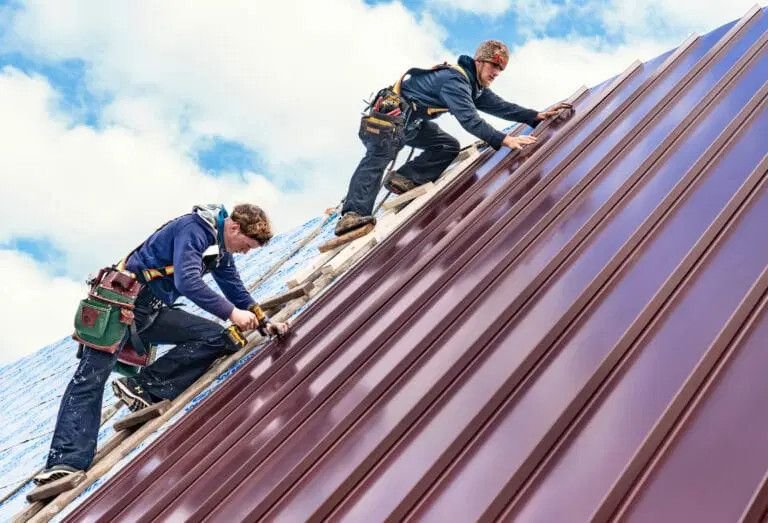
The best metal roofing material for most homes is standing-seam steel — Galvalume-coated steel panels with concealed fasteners, a Kynar 500 or Hylar 5000 paint finish, and a minimum 24-gauge thickness. Standing-seam steel costs $800 to $1,200 per square installed — $16,000 to $24,000 for a 20-square roof. It lasts 40 to 60 years. It requires no maintenance beyond an inspection every 5 to 10 years. It resists winds up to 140 to 180 mph. It is not combustible — a significant advantage in wildfire-prone areas. It reflects solar radiation — reducing cooling costs by 10% to 25% in hot climates — when finished in a light color or a cool-roof coating. The standing-seam steel roof is the default metal roofing choice. The default is the right choice for most homes. The default is standing-seam steel because it balances cost, durability, and appearance more effectively than any other metal roofing option.
Metal roofing is not one product. It is a category of products defined by the metal type, steel, aluminum, copper, zinc, and the panel profile, standing-seam, corrugated, ribbed, metal shingle, metal tile. The metal type determines the cost, the lifespan, and the corrosion resistance. The panel profile determines the appearance and the installation method. The combination of metal type and panel profile is the choice. The choice should match the climate, the architecture, and the budget. Here are the materials and the options.
Metal Roofing Materials, Complete Comparison
Five metals are used for residential roofing, each with a distinct cost, lifespan, and ideal application. Here is the comparison.
| Material | Cost Per Square (Installed) | Lifespan | Best For | Notes |
| Steel, Galvalume (standing-seam) | $800 – $1,200 | 40 – 60 years | Most homes, all climates | Galvalume coating is zinc-aluminum alloy; Kynar paint adds 20+ years to finish life |
| Steel, Galvanized (corrugated) | $400 – $700 | 30 – 50 years | Budget option, agricultural buildings | Exposed fasteners require maintenance; gaskets degrade over time |
| Aluminum | $900 – $1,600 | 40 – 60 years | Coastal areas, saltwater corrosion resistant | Lighter than steel; does not rust; more expensive; softer, dents more easily |
| Copper | $1,500 – $2,500 | 60 – 100+ years | Historic homes, luxury homes | Develops green patina over time; no paint, the patina is the protection; highest cost |
| Zinc | $1,200 – $2,000 | 60 – 100+ years | Modern architecture, luxury homes | Self-healing, scratches fill with patina; naturally weathers to matte gray; malleable |
Metal Roofing Panel Profiles, Appearance and Installation
The panel profile determines the appearance, the fastener type, and the long-term durability. Standing-seam with concealed fasteners is the premium choice for residential roofs.
| Profile | Cost Per Square (Installed) | Fasteners | Appearance | Best Use |
| Standing-seam (snap-lock) | $800 – $1,200 | Concealed, clips under panels | Clean vertical lines, modern | Residential roofs, modern homes |
| Standing-seam (mechanically seamed) | $1,000 – $1,500 | Concealed, clips under panels; seams are field-crimped | Clean vertical lines, most weather-tight | Low-slope roofs, high-wind areas, commercial |
| Corrugated (exposed fasteners) | $400 – $700 | Exposed, screws through panels | Ribbed, traditional rural/agricultural | Budget residential, outbuildings, barns |
| Metal shingle or metal tile | $700 – $1,200 | Concealed or hidden fasteners | Mimics shingle, tile, or slate | Historic districts requiring traditional appearance |
Standing-Seam Steel, the Default Best Choice
Standing-seam steel with a Galvalume coating and a Kynar 500 paint finish is the most commonly installed metal roof on residential homes. The panels are formed on-site or in a factory to the exact length required for each roof slope, eliminating end-lap seams. The panels are connected with concealed clips that allow the metal to expand and contract with temperature changes, steel expands roughly 1/8 inch per 10 feet per 100 degrees of temperature change. The concealed clips absorb the movement. The panels never have exposed fasteners. The concealed fastener system is the reason standing-seam roofs last 40 to 60 years instead of the 20 to 30 years of exposed-fastener roofs. The exposed fastener has a rubber gasket that degrades under UV exposure. The gasket cracks. Water enters through the fastener hole. The decking rots. The roof fails at the fastener, not at the metal. The concealed fastener eliminates the fastener as a failure point. The standing-seam roof is a roof without exposed fasteners. The roof without exposed fasteners lasts twice as long as the roof with them.
The Kynar 500 or Hylar 5000 paint finish is the standard for premium standing-seam roofs. The finish is a PVDF, polyvinylidene fluoride, coating that resists fading, chalking, and UV degradation for 30 to 40 years. A standing-seam roof with a Kynar finish will not need to be painted during its service life. A roof with a polyester or siliconized polyester finish, common on exposed-fastener panels, will fade and chalk within 10 to 15 years and will need to be painted. The Kynar finish is the upgrade. The upgrade costs $150 to $300 per square, $3,000 to $6,000 for a 20-square roof. The upgrade eliminates the cost of painting the roof during its service life. The painting costs $3,000 to $6,000 for a professional application. The upgrade is the same cost as the future painting. The upgrade is paid now. The painting is paid in 15 years. Pay now or pay later. The price is the same. The upgrade is the better deal, the roof never needs painting. The painting is the maintenance. The maintenance is the reminder that the roof was not upgraded. The upgrade is the freedom from the reminder. The freedom is the Kynar finish.
The National Roofing Contractors Association (NRCA) provides guidance on metal roofing systems including standing-seam steel. The NRCA notes that proper installation is as important as the material choice, a correctly installed standing-seam roof will perform for decades. An incorrectly installed roof will fail at the panel seams regardless of the quality of the metal. The contractor’s experience with metal roofing is the variable. The variable is the installation quality. The variable determines whether the roof lasts 40 years or leaks in 5. The variable is the reason to hire a contractor who specializes in metal roofing, not a contractor who installs metal occasionally.
Aluminum and Copper, the Premium Metals
Aluminum is the correct choice for coastal properties. Saltwater spray corrodes steel, the Galvalume coating protects for years, but the salt will eventually find a scratch, a cut edge, or a seam and begin to corrode the steel. Aluminum does not rust. Aluminum will develop a thin oxide layer that protects the metal underneath. The oxide layer is white, it will show as a chalky surface on an unpainted aluminum panel. Painted aluminum, with a Kynar finish, resists corrosion and fading. Aluminum costs $900 to $1,600 per square, 15% to 30% more than steel, and is the premium choice for any property within 10 miles of a saltwater coast. The salt is the enemy. The aluminum is the defense. The steel is the alternative. The alternative will corrode. The aluminum will not. The aluminum is the coastal choice.
Copper is the most expensive metal roofing material and the longest-lasting. A copper standing-seam roof costs $1,500 to $2,500 per square, $30,000 to $50,000 for a 20-square roof, and lasts 60 to 100 years or more. Copper develops a green patina, verdigris, over the first 10 to 30 years of exposure. The patina is a protective layer of copper carbonate that seals the metal from further corrosion. The patina is the desired aesthetic. The copper roof is installed for the patina, not for the shiny penny color that fades within the first year. The copper roof is the statement. The statement is the color. The color is the green. The green says the roof is copper. The copper says the house is worth the roof. The statement is visible from the curb. The statement is permanent.
Frequently Asked Questions
What is the best metal roofing material for a house?
Standing-seam steel with a Galvalume coating and a Kynar 500 paint finish is the best metal roofing for most homes. It balances cost, $800 to $1,200 per square installed, with a 40- to 60-year lifespan and low maintenance. Aluminum is the best choice for coastal properties where saltwater corrosion is a concern. Copper is the best choice for historic or luxury homes where the budget allows.
How much does a metal roof cost compared to asphalt shingles?
A standing-seam steel roof costs $16,000 to $24,000 for a 20-square roof, roughly double the cost of architectural asphalt shingles at $9,000 to $15,000. The metal roof lasts two to three times as long, the per-year cost is lower for metal. The metal roof is the better financial decision for a homeowner who will stay in the home for 20 years or more. The asphalt roof is the better financial decision for a homeowner who will sell within 10 to 15 years.
Is a metal roof noisy when it rains?
No, when installed over a solid roof deck with underlayment. The noise of rain on a metal roof over an open-frame structure, a barn, a pavilion, is loud because the metal is the only surface between the rain and the interior. A metal roof over a residential roof deck, OSB or plywood with an underlayment, is no louder than an asphalt shingle roof. The deck and the underlayment absorb the sound. The metal is the surface. The deck is the sound barrier. The house is quiet.
Does a metal roof increase home value?
A metal roof adds roughly $8,000 to $12,000 to the resale value, roughly 60% to 70% of its cost. The value comes from the longevity, the buyer knows they will not need to replace the roof, and the appearance, the metal roof distinguishes the house from neighboring houses with asphalt shingles. The distinction is the curb appeal. The curb appeal is the value. The value is the metal roof.
Can a metal roof be installed over existing asphalt shingles?
Yes, in many cases, a metal roof can be installed over a single layer of asphalt shingles. The shingles provide a flat substrate. The metal panels are installed on furring strips over the shingles. The tear-off cost is eliminated, saving $2,000 to $4,000. The condition is that the existing shingles must be in good condition, no curling, no granule loss, no soft decking, and the roof structure must be able to support the metal plus the shingles. The overlay is the cost savings. The savings are available only if the existing roof is sound.
What maintenance does a metal roof require over its lifespan?
A standing-seam metal roof requires an inspection every 5 to 10 years to check for loose fasteners at the ridge caps, debris accumulation in the valleys, and any damage from falling branches or severe storms. An exposed-fastener roof requires an inspection every 2 to 3 years, the rubber gaskets on the fasteners degrade and must be replaced periodically. The maintenance difference is the fastener exposure. The exposed fastener requires maintenance. The concealed fastener does not. The concealed fastener is the lower-maintenance choice.
The Metal Roof That Outlasts the Mortgage
Standing-seam steel. Galvalume coating. Kynar 500 paint finish. Concealed fasteners. A 20-square roof costs $16,000 to $24,000 installed. The roof lasts 40 to 60 years. The roof requires no maintenance beyond an inspection every 5 to 10 years. The roof resists wind, fire, and solar heat gain. The roof is the last roof you will buy for this house. The roof outlasts the mortgage. The roof is the permanent choice.
If the house is within 10 miles of a saltwater coast, choose aluminum. The aluminum costs more and lasts as long as steel, without the corrosion. If the house is historic and the budget allows, choose copper. The copper costs the most and lasts the longest. The copper develops a green patina that is the visual signature of a copper roof. If the budget is tight and the house is a budget remodel or an outbuilding, choose an exposed-fastener corrugated steel panel. The panel costs $400 to $700 per square, the least expensive metal roof. The exposed fasteners are the maintenance. The maintenance is the gasket replacement every 10 to 15 years. The maintenance is the cost of the budget. The budget is the savings now. The savings are the trade-off for the maintenance later. The trade-off is the exposed fasteners. The fasteners are the reminder that the budget was the priority. The budget roof protects the building. The budget roof requires maintenance. The maintenance is the reminder. The standing-seam roof requires no reminder. The standing-seam roof is the default. The default is standing-seam steel. The default is the right choice for most homes.