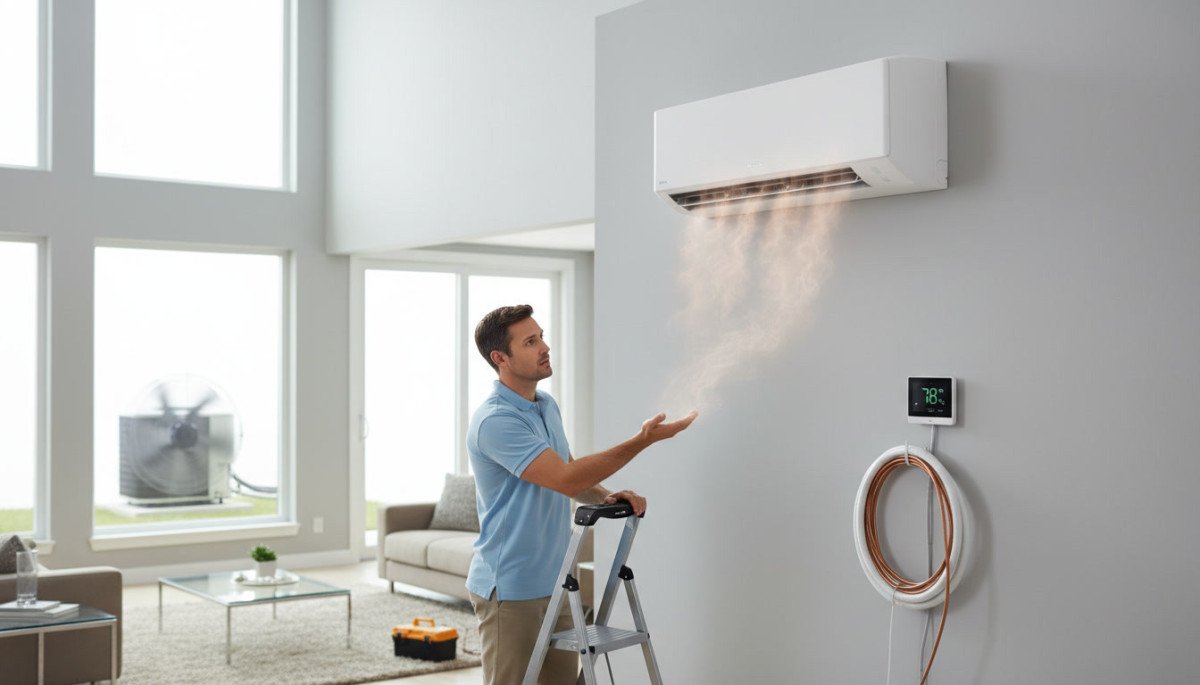
An air conditioner that blows warm air instead of cold is an air conditioner that is running but not cooling. The blower is moving air. The outdoor unit may be humming. But the air coming out of the registers is room temperature or warmer. Somewhere in the refrigeration cycle, heat is not being removed from the indoor air. The cause is almost always one of five things, ranked from the simplest to check to the one that requires a technician: the thermostat is set incorrectly, the outdoor condenser unit is not running, the condenser coil is dirty and cannot reject heat, the system is low on refrigerant, or the compressor is not running because of a failed capacitor. The diagnostic order is from the thermostat to the outdoor unit.
The distinction between warm air that is room temperature and warm air that is actually hot is important. Air that is room temperature, the same as the air in the house, means the compressor is not running at all or the refrigerant is so low that no cooling is happening. The AC is a fan moving indoor air around. Air that is slightly cool but not cold, a few degrees below room temperature, means the compressor is running but the system is not operating at full capacity. The condenser may be dirty, the filter may be restricting airflow, or the refrigerant may be partially low. The degree of cooling tells you whether the compressor is running and whether the refrigeration cycle is working at all.
EPA WaterSense encourages homeowners to maintain their appliances and systems for efficient operation. An AC that is blowing warm air is wasting electricity without providing comfort. Diagnosing and fixing the cause saves both energy and money.
Cause #1: Thermostat Set Incorrectly
The thermostat must be set to “Cool” for the AC to run. A thermostat accidentally set to “Heat,” “Off,” or “Fan Only” will not activate the compressor. Check the mode setting. Set it to “Cool.” Set the temperature several degrees below the current room temperature. The thermostat should click, the blower should start, and the outdoor unit should start within a minute or two. If the thermostat is set correctly and the outdoor unit does not start, the problem is at the outdoor unit.
Check the fan switch. If the fan is set to “On” instead of “Auto,” the blower runs continuously. If the thermostat is not calling for cooling, the blower is circulating unconditioned air. The air feels warm because it is not being cooled. Set the fan to “Auto.” The blower will run only when the AC is actively cooling. This is a five-second fix that is the cause of warm air more often than any other.
Cause #2: The Outdoor Unit Is Not Running
If the indoor blower is running but the outdoor unit is silent, the compressor and the condenser fan are not operating. Without the outdoor unit, the AC is a fan. No cooling can happen. The outdoor unit may not be running because the circuit breaker has tripped, the disconnect switch at the outdoor unit is turned off, or a safety switch in the system has been triggered.
Check the circuit breaker for the AC in the main electrical panel. The AC typically has a double-pole breaker, 30 to 60 amps. If the breaker is tripped, reset it by turning it fully off and then fully on. If the breaker trips again immediately, there is a short circuit in the system that requires a technician. Do not reset the breaker repeatedly. Each reset stresses the wiring and the breaker.
Check the disconnect switch at the outdoor unit. The disconnect is a metal or plastic box mounted on the wall next to the unit. It contains a pull-out handle or a switch. If the handle has been pulled out or the switch is in the off position, the unit has no power. Push the handle in or turn the switch on. The disconnect may have been turned off for maintenance and not turned back on.
If the breaker and the disconnect are both on and the outdoor unit is still not running, the contactor, the electrical relay that turns the unit on when the thermostat calls for cooling, may have failed. The contactor is inside the outdoor unit and should be diagnosed and replaced by a technician.
Cause #3: Dirty Condenser Coil
The condenser coil in the outdoor unit rejects heat from the refrigerant to the outside air. When the coil is packed with dirt, leaves, grass clippings, cottonwood fluff, or pet hair, it cannot reject heat efficiently. The refrigerant stays warm. The indoor coil absorbs less heat. The air coming out of the registers is cool but not cold. The AC runs continuously but the house does not cool down. The compressor works harder and runs hotter because the head pressure in the system is elevated.
Clean the condenser coil. Turn off power at the disconnect switch. Remove the protective grille or the top of the unit to access the coil. Spray the coil from the inside out with a garden hose and a nozzle set to moderate pressure. Do not use a pressure washer. Pressure washer spray will bend the aluminum fins flat and permanently reduce the coil’s ability to transfer heat. If the coil is greasy or coated with a film that water alone cannot remove, use a commercial condenser coil cleaner. Spray the cleaner on, let it foam, and rinse it off according to the product instructions. Clean the coil annually as part of AC maintenance.
Cause #4: The Compressor Is Not Starting — Failed Capacitor
The compressor requires a capacitor to start. The start capacitor provides the extra electrical boost needed to get the compressor motor turning. When the capacitor fails, the compressor hums, draws high current for a few seconds, and then trips its thermal overload protector. The outdoor fan may continue to run. The compressor never starts. The air is warm because no refrigerant is being compressed and no cooling cycle is happening.
A failed capacitor is the most common reason a compressor will not start. The capacitor is a cylindrical component inside the outdoor unit, connected to the compressor by wires. It has a limited service life, typically five to ten years. A failing capacitor may bulge at the top or leak a small amount of oil. A technician can test the capacitor with a multimeter and replace it if it is out of specification. A new capacitor costs $20 to $50. The labor to replace it costs $150 to $300 because the technician must disassemble the outdoor unit to access the capacitor and discharge the old one safely. A capacitor stores electricity and can deliver a dangerous shock even when the power is off. Capacitor replacement is not a DIY repair unless you are trained in safely discharging capacitors.
Cause #5: Low Refrigerant
Low refrigerant produces air that is cool but not cold. The compressor is running. The outdoor unit is running. The indoor blower is running. The air is slightly cooler than room temperature but nowhere near the 15 to 20 degrees cooler than return air that a properly functioning AC should deliver. The refrigerant level is low because there is a leak. An AC does not consume refrigerant. If the level is low, the refrigerant escaped through a leak.
The symptoms of low refrigerant are similar to a dirty condenser coil: reduced cooling, long run times, the house not reaching the set point. The difference is that cleaning the coil fixes a dirty coil and does nothing for low refrigerant. If the coil is clean and the cooling is still weak, call a technician for a refrigerant diagnosis. The technician measures the pressures on the high and low sides of the system. Low pressure on the low side with normal or low pressure on the high side indicates a low charge. The leak must be located and repaired before the system is recharged. The repair cost is $300 to $1,500 depending on the location of the leak. An R-22 system is more expensive to recharge. A system more than 10 years old that needs an expensive refrigerant repair may be a candidate for replacement.
Frequently Asked Questions
Why does my AC blow cool air at first and then warm air?
The coil is freezing. The air is cool at first because the coil is cold. As ice builds up on the coil, airflow is restricted and the air warms. Eventually the ice blocks airflow completely and the air is room temperature. The coil freeze is caused by a dirty filter, low refrigerant, or restricted airflow. Turn the AC off to let the ice melt. Replace the filter. If the coil freezes again, call a technician.
Why is the outdoor fan running but the compressor is not?
The compressor start capacitor has likely failed. The fan and the compressor are separate motors with separate capacitors in most units. The fan capacitor may still be functional while the compressor capacitor has failed. The compressor hums and trips its overload. The fan continues to run. Call a technician to test and replace the capacitor.
Why is only one room blowing warm air?
If the rest of the house is cool and one room is warm, the problem is not the AC. It is the ductwork serving that room. The duct may be disconnected, crushed, or leaking. The damper in the duct may be closed. The register may be blocked by furniture. Check the ductwork in the attic or basement serving the warm room. A duct that has come apart at a joint dumps conditioned air into the attic instead of the room.
The Bottom Line
An AC blowing warm air is caused by the thermostat set incorrectly, the outdoor unit not running, a dirty condenser coil, a failed compressor capacitor, or low refrigerant. Check the thermostat first. Check that the outdoor unit is running. Clean the condenser coil. If the compressor hums but does not start, the capacitor has likely failed. If the cooling is weak but the compressor is running, the refrigerant may be low. Most of these fixes, thermostat, breaker, disconnect, and coil cleaning, are within the ability of a homeowner. Capacitor replacement and refrigerant repair require a technician. The diagnostic order from the thermostat to the refrigerant narrows the cause quickly. The fix is usually simpler than the warm air makes it seem.