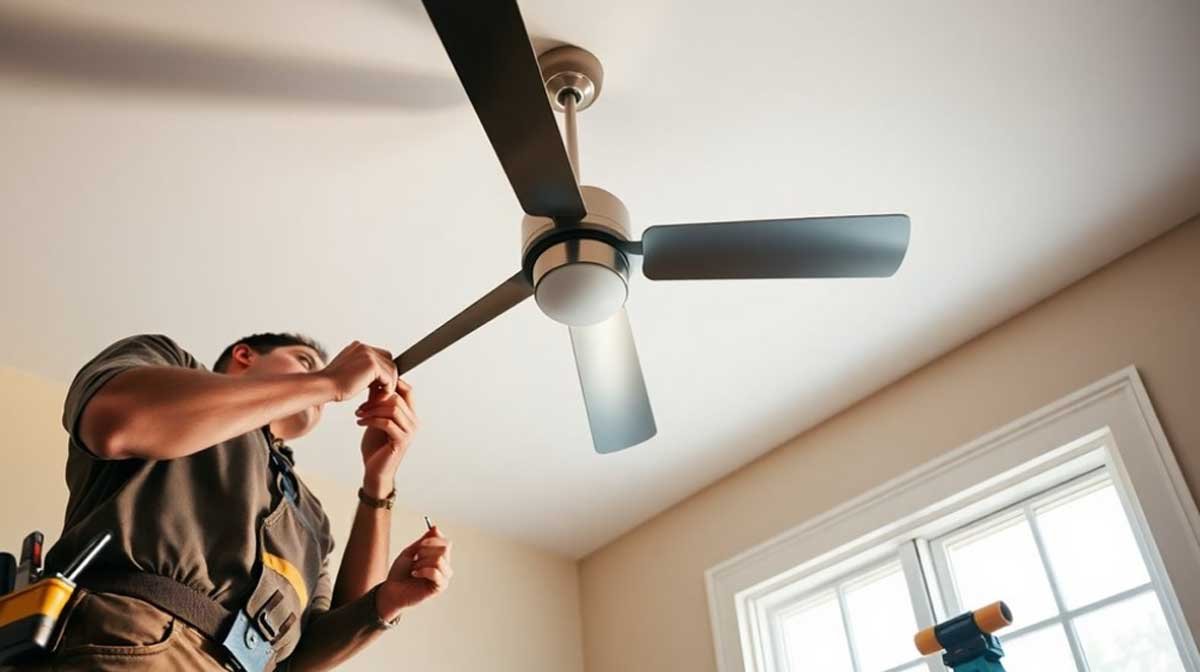
If you are asking how much is it to install a ceiling fan, the short answer is about $150 to $350 in labor for a straightforward replacement, says property management Alexandria VA, and roughly $250 to $800 all-in once the fan itself is included. If the room needs new wiring, a fan-rated box, high-ceiling access, or outdoor-rated hardware, the installed cost can climb into the $400 to $1,000 range or more.
That spread sounds wide until you look at what contractors are actually pricing. Taskrabbit’s May 2026 cost guide says ceiling fan work on its platform starts from an average of $44 per hour, while Triple-O Heating, Cooling, Electrical & Plumbing lists basic installs with existing wiring at $100 to $200 and more complex setups at $250 to $800 depending on wiring, ceiling type, and smart features.
The expensive surprise is usually not the fan. It is the moment a simple fixture swap turns into real electrical work.
| Scenario | Typical installed cost | What usually drives it |
|---|---|---|
| Replace an old fan with a similar new one | $150 to $350 labor, often $250 to $600 all-in | Existing wiring and a fan-rated box keep labor down |
| Replace a light fixture with a fan | $200 to $500 labor, often $300 to $750 all-in | Box upgrades, balancing, and switch compatibility |
| Install a fan where none existed before | $400 to $1,000+ | New wiring, support box, wall switch work, patching |
| Vaulted, high, or outdoor ceiling | $300 to $800+ labor depending on setup | Access difficulty, downrods, adapters, weather-rated parts |
How much is it to install a ceiling fan on average?
A normal ceiling fan install lands in two different bands: install-only labor is often around $150 to $350 for an easy swap, while the total project usually reaches $250 to $800 once the fan and accessories are added. The lower end belongs to existing-wiring replacements; the higher end shows up when the electrical setup is not ready for a fan.
Taskrabbit’s updated May 1, 2026 pricing guide says ceiling fan installation sits inside its Electrical Help category at an average of $44 per hour, with invoice totals in major cities often clustering around $132 to $155 for straightforward work. Triple-O’s 2026 breakdown is more scenario-specific: $100 to $200 for a basic install with existing wiring, $250 to $500 when new wiring or a support box is required, $300 to $600 for vaulted-ceiling work, and $400 to $800 for premium or smart-fan setups.
Hunter Fan’s installation guide adds another useful framing point: professional installation alone often runs about $60 to $250 before you even count the fan. A fan swap looks like a decor change, but the invoice behaves like electrical work.
| Price layer | Low end | Common range | Upper range |
|---|---|---|---|
| Labor only | $100 to $150 | $150 to $350 | $500+ |
| Fan purchase | $89 to $150 | $150 to $400 | $500 to $1,000+ |
| Accessories | $0 to $20 | $20 to $75 | $100+ |
| Total installed project | $250 to $350 | $350 to $800 | $1,000+ |
What makes the price go up fast
The quote jumps fastest when the electrician finds missing wiring, a box that is not rated to hold a spinning fan, a high or sloped ceiling, or a fan with extra controls and lighting. Those details add labor time, specialty parts, and sometimes code-upgrade work all at once.
Taskrabbit’s factor list is a good map here: ceiling height, accessibility, new versus existing wiring, indoor versus outdoor placement, and local labor rates all move the bill. Triple-O makes the same point in plainer pricing bands, and Hunter adds accessory costs such as downrods, which it says usually run about $10 to $75, plus about $37 for a sloped-ceiling adapter when needed.
A fan-rated electrical box is a ceiling box designed to support the weight and vibration of a motorized fan. A downrod is the metal extension that lowers the fan to the correct height in a taller room.
| Cost driver | Why it matters | Likely pricing effect |
|---|---|---|
| Existing wiring | If power and a switch are already in place, the job is mostly replacement labor. | Keeps the quote near the low end. |
| Fan-rated electrical box | A light-fixture box is not always safe for a motorized fan. | Adds material and electrician time. |
| Ceiling height or slope | Access slows down mounting, balancing, and wiring. | Common reason a quote jumps from basic to mid-range. |
| Outdoor or damp-rated install | Weather-rated hardware and location difficulty raise complexity. | Often prices closer to the upper range. |
| Smart controls or integrated lighting | Extra setup, pairing, receivers, and wiring checks take time. | Can push a simple job into premium pricing. |
On paper, replacing a light fixture with a fan sounds simple. In practice, that is exactly where hidden electrical-box and switch-leg problems tend to appear.
Labor cost versus the price of the fan
The final bill is really two purchases stacked together: the fan you buy and the labor needed to make that fan safe, balanced, and code-compliant. In many homes, labor decides the quote more aggressively than the fan itself.
Hunter says many of its fans start around $89 and can go well beyond $1,000, with a large middle band below $400. That matters because someone shopping a $129 fan often assumes the project will stay cheap, but labor alone can still run $150 to $350 for a standard install and more if the room needs electrical correction.
| Component | Typical range | Notes |
|---|---|---|
| Budget fan | $89 to $150 | Basic indoor models with fewer features |
| Mid-range fan | $150 to $400 | Most homeowners end up here |
| Premium or smart fan | $400 to $1,000+ | Integrated lighting, smart controls, designer finishes |
| Downrod or slope adapter | $10 to $75, plus about $37 for some sloped setups | Needed mostly for high or angled ceilings |
The part that catches people is that the fan is the visible purchase, while labor is the invisible one. The second number is usually the one that decides whether the job still feels reasonable.
When the cheapest range is realistic
The low end is realistic only when you are replacing an existing fan or swapping in a new unit where the wiring, fan-rated box, and wall controls are already suitable. If the installer can remove the old unit, mount the new one, connect matching wires, and balance the blades, the job tends to stay near the cheaper band.
Taskrabbit’s average invoice totals can look modest in simple markets and simple rooms because the quote stays small when the electrician is not doing discovery work. A clean replacement in a room with standard ceiling height is the version most homeowners picture, and it is also the one most cost guides quietly assume.
The pressure point is uncertainty. Once the canopy comes down and the installer finds the wrong box or awkward switch wiring, the bargain version of the job usually disappears.
- Existing fan or fan-rated box is already in place.
- No new wall switch, new circuit, or new wiring path is needed.
- The ceiling is standard height and easy to access.
- The fan is an indoor model with no unusual controls.
- No drywall repair or painting is needed after the electrical work.
When installation gets expensive
Ceiling fan installation gets expensive when the job crosses from replacement into modification. New wiring, code upgrades, high ceilings, outdoor exposure, older-house surprises, or a switch from a light fixture to a motorized fan can move the project far beyond the quick-swap price range.
The biggest red flag is older electrical infrastructure. The Environmental Protection Agency notes that homes built before 1978 can trigger lead-safe renovation requirements if the work disturbs painted surfaces, and that can change prep practices and who you hire. Even when lead rules do not apply, older homes are the ones most likely to hide undersized boxes, awkward switch wiring, or circuits that need correction before a fan goes up.
A light-to-fan conversion is a project where an existing light fixture location is upgraded to carry a ceiling fan safely. That distinction matters because the hardware above the canopy often determines the labor below it.
| Higher-cost scenario | Why it costs more | Common outcome |
|---|---|---|
| No existing wiring | New cable runs, switch work, and wall or ceiling access | $400 to $1,000+ is common |
| Replacing a light fixture | The old box may not support fan vibration and weight | Basic quote turns into an upgrade quote |
| Vaulted or very high ceiling | Extra ladder time, downrods, adapters, slower balancing | Often moves into mid or upper range |
| Outdoor patio or damp location | Weather-rated parts and access constraints | Premium labor and hardware pricing |
| Old home with electrical issues | Correction work appears before installation even starts | Quote becomes part repair, part install |
A cheap fan can end up attached to an expensive afternoon. The motor is not the risky part. The ceiling above it is.
DIY versus hiring an electrician
DIY is cheapest only when the job is a true replacement and you already know the box, bracket, wiring, and switch setup are correct. Hiring an electrician costs more in cash, but it sharply reduces the risk of wobble, wiring errors, unsupported mounting, or a fan that looks fine until it starts moving.
Hunter says a typical professional install can take from about one hour to more than two and a half hours depending on the setup. That is useful because time is really what you are buying: safe mounting, correct wiring, blade balancing, and someone else dealing with the part of the project that happens overhead on a ladder.
The risk shifts here. DIY stops being a money saver the moment the project needs correction instead of replacement.
| Approach | Best fit | Main upside | Main downside |
|---|---|---|---|
| DIY | Simple replacement where all hardware is already appropriate | Lowest cash cost | You absorb the safety and troubleshooting risk |
| Handyman or platform help | Basic swaps in newer homes | Lower cost than a licensed electrician in some markets | Scope may narrow quickly if wiring issues appear |
| Licensed electrician | New wiring, old homes, switch changes, vaulted ceilings | Best fit for code and safety issues | Higher hourly rate |
A five-minute estimate that gets close
You can get surprisingly close to a real number by separating the project into three buckets: labor, fan price, and accessories or corrections. Most bad estimates happen because homeowners price the fan and forget the electrical conditions around it.
The pressure point is timing. If the installer has to stop and source a fan-rated box, new switch hardware, or a slope adapter, the project stops behaving like a quick visit and starts behaving like a repair job.
- Decide whether this is a replacement, a light-fixture conversion, or a brand-new location.
- Estimate labor first: use about $150 to $350 for an easy swap, $200 to $500 for a light-to-fan conversion, and $400 to $1,000+ if new wiring is likely.
- Add the fan itself. A practical working range is $89 to $400 for many common indoor fans, with premium or smart models going much higher.
- Add accessories such as downrods, slope adapters, upgraded controls, or wall-patch repair.
- Ask one blunt question before approving the quote: is the existing box already rated for a ceiling fan?
If you only remember one shortcut, use this one: installed ceiling fan cost equals labor reality plus hardware reality, not just the sticker on the box.
When reviewing the electrical conditions around your new fixtures, it is also an ideal time to check on the performance of your home’s larger climate components. Ensuring that your household ventilation and wiring support efficient cooling can protect your initial investment from unexpected seasonal wear. Homeowners can read more about balancing their property’s complete thermal network by tracking electrical usage alongside their cooling setup.
Questions to ask before you book
The best way to control cost is to remove ambiguity before the electrician arrives. A solid quote should tell you exactly what is included, what assumptions are being made about the wiring and box, and what would trigger a price change.
- Does this price assume the existing electrical box is already fan-rated?
- Is this a replacement price only, or does it include converting a light fixture to a fan?
- Are downrods, slope adapters, remote setup, and wall-control changes included?
- Will drywall patching or paint touch-up be extra if new wiring is needed?
- Do local permit or inspection requirements apply to this scope?
A cheap quote is not always a low quote. Sometimes it is just an incomplete one.
Frequently asked questions
How much does an electrician charge to install a ceiling fan?
An electrician often charges about $150 to $350 for a basic ceiling fan replacement, though complex setups can run much higher. Market, ceiling height, wiring condition, and whether the box is already fan-rated usually decide where your quote lands.
Is it cheaper to replace an existing fan than add a new one?
Yes, replacing an existing fan is usually much cheaper than adding a new ceiling fan where none existed before. Existing wiring and a suitable mounting box remove the most expensive part of the job. When homeowners choose to add a fan to a room that was not originally wired for one, the project requires a more comprehensive electrical approach. This often involves running new lines through the ceiling and walls to ensure the fixture has a dedicated power source and proper switch controls. Relying on professional wiring and rewiring services during this phase is essential for maintaining safety and meeting local building codes. By updating the underlying infrastructure, you ensure that the new fan operates reliably without overloading existing circuits or creating potential hazards behind the drywall.
Can you put a ceiling fan where a light fixture is?
Yes, but only if the electrical box is rated to support a ceiling fan and the wiring setup is appropriate. A light-to-fan conversion often costs more than a simple fan replacement because the old hardware may not be safe for a motorized fixture.
How long does it take to install a ceiling fan?
A straightforward installation often takes about one to two and a half hours, while new wiring or difficult ceilings can take longer. Time rises quickly when the installer has to correct old hardware before mounting the fan.
What is the cheapest way to lower the installation bill?
The cheapest safe savings usually come from choosing a simple replacement job and confirming the box, switch, and wiring are already suitable. Cutting labor uncertainty is more effective than chasing the absolute cheapest fan.
For most homes, a realistic answer to how much is it to install a ceiling fan is a few hundred dollars for a clean replacement, with the number rising fast if the ceiling needs electrical work, special hardware, or difficult access. The safest estimate is the one that treats the fan as only part of the project, not the whole project.
Future-Proofing Your Electrical System
As residential energy needs continue to evolve, homeowners are looking beyond standard fixtures to support more advanced technology. Integrating high-capacity circuits during a remodel can simplify the transition to newer sustainable solutions. For instance, many families are now prioritizing EV charger installation for Vineyard homeowners to ensure their properties remain functional as electric vehicle adoption grows. By addressing these infrastructure needs early, you can avoid the higher costs associated with separate, reactive electrical upgrades later on. These proactive improvements help maintain a home’s long-term value while providing the necessary power for modern lifestyle demands.
Source: Taskrabbit ceiling fan installation cost guide
Source: Hunter Fan installation cost guide
Source: EPA Renovation, Repair and Painting program