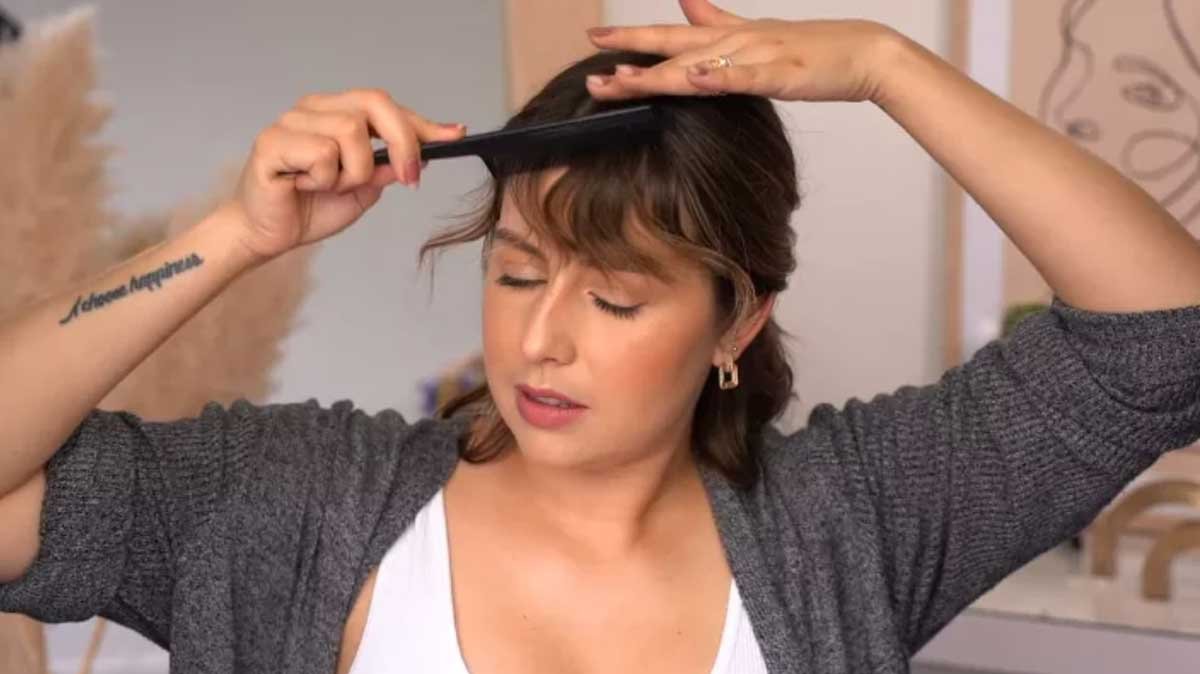
How to style curtain bangs well comes down to one move: direct the fringe forward first, then sweep it away from the face while it cools. That order creates the soft bend at the cheekbone instead of a stiff flip, a split gap, or two pieces that fall straight into your eyes.
The cut looks effortless only after the roots are trained. A round brush, blow-dryer brush, flat iron, roller, or diffuser can all work, but the method changes with hair texture, length, cowlicks, and how much time you have before leaving the house.
The 5-Minute Round-Brush Method
The most reliable way to style curtain bangs is to dampen the fringe, blow-dry it forward over the forehead, roll the ends back and away from the face, then let the hair cool before parting it. Cooling matters because warm hair still changes shape.
Start with damp bangs, not soaking wet hair. Mist only the front section if the rest of your hair is already dry. If someone asks how to style curtain bangs at home, this is the step they usually miss: comb the bangs straight forward so the middle part disappears for a moment, then place a small or medium round brush under the roots.
- Point the dryer nozzle down the hair shaft to reduce frizz.
- Lift the bang section forward and slightly up with the brush.
- Roll the brush backward once the roots feel dry.
- Angle the brush toward the side you want the bang to fall.
- Hold the curve for 10 to 20 seconds while it cools.
- Separate the middle with your fingers, not a sharp comb part.
A small brush gives tighter lift near the root; a medium brush gives the relaxed bend most people want from curtain bangs. A 1.25-inch brush suits shorter bangs, while longer cheekbone pieces usually need something closer to 1.5 or 2 inches.
Vogue’s hairstylist-sourced guidance points to the same basic setup: round brush, blow-dryer, light mousse, and a soft bend rather than a hard curl. The useful detail is not the product list. It is the direction: the bang should move away from the face only after the root has been dried into place.
Choose the Right Tool for Your Hair
The best curtain-bang tool depends on the problem you are solving. Use a round brush for lift, a blow-dryer brush for speed, a flat iron for polish, rollers for a no-fuss set, and a diffuser when natural texture matters more than a blown-out swoop.
| Tool | Best For | How To Use It | Common Mistake |
|---|---|---|---|
| Round brush + dryer | Classic swoop, root lift, salon-style shape | Dry forward first, roll back, cool, then split | Starting with the middle part already set |
| Blow-dryer brush | Fast mornings and longer curtain bangs | Sweep each side up and away, then hold until warm roots dry | Using too much tension on fragile front pieces |
| Flat iron | Frizz control, polished ends, short bangs | Clamp lightly, curve away from the face, release before the ends kink | Making a tight C-shape instead of a soft bend |
| Velcro roller | Fine hair, second-day volume, hands-free setting | Roll bangs backward at the root while slightly warm or misted | Removing it before the hair has cooled |
| Diffuser | Wavy or curly curtain bangs | Apply curl cream, twist pieces away from the face, diffuse on low | Brushing curls smooth and losing the pattern |
The American Academy of Dermatology Association advises using lower heat and limiting hot-tool exposure when hair is prone to damage. That is especially relevant for curtain bangs because the same small pieces get restyled more often than the rest of the head.
“They look good, but in your current photo, it doesn’t look like you have done much to style your hair. Just keep in mind that curtain bangs will require styling every single day to look nice. I have had them before and it’s just so much work.”
– r/Hair, January 2026
That Reddit comment is blunt, but it is also the truth behind most curtain-bang regret. The cut is not difficult. It is just visible. If the front two inches of hair are flat, oily, or bent the wrong way, the whole haircut looks unfinished.
Styling Curtain Bangs by Hair Type
Curtain bangs need a different finish on fine, thick, curly, and cowlick-prone hair. Fine hair needs root lift and dry shampoo, thick hair needs controlled tension, curly hair needs pattern preservation, and cowlicks need water plus directional drying.
Fine or Flat Hair
Fine hair should be styled with the lightest product you can get away with. Use a root mist or a pea-size amount of mousse, then blow-dry forward before rolling the brush back. Heavy cream makes fine curtain bangs separate into strings by lunchtime.
If the bangs collapse quickly, set the dry, warm fringe on a Velcro roller while you finish makeup or get dressed. The roller does not have to create a curl. It only needs to hold the root up while the hair cools into a lifted shape.
Thick or Coarse Hair
Thick curtain bangs usually need more section control. Split the fringe horizontally into a top and bottom layer, dry the bottom first, then shape the top layer over it. A single bulky section often flips outward like wings.
Use a smoothing cream only through the mid-lengths and ends. Keep the roots cleaner and lighter so the bangs can move. The front hairline gets touched constantly, so too much product there turns into a greasy frame around the face.
Wavy or Curly Hair
Curly curtain bangs work best when the curl pattern is respected. Wet the section, add a small amount of curl cream, twist the shorter face-framing pieces away from the face, then diffuse on low heat without pulling the curl straight.
For a softer 1970s-style shape, stretch only the root with a dryer and leave the ends textured. That keeps the curtain shape without forcing curls into a smooth blowout every morning. The small detail is patience: curls that look too short while wet often settle better once fully dry.
Cowlicks and Strong Parts
A cowlick cannot be fixed with a dry flat iron alone. Rewet the root, comb the bang section left, right, and forward while blow-drying, then set the final direction. This cross-drying weakens the old growth pattern before you ask the bangs to split open.
Shorter curtain bangs expose cowlicks faster than longer ones. If the front hairline pushes upward or sideways no matter what you do, ask your stylist to keep the shortest piece below the problem area at the next trim.
Refresh Second-Day Curtain Bangs
To refresh curtain bangs, treat them like their own mini hairstyle. Wash or mist just the fringe, dry the roots forward, reset the bend, then finish with a light dry shampoo or texture spray only where the bangs touch the skin.
The fastest reset is the sink method. Clip the rest of your hair back, wet the bang section at the roots, blot with a towel, then repeat the round-brush method. It takes less time than fighting yesterday’s oil, forehead sunscreen, or a pillow crease with more heat. It is also the cleanest answer for how to style curtain bangs when only the front looks messy.
For second-day bangs that are not greasy, mist the roots and wrap the fringe around a Velcro roller for a few minutes. A cool-shot button helps, too. Hair that cools in the right curve holds longer than hair that is brushed flat while still warm.
Dry shampoo should go under the bang section, not sprayed across the visible front like powder on a pastry. Lift the fringe, spray lightly at the root, wait, then tap it through with fingers. The result should feel airy, not chalky.
Mistakes That Make Curtain Bangs Fall Flat
Most curtain-bang problems come from direction, product weight, or skipping the cooling step. If the bangs fall into your eyes, flip too hard, or separate into greasy strands, the fix is usually small and mechanical.
- Drying them already parted: This locks the middle gap in too early. Dry forward first, then split.
- Using a brush that is too small: Tiny brushes make a tight curl instead of a relaxed sweep.
- Skipping heat protection: Front pieces are fragile because they are shorter and styled often.
- Overloading cream or oil: Curtain bangs need movement, so keep rich products away from the root.
- Touching them all day: Fingers transfer oil. By afternoon, the swoop turns into separated pieces.
- Cutting them too short for your routine: Shorter bangs need more daily control, especially with cowlicks.
The most frustrating mistake is trying to make curtain bangs look like a reference photo on a completely different hair texture. A soft curtain shape is adaptable, but straight, fine hair and dense waves will never sit the same without different prep. That is why advice on how to style curtain bangs should always change by texture, not just by trend photo.
“That’s what you got. The difference is your hair isn’t straight like the picture. You also have a different facial structure.”
– r/Justfuckmyshitup, March 2026
That is a useful reality check, not a reason to give up on the style. The better goal is not copying the exact swoop. It is getting the shortest pieces to open the face, blend into the sides, and stay out of your eyes.
FAQ
How do you style curtain bangs for beginners?
Beginners should dampen the bangs, blow-dry them forward, roll them back with a round brush, cool the shape, then split them with fingers. This creates a soft curtain effect without needing advanced brush work.
Can you style curtain bangs with a flat iron?
Yes, a flat iron can style curtain bangs if you use light pressure and a soft outward curve. Clamp near the mid-length, rotate away from the face, and release before the ends form a tight hook.
How do you style curtain bangs without heat?
For no-heat styling, mist the bangs, roll them backward on a Velcro roller, clip the sides away from the face, and let them dry fully. No-heat methods work best on hair that already has some natural bend.
Why do my curtain bangs not swoop?
Curtain bangs usually fail to swoop because the roots were dried in the wrong direction, the brush was too small, the hair was not allowed to cool, or the bang section is too heavy for your texture.
Do curtain bangs need styling every day?
Most curtain bangs need at least a quick daily reset because the front hairline picks up oil, sleep creases, and product faster than the rest of the hair. A full wash is not necessary, but the fringe often needs misting or reshaping.
Final Takeaway
Good curtain bangs are made at the root. Wet the front, dry it forward, shape it away from the face, and let it cool before touching it. Once that sequence becomes muscle memory, the style stops feeling mysterious and starts feeling like a small morning habit.