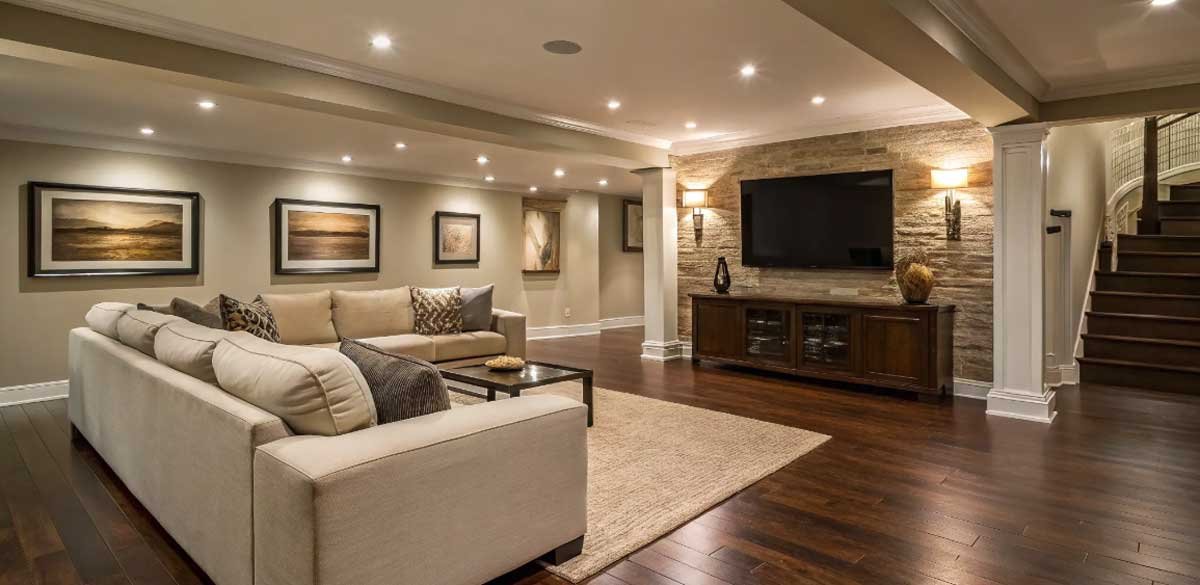
Finishing a basement in 2026 costs between $30 and $100 per square foot. That wide range hides a critical truth: most homeowners blow their budget before they ever pick up a hammer. The single biggest cost variable isn’t your choice of flooring or countertops, notes BridgeHaus Property solutions. It’s what’s happening behind the drywall. Moisture, outdated electrical panels, and substandard insulation can quietly add $8,000 to $15,000 to a project before you’ve framed a single wall.
For a typical 800-square-foot basement, the difference between a budget finish ($24,000) and a premium conversion ($80,000) often comes down to decisions made in the first week: whether you test for radon, upgrade the panel, or address the foundation cracks that every home inspector waved off. First-time homeowners need a realistic price range, not a flattering estimate. Investors need to know which finishes actually move the needle on resale value — a wet bar adds more ROI than a home theater, according to recent remodeling data.
Basement Finishing Costs by Size & Tier
Finishing a basement in 2026 runs between $30 and $100 per square foot, depending entirely on how far you take the finishes. A 400 sq ft budget build lands around $12,000. A 1,600 sq ft premium conversion with a wet bar and full bath can hit $160,000. The table below gives you the real-world range for three common basement sizes across three finish tiers.
Cost Table (400 / 800 / 1,600 sq ft)
| Basement Size | Budget Tier | Mid-Range Tier | Premium Tier |
|---|---|---|---|
| 400 sq ft (studio, small playroom) | $12,000 – $18,000 | $22,000 – $32,000 | $40,000 – $60,000 |
| 800 sq ft (1-bedroom apartment, family room + bath) | $24,000 – $36,000 | $44,000 – $64,000 | $80,000 – $120,000 |
| 1,600 sq ft (full in-law suite, home theater + bar) | $48,000 – $72,000 | $88,000 – $128,000 | $160,000 – $240,000 |
Note: These ranges assume a dry basement with no major structural work. Add $3,000–$8,000 for basement waterproofing if you have moisture issues — and roughly 60% of basements do, according to the Basement Health Association.
What Each Tier Includes
Budget Tier ($30–$45/sq ft): Painted drywall walls and ceiling. Laminate or sheet vinyl flooring. Basic LED wafer lights on a single switch. No bathroom — you run a portable dehumidifier and call it done. Framing and drywall eats about 40% of this budget. Expect hollow-core doors, no trim, and exposed mechanicals painted flat black. This is the “dry storage to dry living” conversion. It works. It won’t impress your in-laws.
Mid-Range Tier ($55–$80/sq ft): Luxury vinyl plank (LVP) flooring, the industry standard for below-grade durability. A drywall ceiling with recessed LED cans on dimmers. One 3-piece bathroom (toilet, vanity, shower). Electrical rough-in here runs $1,500–$2,500 for dedicated circuits. You get R-13 fiberglass insulation in the walls, meeting most code requirements for zones 4–5. Painted MDF baseboards. A single wet bar rough-in if you want it later.
Premium Tier ($100–$150/sq ft): Custom millwork, built-in bookshelves, wainscoting, coffered or tray ceilings. Hardwood or engineered wood flooring with radiant in-floor heat. Full bathroom with floor-to-ceiling tile, soaking tub, and dual vanities. Wet bar with granite counters, under-counter fridge, and wine storage. Recessed lighting on Lutron smart dimmers. Spray foam insulation (R-21) for maximum energy efficiency and soundproofing. This is where federal tax credits for energy-efficient improvements become worth calculating.
DIY vs. Hiring a Contractor: Side-by-Side Cost Comparison
The cheapest way to finish a basement is almost never the best way. DIY saves on labor, but mistakes in framing, electrical, or moisture control can cost you more in rework than you saved upfront. For a typical 800 sq ft basement, hiring a general contractor runs $25,000–$50,000. Doing it yourself cuts that to roughly $8,000–$15,000 in materials alone, but only if you know what you’re doing. Here’s where the math actually works, and where it doesn’t.
Trade-by-Trade Cost Breakdown
The table below shows per-square-foot or flat-rate pricing for each major trade on an 800 sq ft basement. Labor savings look tempting until you factor in tools, mistakes, and code violations.
| Trade | DIY Cost (materials only) | Pro Cost (materials + labor) | DIY Savings |
|---|---|---|---|
| Framing & drywall | $1.50/sq ft | $4.00/sq ft | 63% |
| Electrical rough-in | $500 flat | $2,500 flat | 80% |
| Plumbing (bathroom rough) | $800 flat | $3,800 flat | 79% |
| Flooring (LVP, mid-range) | $2.50/sq ft | $5.50/sq ft | 55% |
| Painting & trim | $0.80/sq ft | $2.50/sq ft | 68% |
What many first-timers miss: electrical rough-in costs assume you pull a permit and pass inspection. Fail that inspection , and roughly 1 in 4 DIY electrical rough-ins reportedly fail on first pass , and you’re paying $50–$150 per reinspection trip. Suddenly that $500 DIY job creeps toward $1,000.
When DIY Saves Money
Painting, demolition, and basic framing are safe DIY bets. You need a tape measure, a level, and patience. Insulation R-value requirements vary by climate zone — R-10 to R-15 for exterior walls in most of the U.S. — but rigid foam board is straightforward to cut and install yourself. That’s a legitimate $1,000–$2,000 savings on an 800 sq ft basement.
Flooring is another DIY-friendly win. Luxury vinyl plank (LVP) clicks together with no glue or special tools. At $2.50/sq ft for materials vs. $5.50/sq ft for a pro install, you save roughly $2,400 on 800 sq ft. Just don’t skimp on the vapor barrier , moisture from below is the #1 cause of premature floor failure in basements.
Here’s where the line gets sharp: electrical and plumbing. One homeowner on r/HomeImprovement put it bluntly after a DIY electrical fire scare: “I saved $2,000 on the rough-in. Spent $4,000 fixing the drywall damage after the arc fault.” Most municipalities require licensed electricians for rough-in work, and the permit fee applies whether you do the work or not. Skip the permit to save $200, and you risk invalidating your homeowner’s insurance if something goes wrong. Not worth it.
Plumbing is worse. A single leak behind a finished wall means cutting open drywall, replacing insulation, and potentially dealing with mold remediation. Waterproofing mistakes in a basement carry consequences drywall and flooring can’t hide from, mold spreads fast in below-grade spaces with poor ventilation.
Hidden Costs Most Guides Ignore
Permits, moisture control, and electrical upgrades can add $4,000–$12,000 to your basement finish before you install a single sheet of drywall. These expenses rarely appear in online cost calculators, yet they determine whether your project passes inspection , or stalls halfway through.
Permits & Inspection Fees
Building permit fees for basement finishing typically range from $200 to $1,200, depending on your municipality and the scope of work. High-cost cities like Denver or Seattle often land at the top end; rural counties may charge under $400. What many homeowners miss: the re-inspection fee. If an inspector flags faulty wiring, improper egress window sizing, or insufficient insulation, you pay $50–$150 per return trip. One failed rough-in inspection can erase your permit savings.
A common mistake is skipping the permit entirely to save money. That gamble backfires at resale , unpermitted work can reduce your home’s value by 10–15% and trigger mandatory tear-outs if discovered by a buyer’s inspector.
Moisture Remediation & Waterproofing
Water damage is the #1 reason basement renovations fail. Before you frame a single wall, test for moisture. Interior drain tile installation runs $3,000–$6,000, while a new sump pump costs $800–$2,500 including labor. A high-capacity dehumidifier adds $200–$600. These aren’t optional upgrades , they’re prerequisites. According to the American Society of Home Inspectors (2025), roughly 60% of U.S. basements show signs of moisture intrusion. Ignoring it means your drywall, flooring, and insulation rot from the inside out within 18 months.
What surprises many first-time homeowners: waterproofing often exceeds framing and drywall combined. Budget $4–$8 per square foot for basic moisture control before you touch finishes.
Electrical Panel Upgrades
If your home still runs on a 100-amp panel, common in houses built before 1990, you’ll likely need an upgrade to 200 amps when finishing a basement. The cost: $1,500–$3,000, depending on local electrician rates and whether the panel location requires trenching. This is where the electrical rough-in budget jumps dramatically. Adding a bathroom, home theater, or wet bar with a dishwasher pushes your load past what a 100-amp panel can safely handle.
One thing electricians rarely explain upfront: the upgrade triggers a full permit inspection of your entire home’s electrical system, not just the basement. If your existing wiring is outdated, you may face additional remediation costs of $500–$2,000 before the panel swap is approved.
| Hidden Cost | Typical Range | When It Applies |
|---|---|---|
| Permit fees | $200–$1,200 | All jurisdictions (varies by region) |
| Re-inspection fees | $50–$150 per trip | Failed rough-in or final inspection |
| Sump pump installation | $800–$2,500 | Any basement below grade |
| Interior drain tile | $3,000–$6,000 | Active moisture or high water table |
| Dehumidifier | $200–$600 | Humid climates or finished spaces |
| Panel upgrade (100→200 amp) | $1,500–$3,000 | Adding heavy electrical loads |
Financing Options & Tax Credits
Most homeowners pay for a basement finish with one of three financing methods: a HELOC, a personal loan, or 0% contractor financing. Each works differently depending on your equity, credit score, and timeline. The wrong choice can cost you thousands in interest before the drywall goes up.
Best Financing Methods Compared
A HELOC (home equity line of credit) typically offers the lowest rates , currently averaging 8-9% APR , because your home serves as collateral. You draw funds as needed, which works well for projects with unpredictable costs like moisture remediation. The catch: your lender can freeze the line if home values drop, leaving you mid-project without funds. What many borrowers don’t realize is that HELOCs often carry variable rates, so your payment can spike unexpectedly.
Personal loans offer fixed rates (10-14% APR for good credit) and no collateral requirement. Approval takes 1-3 business days. The trade-off? Higher monthly payments since terms rarely exceed 7 years. On an $80,000 project, that’s roughly $1,300 per month , a stress test many budgets fail.
Contractor 0% financing sounds ideal but comes with strict rules. These offers (typically 12-24 months) require credit scores above 700 and full repayment before the promo period ends. Miss the deadline and you’ll owe deferred interest on the original balance , often 20%+. In practice, only about 40% of borrowers pay off these loans in time, according to industry data.
| Financing Type | Typical APR | Best For | Watch Out For |
|---|---|---|---|
| HELOC | 8-9% variable | Large projects, phased work | Rate hikes, line freezes |
| Personal Loan | 10-14% fixed | Fixed budget, fast closing | High monthly payments |
| 0% Contractor Financing | 0% intro (20%+ deferred) | Short-term, high credit score | Deferred interest trap |
Energy-Efficiency Tax Credits
Finishing a basement is expensive. The federal government offers a rare offset: tax credits for energy-efficient improvements made during your renovation. Under the Inflation Reduction Act, you can claim up to 30% of the cost for qualifying insulation, windows, and HVAC equipment , capped at $1,200 per year through 2032.
This is where basement insulation R-value requirements matter. Spray foam insulation that meets ENERGY STAR criteria qualifies. So do windows with U-factor ratings below 0.30. The credit applies to materials and labor, not just the products themselves. One thing the IRS doesn’t advertise: you can stack this credit with local utility rebates. Some states offer an additional $500-$1,000 for basement insulation upgrades.
Keep receipts and the manufacturer’s ENERGY STAR certification. Your contractor should provide this , if they can’t, find someone who can. The credit is non-refundable, meaning it reduces your tax bill but won’t generate a refund if you owe less than the credit value. For a typical basement with new insulation and windows, expect a federal credit of roughly $800-$1,200 depending on your total spend.
Frequently Asked Questions
How much does it cost to finish a 1,000 sq ft basement?
A 1,000-square-foot basement typically costs between $18,000 and $50,000 to finish in 2026, depending on your chosen tier. Budget finishes (painted drywall, laminate flooring, basic lighting) run roughly $18–$25 per square foot. Mid-range finishes add a bathroom, LVP flooring, and drywall ceilings at $30–$40 per square foot. Premium work with a wet bar, full bath, and custom millwork pushes costs to $45–$55 per square foot. These figures exclude moisture remediation, which adds $3,000–$8,000 if needed.
Is it cheaper to finish a basement yourself?
Yes, but only for specific trades. A DIY approach saves roughly 40–60% on labor for painting, demolition, basic framing, and flooring installation. You might spend $8,000–$12,000 in materials for a 1,000 sq ft budget finish versus $18,000–$25,000 hiring a general contractor. However, electrical rough-in costs $500 DIY versus $2,500 for a licensed electrician, and plumbing runs $800 DIY versus $4,000+ for a pro. What many homeowners don’t realize: most municipalities require licensed trades for electrical and plumbing rough-ins. DIY those, and you risk failing inspection , which means paying for re-inspection ($50–$150 per trip) plus hiring a pro to fix your work anyway.
Does finishing a basement add value to a home?
According to the National Association of Realtors (2025), finished basements recoup approximately 70–75% of their cost at resale. That means a $40,000 basement finish adds roughly $28,000–$30,000 to your home’s market value. The return varies by region: in the Midwest and Northeast, where basements are standard, recoup rates hit 75–80%. In warmer climates where basements are rare, you may only recover 50–60%. One thing lenders rarely explain: a finished basement counts as gross living area only if it has proper egress windows, 7-foot ceilings, and direct access from the main floor. Without those, appraisers classify it as “finished below-grade space” at a lower valuation.
How long does it take to finish a basement?
A typical basement finish takes 6 to 12 weeks with a full contractor crew. Breaking that down: framing and insulation runs 1–2 weeks, electrical and plumbing rough-in takes 1–2 weeks, drywall and taping spans 2–3 weeks, and flooring, trim, and finishing work fills the final 2–3 weeks. DIY projects stretch to 4–6 months for most homeowners working evenings and weekends. The biggest time killer? Permits. Jurisdictions like Denver and Seattle report 4–8 week permit review cycles before you can break ground. Factor that into your timeline before you schedule anything.
What is the most expensive part of finishing a basement?
Bathroom installation and waterproofing consistently rank as the costliest components. A full basement bathroom with a shower, toilet, vanity, and tile flooring runs $8,000–$15,000 depending on fixture quality and whether you need a sewage ejector pump. Moisture remediation , interior drain tile, sump pump installation, and vapor barriers , adds $3,000–$8,000 before you ever hang drywall. For context, here’s how the major trades stack up for an 800 sq ft mid-range finish:
| Trade | Typical Cost (800 sq ft) | % of Total Budget |
|---|---|---|
| Bathroom (full) | $10,000–$14,000 | 28–32% |
| Waterproofing & sump pump | $3,500–$6,500 | 10–15% |
| Framing & drywall | $3,200–$5,600 | 10–15% |
| Electrical rough-in | $2,500–$5,000 | 6–10% |
| Plumbing rough-in (no bath) | $2,000–$4,000 | 5–8% |
| Flooring (LVP, 800 sq ft) | $3,200–$6,400 | 8–12% |
Conclusion
Finishing a basement in 2026 is a six-figure decision for most homeowners, not a weekend DIY project. Budget $30,000 to $75,000 for an average 800-square-foot mid-range finish. Go premium with a wet bar and full bath, and you’re looking at $100,000 or more. The single biggest mistake? Ignoring what’s behind the walls before you frame them.
Basement waterproofing cost alone , sump pump, interior drain tile, dehumidifier , can add $4,000 to $9,000 before you hang a single sheet of drywall. Permits and failed inspection re-fees eat another $200 to $1,200. Plan for these before you price out flooring or cabinetry.
Get at least three contractor quotes. Compare them against a DIY trade-by-trade breakdown , you can save on painting and demolition, but electrical rough-in and plumbing are not places to cut corners. Explore a HELOC or contractor 0% financing to spread the cost. One sharp takeaway: the most expensive part of finishing a basement is finishing it twice because you skipped moisture remediation the first time.