Quick answer: why your AC is running but not cooling
Your AC may be running but not cooling because the thermostat is set incorrectly, the air filter is clogged, return or supply airflow is restricted, the outdoor condenser is dirty or not actually running, the evaporator coil is frozen, the refrigerant charge is low from a leak, the condensate drain safety switch has interrupted cooling, or an electrical part such as a capacitor, contactor, fan motor, or compressor has failed. Air conditioners cool by moving heat from indoors to outdoors through indoor and outdoor coils, a compressor, and refrigerant; if airflow, heat rejection, electrical operation, or refrigerant flow breaks down, the fan can still run while cooling stops.[1]
Start with the safe checks: confirm the thermostat is on Cool, not Fan; set it 3–5°F below room temperature; replace a dirty filter; make sure vents and returns are open; clear debris around the outdoor unit; and look for ice on the refrigerant lines or indoor coil. If the outdoor unit is silent, buzzing, repeatedly tripping a breaker, covered in ice, or leaking refrigerant, shut the system down and call a licensed HVAC technician.
Do these safe checks first
Before assuming the compressor has failed, do a short homeowner check. These steps do not require opening sealed refrigerant lines, removing electrical covers, or touching live components. They also match the maintenance priorities recommended by ENERGY STAR: thermostat settings, electrical operation, condensate drainage, coils, refrigerant level, blower airflow, and regular filter care all affect cooling performance and equipment life.[2]
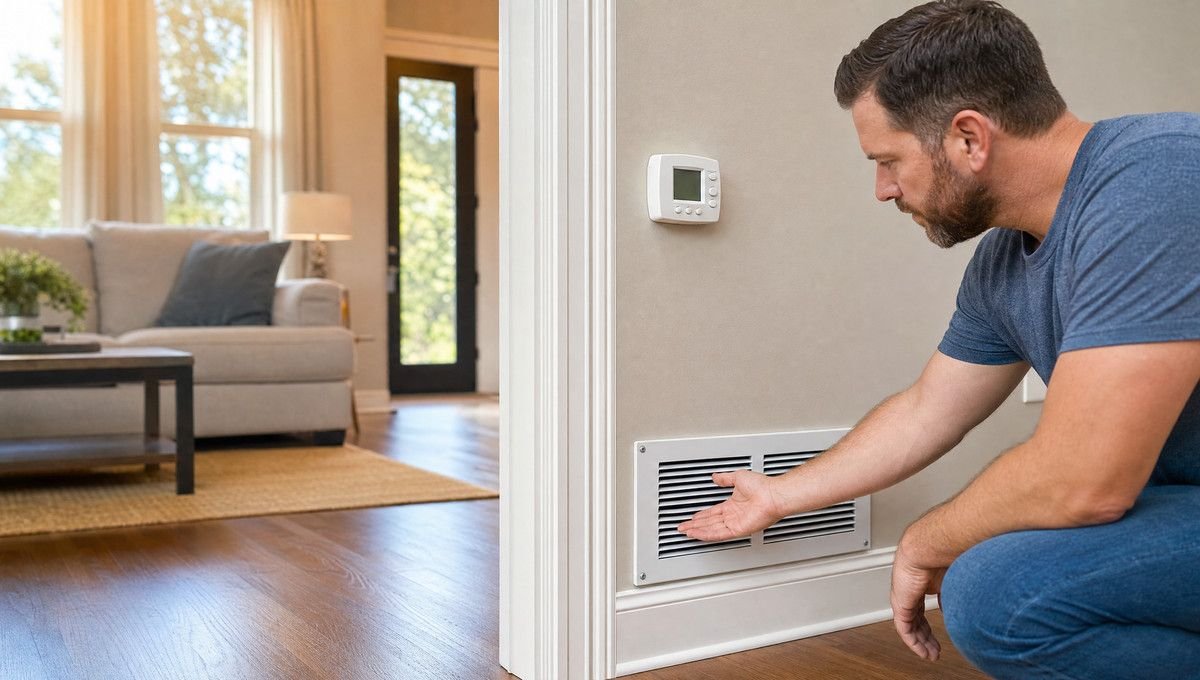
- Check thermostat mode. It should say Cool, not Heat, Off, or Fan. If it is set to Fan, the blower can circulate room-temperature air without cooling.
- Lower the set temperature. Set the thermostat 3–5°F below the current indoor temperature and wait several minutes.
- Inspect the air filter. A clogged filter can reduce airflow, freeze the indoor coil, and make the system run longer with little cooling. ENERGY STAR advises homeowners to inspect, clean, or change filters once a month during use.[2]
- Open vents and clear returns. Move furniture, rugs, curtains, boxes, and pet beds away from supply vents and return grilles.
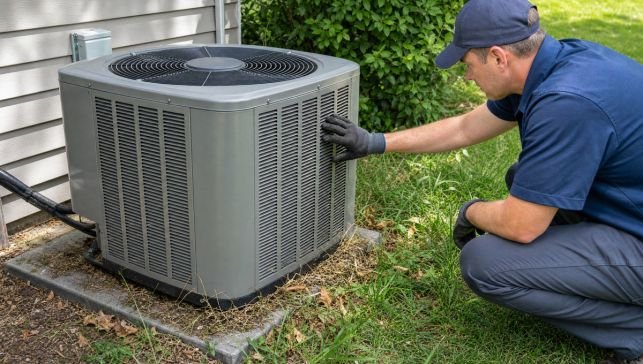
- Look at the outdoor condenser. The outdoor fan should usually be running during a cooling call. Clear leaves, grass clippings, cottonwood, and other debris from around the cabinet while staying away from electrical panels.
- Look for ice. Ice on the copper refrigerant lines, indoor coil cabinet, or outdoor line set is a stop sign. Turn cooling off and let the system thaw before restarting.
Symptom table: what your AC behavior usually means
The most useful question is not just whether the AC is running. The better question is which part is running. A thermostat can call for cooling, an indoor blower can move air, an outdoor fan can spin, and the compressor can still fail to move refrigerant effectively.
| What you notice | Most likely causes | Safe homeowner action | When to call a technician |
|---|---|---|---|
| Air comes from vents, but it is warm or room temperature. | Thermostat on Fan, outdoor unit not running, bad capacitor, low refrigerant, frozen coil, compressor issue. | Confirm Cool mode, replace filter, check outdoor unit sound/fan, look for ice. | Call if outdoor unit is silent, buzzing, iced, or breaker trips again. |
| Indoor fan runs, but outdoor unit is not running. | Tripped breaker, pulled disconnect, failed capacitor, contactor, control board, thermostat wiring, compressor fault. | Check thermostat and breaker once. Do not repeatedly reset a tripping breaker. | Call for electrical diagnosis, capacitor testing, contactor repair, or compressor testing. |
| Outdoor fan runs, but the house temperature keeps rising. | Low refrigerant, compressor not pumping, dirty coil, duct leakage, severe heat load, restricted airflow. | Change filter, clear condenser area, verify vents and returns are open. | Call if the air is not 15–20°F cooler at vents, the lines are not cold/warm as expected, or cooling worsens. |
| Weak airflow from multiple vents. | Dirty filter, blocked return, frozen evaporator coil, blower issue, duct restriction. | Replace filter, open vents, thaw ice if present. | Call if airflow stays weak after a clean filter or ice returns. |
| System runs all day but never reaches set temperature. | Dirty coils, low refrigerant, leaky ducts, undersized system, poor insulation, extreme humidity or heat. | Improve airflow, shade and seal obvious heat gains, check filter and outdoor clearance. | Call for refrigerant, duct, load calculation, and performance testing. |
First, clarify what “running” means
Homeowners often say the AC is running when they hear air from the vents. In many central systems, that sound may only be the indoor blower. The outdoor condenser and compressor may be off, struggling, or locked out. That distinction matters because the indoor fan can move air even when no heat is being removed from the house.
“System fan running? Yes. Air blow out of vents? Yes. Air out vents is cold? NO. Outside unit running? NO.” — homeowner discussion in r/ecobee
That real-world diagnostic sequence is exactly how you should think about the problem. Ask three questions: is the thermostat calling for cooling, is the indoor blower moving air, and is the outdoor condenser actually running? If the indoor fan is on but the outdoor unit is silent or only buzzing, the issue is likely outside the safe DIY zone.
12 reasons your AC is running but not cooling
1. The thermostat is set to Fan, Heat, or the wrong temperature
The simplest cause is also one of the most common. If the thermostat fan setting is On, the blower may run continuously even when the cooling cycle is not active. If the mode is not set to Cool, or the set point is above the room temperature, the system may move air without lowering the temperature.
Set the thermostat to Cool, choose Auto for the fan, and lower the set point several degrees below the current room temperature. If the display is blank or unreliable, replace batteries if your thermostat uses them and confirm the thermostat has power.
2. A dirty air filter is choking airflow
A clogged filter makes it harder for the blower to move warm indoor air across the evaporator coil. That reduces cooling, increases run time, raises energy use, and can eventually cause the indoor coil to freeze. ENERGY STAR specifically warns that dirty filters can increase energy costs and damage equipment, leading to early failure.[2]
Replace the filter with the correct size and airflow direction. If cooling improves over the next hour, the filter was likely part of the problem. If airflow remains weak, do not assume the new filter fixed everything; check for ice, blocked returns, or blower trouble.
3. Return grilles or supply vents are blocked
Your AC needs both return airflow and supply airflow. A blocked return starves the system of warm air to cool, while closed or covered supply vents prevent conditioned air from reaching rooms. This can make the house feel warm even while the unit runs.
Open supply registers, remove furniture from vents, and make sure the main return grille is not blocked by rugs, pet beds, storage boxes, or dust buildup. If only one room is warm, the problem may be a closed damper, duct restriction, solar heat gain, or duct leakage rather than a central AC failure.
4. The outdoor condenser is dirty, covered, or blocked
The outdoor condenser releases heat pulled from the home. If the coil is packed with debris or surrounded by tall grass, shrubs, leaves, or cottonwood, heat cannot leave the refrigerant efficiently. The system may run longer, cool poorly, and operate under higher stress.
Turn the thermostat off before clearing debris around the cabinet. Maintain open space around the unit and gently remove loose material from the exterior. Avoid bending fins or spraying electrical components. ENERGY STAR lists cleaning evaporator and condenser coils as a cooling-specific maintenance task because dirty coils reduce cooling ability and cause longer run times.[2]
5. The indoor blower runs, but the outdoor unit does not
If the indoor fan is blowing but the outdoor unit is silent, the system may not be cooling at all. Possible causes include a tripped condenser breaker, a pulled outdoor disconnect, a failed capacitor, a bad contactor, low-voltage control problems, a failed fan motor, or compressor trouble.
While some issues like a dirty filter or blocked vents can be addressed by a homeowner, many underlying mechanical failures require specialized tools and training. If the indoor fan is spinning but the air remains warm, the problem could stem from a faulty capacitor, a failing compressor, or an electrical disconnection within the outdoor unit. In these situations, seeking professional ac repair is often the most efficient way to restore comfort and prevent further damage. A qualified technician can safely test the electrical components and refrigerant levels, ensuring the cooling cycle is fully restored without the risks associated with DIY electrical work.
Trane’s troubleshooting guidance also separates “air conditioner running but not lowering the thermostat temperature” from thermostat, airflow, condenser, refrigerant, and sizing problems.[3]
You can check whether the breaker is tripped and whether the outdoor disconnect appears seated, but do not open electrical compartments. If a breaker trips again after one reset, leave it off. Repeated resets can create a fire or equipment-damage risk.
6. The evaporator coil is frozen
A frozen evaporator coil can make the AC run while little or no cooling reaches the rooms. Ice can form because airflow is too low, the filter is clogged, the blower is weak, refrigerant is low, or the metering device is malfunctioning. Once the coil is iced over, the ice itself blocks heat transfer and airflow.
Turn cooling off. You may run the fan to help thaw the coil, but do not chip ice away. After thawing, replace the filter and restore normal airflow. If the coil freezes again, call an HVAC technician because the underlying cause may be refrigerant or mechanical failure.
7. The refrigerant is low because there is a leak
Refrigerant is not fuel that gets “used up.” In a sealed system, low refrigerant usually means a leak or an improper charge. Low refrigerant can make the AC run constantly, blow air that is not cold enough, freeze the coil, or damage the compressor. Carrier and Trane both list low or leaking refrigerant as a common reason an AC runs without cooling properly.[3] [4]
This is not a homeowner refill job. The refrigerant circuit must be diagnosed, repaired, evacuated, and charged correctly by trained personnel. EPA rules also regulate refrigerant recovery and safe handling for air-conditioning equipment to reduce emissions.[5]
8. A condensate drain problem has triggered a safety switch
Central AC systems remove moisture as they cool. That water drains through a condensate line or pump. If the drain clogs, water can back up into a pan and trigger a float switch that interrupts cooling to prevent water damage. Sometimes the blower may still run, which makes the system seem active even though cooling has been stopped.
Look for water in the secondary pan, water around the indoor unit, a full condensate pump reservoir, or a visible float switch. ENERGY STAR includes checking and inspecting the condensate drain in standard maintenance because a plugged drain can cause water damage and affect indoor humidity.[2]
9. A capacitor, contactor, fan motor, or compressor electrical part has failed
A failed capacitor can prevent the outdoor fan or compressor from starting. A worn contactor can fail to send power to the condenser. A bad fan motor can leave the compressor overheating. A compressor problem can allow the unit to hum or cycle without moving refrigerant effectively. These failures often appear during heat waves because electrical components are under heavier load.
Do not test or replace capacitors unless you are qualified. Capacitors can store charge even after power is off. A technician will safely test capacitance, contactor operation, voltage, amperage, control signals, and compressor behavior.
10. Ductwork is leaking, disconnected, crushed, or poorly insulated
If the AC equipment is producing cold air but the house is not cooling, the cold air may be escaping before it reaches the rooms. Leaky ducts in an attic, crawl space, garage, or wall cavity can waste cooling and pull hot, dusty air into the system. Disconnected or crushed ducts can leave one area warm while others cool normally.
Signs include uneven room temperatures, dusty vents, high bills, weak airflow at distant registers, or an attic that feels unusually cold while the living space stays warm. A duct inspection, static pressure test, and duct sealing plan may be needed.
11. A heat pump is stuck in the wrong mode
If your “AC” is actually a heat pump, it uses a reversing valve to switch between heating and cooling. If the valve, thermostat wiring, control board, or mode setting fails, the system may run without cooling the house. In some cases, it may even blow warm air while set to cool.
Confirm the thermostat is not in emergency heat or heat mode. If settings are correct and the system still will not cool, this becomes a professional diagnosis because reversing valve and control issues are not simple homeowner repairs.
12. The system is undersized, aging, or overwhelmed by the heat load
Sometimes the AC is cooling, but not enough. The U.S. Department of Energy notes that proper sizing matters; an air conditioner that is not correctly sized for the space can perform poorly, and an oversized unit can also create comfort problems such as poor dehumidification.[1] Older systems can lose capacity from worn components, dirty coils, duct leakage, or repeated refrigerant issues.
If the unit cools well in mild weather but cannot keep up on hot afternoons, the cause may be heat load, insulation, attic ventilation, duct design, solar gain, or sizing. A qualified contractor can perform load calculations instead of guessing based only on square footage.
Should you turn off the AC if it is running but not cooling?
Yes, turn the AC off if you see ice on the refrigerant lines or indoor coil, smell burning, hear loud buzzing or grinding, notice the outdoor fan is not spinning while the unit hums, see water overflowing around the indoor unit, or the breaker trips more than once. Running the system in these conditions can turn a repairable airflow, refrigerant, drain, or electrical problem into a more expensive compressor or water-damage problem.
If there is no ice, no burning smell, no water issue, and both indoor and outdoor units appear to be operating, you can run the checklist above. If the air from the vents does not become noticeably cooler within a short period, stop and schedule service.
What an HVAC technician will test
A good technician should not simply add refrigerant and leave. The diagnostic process usually includes measuring temperature split, checking filter and blower airflow, inspecting evaporator and condenser coils, testing the capacitor and contactor, measuring voltage and amperage, checking pressure and superheat/subcooling where appropriate, inspecting the condensate safety circuit, and looking for duct or load issues.
Ask the technician to explain the evidence for the diagnosis.
Expert diagnostics provide more than just a quick fix; they offer a clear roadmap for maintaining system reliability throughout the year. When homeowners understand the specific readings behind a component failure or airflow restriction, they can make better decisions regarding repairs versus equipment upgrades. For residents in Oklahoma, Quality Heating, Cooling, Plumbing & Electric serves Bartlesville by offering transparent evaluations that prioritize long-term performance and indoor safety. Focusing on thorough testing helps identify minor electrical or mechanical issues before they lead to an unexpected system shutdown during a heat wave, ensuring the cooling cycle remains stable and efficient when it is needed most.
Selecting a dedicated service provider involves looking beyond technical skills to find a team that prioritizes customer education and long-term system health. When you work with experienced specialists, you can learn this here now by observing how they evaluate every part of the cooling cycle rather than just fixing a single symptom. A comprehensive approach ensures that your air conditioner is not just running, but operating at peak efficiency to maintain a comfortable indoor environment. By choosing professionals who value transparency, you gain a better understanding of your home’s mechanical needs and how to avoid future cooling interruptions.
While some issues like a dirty filter or blocked vents can be addressed by a homeowner, many underlying mechanical failures require specialized tools and training. If the indoor fan is spinning but the air remains warm, the problem could stem from a faulty capacitor, a failing compressor, or an electrical disconnection within the outdoor unit. In these situations, seeking ac repair near me is often the most efficient way to restore comfort and prevent further damage. A qualified technician can safely test the electrical components and refrigerant levels, ensuring the cooling cycle is fully restored without the risks associated with DIY electrical work.
For example, “low refrigerant” should lead to leak evaluation, not just a recharge. “Bad capacitor” should be supported by a measured reading. “Undersized system” should ideally be supported by load calculation, duct assessment, and equipment data.
How to prevent an AC from running without cooling
Prevention is mostly about airflow, cleanliness, and early testing. Schedule cooling maintenance before peak summer, when contractors are less overloaded. Establishing a routine for seasonal inspections can help homeowners identify minor vulnerabilities before they escalate into significant mechanical failures. When a cooling unit sits dormant during the transitional months, mechanical stiffness and dust accumulation often lead to unexpected strain once the thermostat is finally adjusted for the summer. Addressing these potential issues early through professional heating and cooling in Tuscumbia at http://priceheatingandair.com/heating-cooling-tuscumbia-al/ ensures the system remains prepared for high-demand periods. This proactive approach supports more consistent indoor temperatures and contributes to the overall longevity of the equipment by reducing the likelihood of sudden breakdowns during extreme heat waves. ENERGY STAR recommends annual pre-season checkups and says typical maintenance should include thermostat checks, electrical connections, condensate drain inspection, system controls, coil cleaning, refrigerant level checks, and blower adjustments.[2]
| Maintenance habit | Why it matters | Suggested frequency |
|---|---|---|
| Inspect or replace the filter | Protects airflow, coil temperature, and blower performance. | Monthly inspection during heavy use; replace as needed. |
| Clear the outdoor unit | Helps the condenser reject heat efficiently. | Monthly in leaf, pollen, cottonwood, or mowing seasons. |
| Keep vents and returns open | Reduces static pressure and uneven cooling. | Whenever furniture or rugs are moved. |
| Schedule pre-season maintenance | Finds coil, refrigerant, drain, electrical, and blower problems before a heat wave. | Once per year before cooling season. |
| Watch run time and temperature trends | A sudden change often reveals a developing fault before total failure. | During the first hot weeks of the season. |
FAQ: AC running but not cooling
- Why is my AC blowing air but not cold air?
- The most common reasons are Fan mode, a dirty filter, a frozen evaporator coil, an outdoor unit that is not running, low refrigerant, or an electrical fault such as a bad capacitor. Start with thermostat mode, airflow, filter condition, and outdoor-unit operation.
- Why is my indoor AC fan running but the outside unit is not?
- The indoor blower can run independently of the outdoor condenser. If the outside unit is not running during a cooling call, possible causes include a tripped breaker, outdoor disconnect problem, failed capacitor, bad contactor, thermostat/control issue, fan motor failure, or compressor problem.
- Can a dirty filter really stop my AC from cooling?
- Yes. A severely dirty filter can reduce airflow across the evaporator coil, weaken vent airflow, increase run time, and contribute to coil freezing. ENERGY STAR advises inspecting, cleaning, or changing filters once a month in central air conditioners, furnaces, and heat pumps during use.[2]
- Is low refrigerant something I can fix myself?
- No. Low refrigerant usually indicates a leak or incorrect charge, and the refrigerant circuit requires proper tools, leak diagnosis, recovery, repair, evacuation, and charging. EPA rules regulate refrigerant handling and recovery for air-conditioning equipment.[5]
- How long should I wait after changing the filter?
- If the system was not frozen, you may notice airflow improvement quickly and cooling improvement within 15–30 minutes. If the coil was iced, it may need several hours to thaw before cooling can be judged. If ice returns, call a technician.
- Why does my AC cool at night but not during the day?
- Daytime heat load may expose marginal performance. Dirty coils, low refrigerant, leaky ducts, poor insulation, attic heat, solar gain, undersizing, or an aging system can all make the AC struggle during peak afternoon heat.
References
- U.S. Department of Energy — Air Conditioning. Explains air conditioner components, heat transfer, efficiency, and sizing considerations.
- ENERGY STAR — Maintenance Checklist. Lists thermostat, electrical, condensate, coil, refrigerant, blower, and filter maintenance tasks.
- Trane — Air Conditioner Troubleshooting: Why Your AC Is Not Cooling. Covers filters, thermostat settings, condenser blockage, low refrigerant, sizing, and related AC symptoms.
- Carrier — AC Not Blowing Cold Air. Industry troubleshooting reference for thermostat, airflow, condenser, coil, refrigerant, and equipment issues.
- U.S. Environmental Protection Agency — Stationary Refrigeration Safe Disposal Requirements. Summarizes Section 608 refrigerant recovery and safe-disposal requirements for air-conditioning equipment.