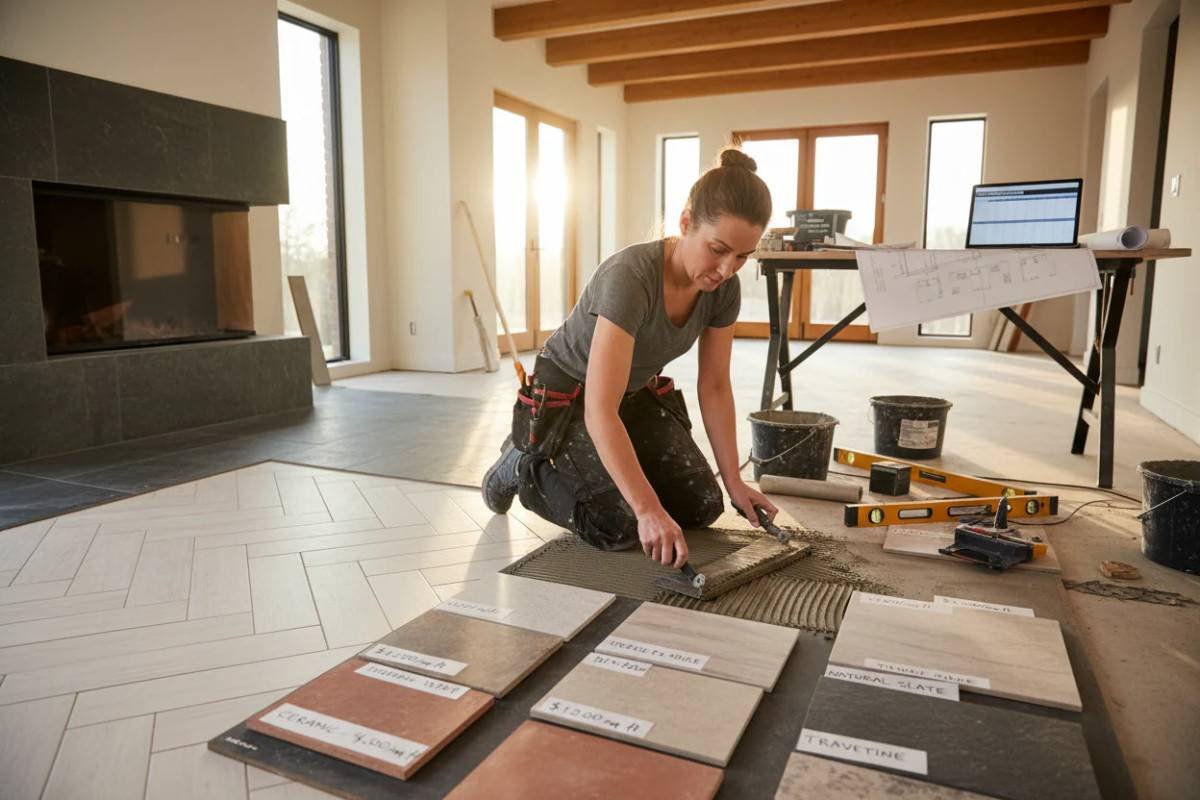
According to Northwoods Property Management, tile installation costs \$8 to \$40 per square foot installed in 2026, depending on the tile material, the surface being tiled, the complexity of the layout, and the condition of the substrate. A standard ceramic tile floor installation costs \$8 to \$15 per square foot. A porcelain tile shower with a mortar pan and full-height walls costs \$15 to \$40 per square foot.
Tile installation is the most skill-dependent trade in home improvement. The difference between a floor that looks like the showroom and a floor that looks like a DIY Saturday is not the tile. It is the layout, the subfloor preparation, the thinset coverage, and the grout lines. The installer’s skill determines 80% of the result. The tile determines 20%.
Tile Installation Costs by Project Type
Tile installation costs range from $8 per square foot for a standard ceramic floor to $40 per square foot for a custom natural stone shower, with the price driven by the tile material, the project type, and the substrate preparation required. Here is how eight common tile projects compare.
| Project | Cost Per Sq Ft (Installed) | 200 Sq Ft Project Total |
| Ceramic floor tile (standard layout) | $8 – $15 | $1,600 – $3,000 |
| Porcelain floor tile (standard layout) | $10 – $20 | $2,000 – $4,000 |
| Ceramic or porcelain floor (complex pattern: herringbone, diagonal) | $15 – $28 | $3,000 – $5,600 |
| Natural stone floor (marble, travertine, slate) | $18 – $40 | $3,600 – $8,000 |
| Ceramic subway tile backsplash | $11 – $23 | $330 – $690 (30 sq ft) |
| Glass tile backsplash | $18 – $50 | $540 – $1,500 (30 sq ft) |
| Ceramic shower walls (standard tile, prefab pan) | $12 – $25 | $1,200 – $2,500 (100 sq ft walls) |
| Porcelain shower with mortar pan (full custom) | $20 – $40 | $3,000 – $6,000 (150 sq ft total) |
Tile Installation Labor Costs — What the Installer Charges
Tile installation labor costs $5 to $15 per square foot for standard ceramic or porcelain tile in a straightforward layout — a rectangular room with a grid pattern and no diagonal cuts, no borders, and no accent strips. The labor rate covers surface preparation, applying thinset mortar, setting the tile, cutting edge pieces to fit, waiting for the thinset to cure, applying grout, and cleaning the grout haze.
Labor rates increase for: tiles smaller than 2 inches — more pieces to set, more grout lines; tiles larger than 12 inches, heavier, require larger trowels and back-buttering for proper thinset coverage; tiles larger than 24 inches, require a perfectly flat substrate, anti-fracture membrane, and leveling clips to prevent lippage; natural stone, heavier, requires sealing, and is more fragile to cut; glass tile, requires a special blade, white thinset to avoid color bleed-through, and meticulous cleanup; patterns that require matching across sheets, herringbone, chevron, Versailles; and diagonal layouts, every perimeter tile must be cut at a 45-degree angle.
The National Association of Home Builders (NAHB) includes tile installation costs in its construction cost surveys, noting that tile labor rates have increased steadily due to a shortage of skilled tile setters. The installer’s experience commands a premium, $12 to $15 per square foot for a journeyman tile setter versus $5 to $8 for a general handyman who tiles occasionally. The difference in price is visible in the grout lines, the cuts around door frames, and the transitions between rooms. Tile installation is a trade where the quality is visible from a standing height.
Substrate Preparation, the Layer Beneath the Tile
The substrate is the surface the tile is installed on, and its condition determines whether the tile installation lasts 5 years or 50. Tile is rigid. The substrate must be equally rigid. Any movement in the substrate, deflection from floor joists that bounce, plywood that flexes, concrete that cracks, will transmit through the tile and cause cracking, grout failure, or tile delamination. The substrate preparation is not optional. It is the structural foundation of the installation.
Concrete slab: Must be clean, flat, and free of cracks. Cracks wider than 1/8 inch require an anti-fracture membrane, a flexible sheet or liquid-applied membrane that isolates the tile from the crack, at a cost of $2 to $5 per square foot. The slab must be tested for moisture vapor emission. Excessive moisture in a concrete slab can cause thinset failure and tile delamination. A calcium chloride moisture test costs $200 to $400 and is recommended before installing tile over any concrete slab on grade.
Wood subfloor: Must be rigid enough to prevent deflection. The industry standard is L/360, the floor must not deflect more than the span divided by 360 under a 300-pound concentrated load. Most residential floor joists meet this standard. The subfloor must then be covered with a tile backer board, cement board or an uncoupling membrane like Schluter Ditra, at a cost of $2 to $4 per square foot for materials and installation. The backer board provides a stable, non-flexing surface for the tile and prevents the wood subfloor from absorbing moisture from the thinset.
Shower pan: A site-built mortar shower pan costs $1,000 to $3,000 including the sloped mortar bed, the waterproof membrane, and the labor. The pan must slope 1/4 inch per foot toward the drain. The waterproof membrane must extend up the walls at least 6 inches above the finished curb height. The corners, where the pan meets the walls, are the most common failure point in a tile shower. The membrane must be folded, not cut, at the corners. A cut corner will leak.
Tile vs. Alternatives, When Tile Is Worth the Cost
Tile costs more to install than vinyl plank, laminate, or carpet. It also lasts longer, 30 to 50 years or more for the tile itself, with the grout being the first component to show wear. The lifetime cost of tile is competitive with or lower than materials that must be replaced every 10 to 20 years. A $3,000 tile floor that lasts 40 years costs $75 per year. A $1,800 LVP floor that lasts 20 years costs $90 per year. The tile floor costs more upfront and less per year.
Tile is the right choice for bathrooms, kitchens, laundry rooms, mudrooms, and entryways, any room with water, mud, or heavy foot traffic. Tile is the wrong choice for bedrooms and living rooms where comfort underfoot and warmth matter more than water resistance. Tile in a bedroom is cold at 6 a.m., hard underfoot, and noisy, every footstep echoes. The material is capable of being installed in any room. That does not mean it belongs in every room.
Frequently Asked Questions
How much does tile installation cost per square foot?
Tile installation costs $8 to $40 per square foot installed. Ceramic floor tile costs $8 to $15. Porcelain costs $10 to $20. Natural stone costs $18 to $40. The tile itself accounts for $3 to $25 per square foot. Labor and installation materials account for $5 to $25. Complex patterns, large-format tile, and glass or stone add to the labor cost.
Can I install tile myself?
A ceramic subway tile backsplash is the most DIY-friendly tile project, small area, vertical surface, forgiving layout. A tile floor is significantly harder, the substrate preparation, the layout, and the leveling require experience that cannot be acquired from a video. A tile shower with a mortar pan is the hardest tile project and should not be attempted as a first tile job. The cost of a failed DIY shower pan, demolition, mold remediation, and professional replacement, is three to five times the cost of hiring a professional to begin with.
How long does tile installation take?
A professional installer completes a standard 200-square-foot ceramic floor in two to three days: day one for substrate preparation, day two for tile setting, day three for grouting. A tile shower with a mortar pan takes five to seven working days spread across two to three weeks because the mortar bed must cure for 24 to 48 hours before tiling can begin, and the grout must cure before the shower can be used. The timeline is dictated by the materials, not the installer.
What is the difference between ceramic and porcelain tile?
Porcelain is a type of ceramic tile made from finer clay and fired at a higher temperature. It is denser, less porous, more durable, and more water-resistant than standard ceramic. Porcelain is rated for higher traffic and is the better choice for floors, especially in wet areas. Ceramic is adequate for walls, backsplashes, and low-traffic floors. The cost difference is $2 to $5 per square foot for the tile itself. The installation labor is the same for both.
Does tile need to be sealed after installation?
Glazed ceramic and porcelain tile do not need to be sealed, the glaze is impervious. Unglazed tile, natural stone, and the grout lines between all tiles do need to be sealed. Grout sealer costs $10 to $20 for a bottle that covers 200 to 500 square feet and should be reapplied every one to two years. Natural stone sealer costs $20 to $50 and must be reapplied on a similar schedule. The sealer prevents stains from penetrating the porous material. Unsealed grout in a kitchen absorbs cooking oil, coffee, and red wine permanently within weeks.
Why does my tile crack after installation?
Tile cracks because the substrate underneath it is moving. The crack is a symptom, not the cause. Common substrate failures include: floor joists that deflect under load, the tile bends and cracks; plywood subfloor that is not covered with backer board, the wood expands and contracts, and the tile cannot; concrete slab that cracked after installation, the crack telegraphs through the tile; and thinset that did not achieve full coverage under the tile, voids under the tile allow it to flex and crack under weight. The tile did not fail. The installation did.
What Good Tile Installation Costs
Ceramic or porcelain tile installed by a skilled professional over a properly prepared substrate costs $8 to $20 per square foot and lasts 30 to 50 years. The tile itself costs $3 to $12. The labor costs $5 to $15. The substrate preparation costs $2 to $4. The installation is not cheap and it is not fast. It is permanent. When the floor is still flat and the grout is still intact 30 years from now, the invoice from 2026 will look like a bargain.
Spend the money on the installer, not the tile. A $5-per-square-foot porcelain tile installed by a journeyman who charges $12 per square foot will look better and last longer than a $15-per-square-foot marble tile installed by a handyman who charges $5. The installer’s skill is visible in every grout line. The tile’s price is not. Ever walked across a tile floor and felt a corner of one tile sitting slightly higher than its neighbor? That is lippage. The installer rushed. The tile was flat. The floor was not. Your foot notices the difference every time you cross the room. The installer who left that lip behind does not live there. You do.