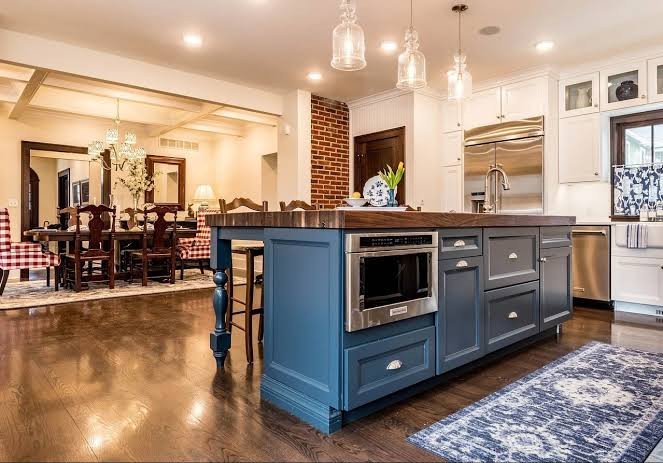
This guide covers the best kitchen island storage ideas — from deep drawers to charging stations. The best kitchen island storage idea is to replace every base cabinet in the island with deep, full-extension drawers. A standard base cabinet with a fixed shelf stores pots and pans in two dimensions — front to back, left to right. The pans at the back are accessible only by kneeling on the floor, reaching into the dark, and pulling everything in front of them out first. A deep drawer — 24 to 30 inches deep, 30 to 36 inches wide — pulls out on full-extension slides, bringing every pot, every pan, and every lid into the light. Nothing is lost at the back. The entire drawer is accessible. The drawer that used to hold four items now holds eight because the full depth is usable. The drawer is the most efficient storage configuration for a kitchen island. The island is the largest storage opportunity in the kitchen outside the perimeter cabinets. The drawers maximize the opportunity.
A kitchen island is typically 36 to 48 inches deep and 60 to 96 inches long — roughly 15 to 32 square feet of interior storage volume. The storage volume is the same regardless of the configuration. The configuration determines how much of that volume is usable. Deep drawers make 90% of the volume accessible. Fixed shelves make 50% accessible. The difference is the reach. The drawer brings the contents to you. The shelf requires you to go to the contents. The drawer is worth the premium. Here are the storage ideas that make a kitchen island work harder.
Idea 1: Deep Drawers Instead of Base Cabinets
A deep drawer can hold stacks of plates, bowls, and serving dishes — a dinnerware drawer at the end of the island nearest the dining table eliminates the walk to the perimeter cabinets. A deep drawer can hold pots and pans, organized by size with adjustable dividers. A deep drawer can hold small appliances, the blender, the food processor, the stand mixer, on a heavy-duty slide rated for 100 to 150 pounds. The appliance drawer eliminates the appliance garage on the countertop. The countertop is clear. The appliances are accessible. The drawer is the home for the things that used to live on the counter. The counter is grateful.
Deep drawers cost $100 to $300 per drawer more than standard shelves, $1,500 to $4,000 for a kitchen island with 8 to 12 drawers. The cost is the drawer box, the full-extension slides, and the installation. The return is the accessibility. The accessibility is used every day. The drawer is the most-used component in the kitchen after the faucet and the refrigerator. The drawer is opened multiple times per meal. The drawer that slides smoothly, opens fully, and closes silently is the drawer that makes the kitchen a pleasure to use. The drawer that sticks, scrapes, and stops halfway is the drawer that makes the kitchen a frustration. The premium for the smooth drawer is $200. The frustration of the sticky drawer is free. The frustration is included with the standard slides. The premium buys the elimination of the frustration. The elimination is worth the premium.
Idea 2: Built-In Pull-Out Trash and Recycling Bins
A pull-out trash and recycling bin system, two bins in a drawer or a cabinet with a door-mounted slide, removes the trash can from the floor and hides it inside the island. The bins are accessible from the prep side of the island. The cook scrapes trimmings directly into the bin. The bin is where the prep happens. The trash can that used to sit in the corner of the kitchen is gone. The island conceals it. The kitchen looks cleaner. The island does double duty, storage and waste management in the same footprint. The pull-out bin system costs $200 to $500 for the hardware and the bins. The installation is included in the cabinet order. The pull-out trash is the least glamorous storage idea in the kitchen and one of the most transformative. The trash is invisible. The invisibility is the transformation. The trash was visible. Now it is not. The kitchen is better for its absence.
The National Association of Home Builders (NAHB) identifies kitchen storage as one of the top buyer priorities. An island with deep drawers, pull-out bins, and dedicated storage for every category of item signals an organized, efficient kitchen. The storage is visible when the drawers are open. The storage is invisible when the drawers are closed. The closed drawers present a clean, uncluttered face to the room. The open drawers reveal a kitchen where everything has a place. The place is the drawer. The drawer is the island. The island is the center of the kitchen. The storage radiates from the center.
Idea 3: Open Shelving at the Ends of the Island
The ends of a kitchen island, the short sides, are often blank cabinet panels. Open shelving built into the ends of the island turns dead space into display and storage. The shelves face outward, toward the dining area, the living room, or the adjacent hallway. The shelves hold cookbooks, decorative bowls, a vase, a plant. The items on the shelves are curated. The shelves are visible from the adjacent room. The island is a piece of furniture. The furniture has bookshelves. The kitchen reads as a living space, not just a work space. The open shelves cost $200 to $800 per end depending on the material and the number of shelves. The shelves add storage, shallow storage for display items, and warmth. The warmth is in the objects. The objects are personal. The personal objects on the shelves tell you that someone lives here. The kitchen with only closed cabinets tells you that someone cooks here. The kitchen with open shelves tells you that someone lives here. The difference is the shelves. The shelves are the personality of the kitchen. The personality costs $500. The personality is visible from the living room.
Idea 4: Microwave Drawer in the Island
A microwave drawer, a microwave that slides out of the island like a drawer, eliminates the microwave from the countertop and from the upper cabinets. The microwave is in the island. The island is below the countertop. The microwave is accessible by pulling out the drawer and placing the food in from above. The microwave drawer costs $800 to $1,500 for the appliance, $200 to $500 more than a standard countertop microwave, plus $100 to $300 for the dedicated circuit or the electrical outlet inside the island cabinet. The microwave drawer is the premium microwave solution. The premium is the location. The location is invisible. The microwave that used to sit on the counter or in the upper cabinet is gone. The counter is clear. The upper cabinets are fully available for storage. The microwave is in the island. The island is the home of the microwave. The microwave is only visible when the drawer is open. The drawer is closed. The microwave is hidden. The kitchen is cleaner. The microwave drawer is the most transformative appliance location decision in a kitchen remodel. The undercounter microwave drawer replaces the countertop microwave. The countertop microwave was visible from every angle. The undercounter microwave is invisible. The invisibility is the upgrade.
Idea 5: Charging Drawer with Built-In USB Ports
A dedicated drawer in the kitchen island with built-in USB charging ports and power outlets is the home for every phone, tablet, and laptop that accumulates on the kitchen counter. The charging drawer is lined with soft material. The devices are plugged in. The drawer is closed. The counter is clear. The devices are charging. The drawer that used to hold miscellaneous items, the junk drawer, becomes a charging station. The junk drawer moves to a different location. The charging drawer takes the prime real estate at the end of the island. The prime real estate is where the phones always end up anyway, on the counter near the end of the island. The drawer formalizes the habit. The drawer costs $200 to $500 for the electrical rough-in and the power strip or the hardwired USB hub. The drawer itself is a standard drawer with a grommet in the back for the power cord. The charging drawer is the most contemporary storage idea in the kitchen. The kitchen is where the day starts, checking the phone for the weather, the news, the calendar. The charging drawer is where the phone lives when it is not in your hand. The drawer is the phone’s home. The home is in the island. The island is the center of the kitchen. The phone returns to the center.
Frequently Asked Questions
What is the best storage configuration for a kitchen island?
Deep, full-extension drawers on the prep side of the island are the most efficient storage configuration. Pull-out trash and recycling bins are the second most practical addition. A microwave drawer and open shelving at the ends add specialized storage and display. The combination of deep drawers, pull-out bins, and end shelving maximizes the island’s storage volume.
How much storage does a kitchen island add compared to perimeter cabinets?
A standard kitchen island adds 15 to 32 square feet of interior storage volume, comparable to 4 to 8 base cabinets. The island storage is more accessible than perimeter storage because it is open on multiple sides. Deep drawers in the island can replace an entire wall of base cabinets in a smaller kitchen.
Are deep drawers in a kitchen island worth the extra cost?
Yes. Deep drawers cost $100 to $300 more per drawer than fixed shelves and make 90% of the storage volume accessible, compared to roughly 50% for shelves. The drawers bring the contents to you. The shelves require you to reach into the dark. The drawers are worth the premium for every drawer you open more than once a week.
Can I add storage to an existing kitchen island?
Pull-out shelves and roll-out trays can be retrofitted into existing island cabinets. The retrofit costs $100 to $300 per shelf. Deep drawers cannot be retrofitted, the drawer boxes and full-extension slides must be built into the cabinet at the time of manufacture. If the island cabinets have doors, pull-out trays behind the doors are the retrofit solution. If the island has drawers, upgrading to full-extension slides is the retrofit.
What should I store in a kitchen island versus the perimeter cabinets?
Store items in the island that are used at the island, prep tools, cutting boards, mixing bowls, small appliances, and items that are used in the center of the kitchen. Store items in the perimeter cabinets that are used at the perimeter, spices near the cooktop, dishes near the dishwasher, glasses near the sink. The island storage should serve the island’s function: prep, serving, and socializing. The perimeter storage should serve the perimeter functions: cooking, cleaning, and food storage.
How do I maximize storage in a small kitchen island?
Use deep drawers on one side and a pull-out trash bin on the other. Install open shelving at one end. Use the entire depth, 36 to 48 inches, for storage on both sides. A small island that is 48 inches long and 36 inches deep can hold six deep drawers, a pull-out trash bin, and open shelving at one end. The small island can hold more than a wall of base cabinets if it is configured correctly. The correct configuration is deep drawers and pull-out bins. The incorrect configuration is fixed shelves and cabinet doors. The drawers are the difference.
The Island That Works Harder
Deep, full-extension drawers on the prep side. Pull-out trash and recycling bins on the sink side. Open shelving at the end facing the dining area. A microwave drawer under the counter at the bar end. A charging drawer at the seating end. The island is 84 inches long and 42 inches deep. The island holds two dozen pots and pans, the trash and recycling, the cookbooks, the microwave, and every phone and tablet in the house. The island does more than any perimeter cabinet run. The island is the storage engine of the kitchen. The engine runs on drawers and pull-out bins. The drawers cost $3,000 more than fixed shelves. The drawers return the accessibility every time you open one. The return is daily. The drawers are the best $3,000 in the kitchen. The countertop costs more. The appliances cost more. The drawers deliver more daily satisfaction per dollar than either. The satisfaction is the smooth glide of a full-extension slide. The satisfaction is the ability to see every pot in the drawer without reaching into the dark. The satisfaction is the silence of a drawer that closes softly. The satisfaction is worth $3,000. The satisfaction is felt every time you cook. The island is the center of the kitchen. The drawers are the center of the island. The center holds everything. Ever kneeled in front of a base cabinet, one hand holding a heavy pot lid, the other hand reaching into the dark back corner where the matching pot should be, and thought “there has to be a better way”? The better way is a deep drawer. The drawer brings the pot to you. You do not go to the pot. The drawer is the better way. The drawer costs $200 more than the shelf. The drawer returns the $200 the first time you pull it open and see every pot, every pan, and every lid in a single sweep of your eyes. The drawer is the end of kneeling in front of a cabinet. The drawer is the beginning of standing upright and seeing everything. The drawer is the storage idea that makes the island worth building.