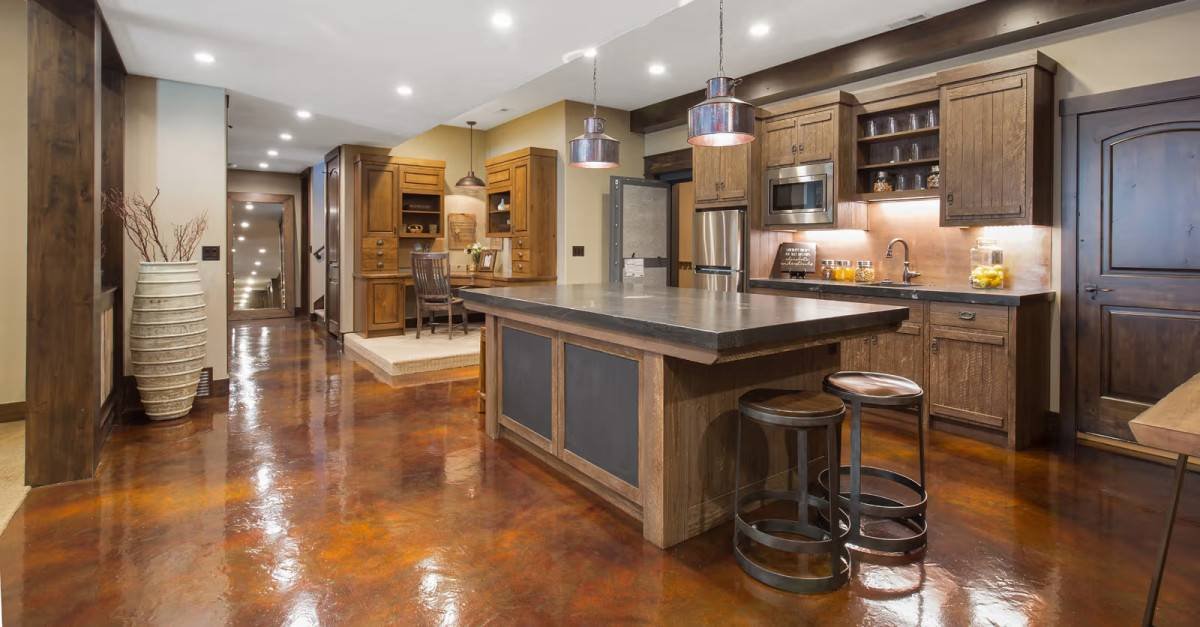
This kitchen flooring cost guide covers what you will pay in 2026. Kitchen flooring costs between $1,000 and $8,000 for a typical 200-square-foot kitchen, depending on the material, the condition of the subfloor, and whether the installation includes removing and disposing of the old flooring. Sheet vinyl costs $600 to $1,500. Luxury vinyl plank costs $1,200 to $3,000, shares Personal Touch Property Management.
Kitchen flooring is the hardest-working floor in the house. It takes spills, dropped pots, chair scrapes, and standing water from the dishwasher that leaked while you were on vacation. The material you choose must survive all of that and still look good when you are standing on it barefoot at 6 a.m. waiting for the coffee to brew. Some materials handle the abuse. Some do not.
Kitchen Flooring Costs by Material
Kitchen flooring materials range from $1 per square foot for sheet vinyl to $25 per square foot for natural stone, with installed costs running $3 to $40 per square foot depending on material, subfloor preparation, and old-floor removal. Here is how eight popular materials compare for a typical 200-square-foot kitchen.
| Material | Cost Per Sq Ft (Material) | Cost Per Sq Ft (Installed) | 200 Sq Ft Total |
| Sheet vinyl | $1 – $3 | $3 – $8 | $600 – $1,600 |
| Luxury vinyl plank (LVP) | $3 – $7 | $6 – $15 | $1,200 – $3,000 |
| Ceramic tile | $3 – $8 | $8 – $20 | $1,600 – $4,000 |
| Porcelain tile | $5 – $12 | $10 – $25 | $2,000 – $5,000 |
| Laminate | $2 – $5 | $5 – $12 | $1,000 – $2,400 |
| Engineered hardwood | $5 – $10 | $10 – $20 | $2,000 – $4,000 |
| Solid hardwood | $8 – $15 | $12 – $30 | $2,400 – $6,000 |
| Natural stone (marble, slate, travertine) | $10 – $25 | $18 – $40 | $3,600 – $8,000 |
The Best Kitchen Flooring Materials — and the Worst
Luxury vinyl plank (LVP) is the best kitchen flooring material for most homeowners. It costs $6 to $15 per square foot installed, is completely waterproof, resists scratches and dents better than hardwood, feels warmer and softer underfoot than tile, and installs as a floating floor with no adhesive — the planks click together and can be walked on the same day. LVP looks convincingly like wood or stone from a standing height. Up close, the texture and repetition of the printed pattern reveal that it is not the real thing. Whether that matters depends on whether you spend more time looking at your kitchen floor or standing on it.
Ceramic and porcelain tile are the most durable kitchen flooring options and the least forgiving. A dropped glass shatters on tile. A dropped pot chips the tile. A barefoot at 6 a.m. finds tile cold and hard. Tile also requires a perfectly flat, deflection-free subfloor — any movement in the subfloor or the joists beneath it will crack the tile or the grout lines. The subfloor preparation for tile is more extensive and more expensive than for any other flooring material. If the subfloor is not ready, the tile installation will fail regardless of how good the tile itself is.
Solid hardwood is the best-looking kitchen floor and the least practical. Wood expands and contracts with humidity changes. Water from a leaking dishwasher, a spilled pot of pasta water, or a refrigerator ice maker line that quietly drips for months will warp, cup, and stain hardwood beyond repair. Engineered hardwood — a plywood core with a real wood veneer on top — is more dimensionally stable than solid wood and a better choice for kitchens, but it is still wood. It will still be damaged by standing water. If the kitchen is open to a dining room or living room with hardwood floors and the homeowner wants a continuous wood floor throughout, engineered hardwood is the compromise. LVP that convincingly matches the adjacent hardwood is the smarter one.
The National Association of Home Builders (NAHB) includes kitchen flooring as one of the top categories in its remodeling cost-vs-value analysis. The material choice influences buyer perception more than most other kitchen surfaces because the floor is the largest uninterrupted visual surface in the room. A dated sheet vinyl floor makes the entire kitchen feel dated, regardless of how new the cabinets and countertops are. The floor anchors the room. If the floor looks old, everything above it looks old too.
Subfloor Preparation and Installation Costs
The subfloor is the layer beneath the finished floor, and its condition determines whether the new floor will last 5 years or 25. A concrete slab in a kitchen on a slab foundation must be flat, dry, and free of cracks that telegraph through the new flooring. A wood subfloor over a basement or crawl space must be flat, rigid, and free of deflection, the bounce or flex that cracks tile and separates vinyl plank seams.
Subfloor preparation adds $1 to $4 per square foot to the total cost depending on what is needed. Minor leveling with a self-leveling compound costs $2 to $4 per square foot. Replacing damaged sections of plywood subfloor costs $3 to $6 per square foot. Adding a cement backer board under tile, required for any tile installation over a wood subfloor, costs $2 to $4 per square foot for materials and installation. Removing old flooring adds $1 to $3 per square foot for demolition and disposal. If the old floor contains asbestos, common in sheet vinyl and vinyl tile installed before 1980, professional abatement costs $5 to $15 per square foot and must be done before the new floor goes down.
Waterproof Flooring, What It Means and What It Does Not
LVP is marketed as waterproof. The planks themselves are waterproof, they are made of PVC and will not swell, warp, or stain when exposed to water. The subfloor underneath the LVP is not waterproof. Water that seeps through the seams between planks, a slow dishwasher leak over months, a spill that is not wiped up promptly, can reach the subfloor and cause mold or rot that is invisible from above. Waterproof flooring means the flooring material will not be damaged by water. It does not mean the subfloor is protected. The distinction matters. An LVP floor over a concrete slab is genuinely waterproof. An LVP floor over a wood subfloor is water-resistant from above and vulnerable from below, the same as any other floating floor.
Frequently Asked Questions
How much does kitchen flooring cost?
Kitchen flooring costs $1,000 to $8,000 for a typical 200-square-foot kitchen. Sheet vinyl costs $600 to $1,500. LVP costs $1,200 to $3,000. Tile costs $1,600 to $5,000. Hardwood costs $2,500 to $6,000. The installed cost includes materials, labor, subfloor preparation, and old-floor removal.
What is the best flooring material for a kitchen?
Luxury vinyl plank (LVP) is the best kitchen flooring for most homeowners. It is waterproof, durable, comfortable underfoot, and costs $6 to $15 per square foot installed. Porcelain tile is more durable but harder and colder. Hardwood is more beautiful but vulnerable to water damage. LVP balances performance, appearance, and cost better than any other kitchen flooring material.
Can hardwood floors be installed in a kitchen?
Yes, but they are vulnerable to water damage from spills, leaks, and humidity. Engineered hardwood is more dimensionally stable than solid hardwood and a better choice for kitchens. If the kitchen is open to adjacent rooms with hardwood, LVP that matches the hardwood is often a smarter choice than extending the wood into the kitchen, the LVP handles the kitchen environment without the water-damage risk.
How long does kitchen flooring last?
Sheet vinyl lasts 10 to 20 years. Laminate lasts 10 to 20 years. LVP lasts 15 to 25 years. Tile lasts 30 to 50 years or more, the tile itself is nearly indestructible; the grout and the subfloor are what eventually fail. Hardwood lasts 30 to 100 years and can be refinished multiple times. The lifespan depends as much on installation quality and subfloor preparation as on the material itself.
Can I install kitchen flooring myself?
LVP and laminate as floating floors are the most DIY-friendly options, the planks click together with no adhesive and can be cut with a utility knife or a chop saw. Sheet vinyl requires precise cutting around cabinets and appliances and is harder to get right than it looks. Tile requires subfloor preparation, thinset mixing, tile cutting, and grouting, skills that take practice to develop. Hardwood installation requires a flooring nailer and experience with layout and board selection. LVP is the best starting point for a first-time flooring DIY project.
Does the kitchen floor need to match the adjacent rooms?
No, but the transition between materials should be intentional, a clean threshold strip, a change in direction, or a deliberate contrast in material. A kitchen floor that is a close-but-not-perfect match to the adjacent hardwood looks like a mistake. A kitchen floor that is clearly different, LVP in the kitchen, hardwood in the dining room, with a visible transition, looks like a choice. Match or contrast. Do not almost-match.
What the Kitchen Floor Should Cost
Luxury vinyl plank costs $1,200 to $3,000 for a typical kitchen and is the right answer for most homeowners. It is waterproof. It is comfortable. It looks like wood from a standing height. It installs in a day. It handles everything a kitchen throws at it, spills, drops, chair legs, wet shoes, the dog’s water bowl that gets kicked over three times a week, without complaint.
Tile is for homeowners who want permanence. Hardwood is for homeowners who want continuity with adjacent rooms and are willing to accept the water risk. Sheet vinyl is for rental properties and budgets that cannot stretch to LVP. The floor takes more abuse than any surface in the house except the roof. Choose the material that survives the abuse, not the material that looks best in the showroom. The showroom does not have a toddler, a dog, and a dishwasher that is about to leak. Your kitchen does. Ever stood in a kitchen in sock feet and felt the floor squish under your weight? That is not the flooring. That is the subfloor, rotting underneath waterproof vinyl planks that did exactly what they were supposed to do — protected themselves while the water seeped through the seams. The floor looked fine. The problem was underneath. It always is.