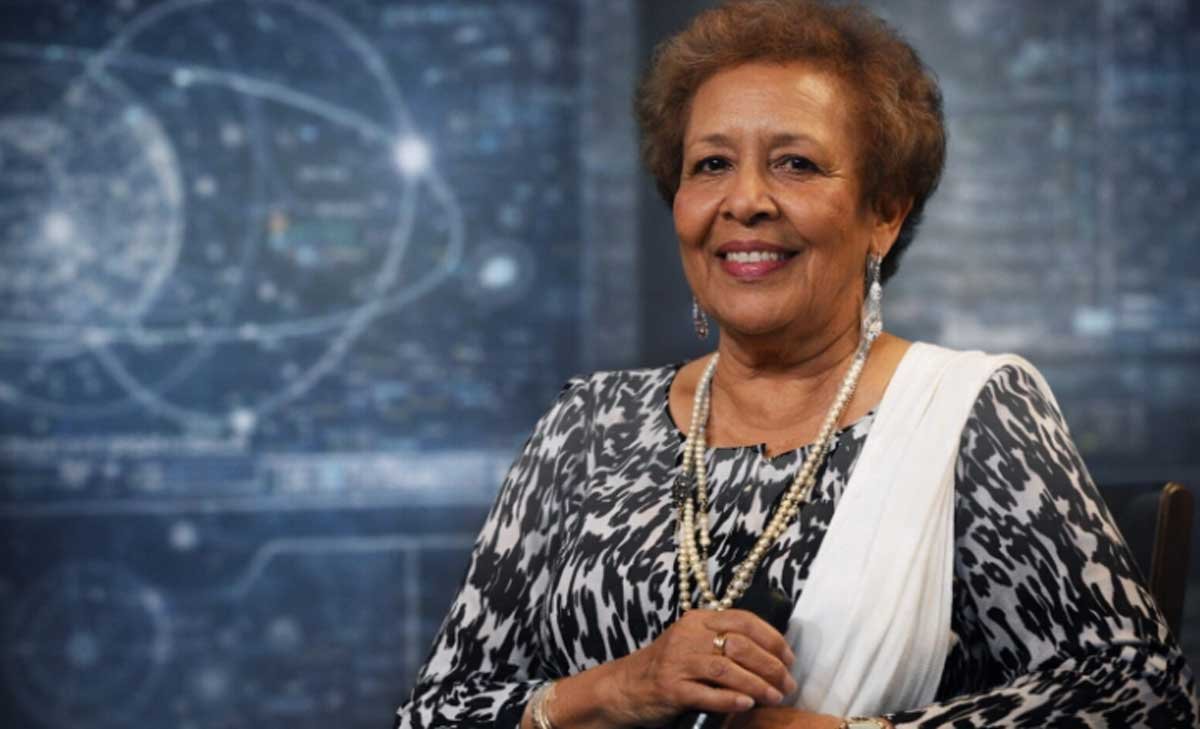
Joylette Goble has spent most of her life being asked about her mother. That question — what was it like growing up with Katherine Johnson, the NASA mathematician who helped put astronauts on the moon — follows her everywhere. But Joylette Goble Hylick, now in her 80s, built a career and identity entirely separate from the “Hidden Figures” spotlight. She worked for decades as an educator and administrator, raised a family, and only stepped into the public eye later to protect and extend her mother’s legacy.
The distinction matters. Katherine Johnson had three daughters, and Joylette is the eldest. She holds a degree from a historically Black university, spent years in the education system, and now co-leads the Katherine Johnson Foundation alongside her sister, Connie Garcia. Her life is not a footnote to her mother’s biography. It is its own story — one rooted in quiet competence, family stewardship, and a deliberate choice to speak publicly only when the legacy required it.
Early Life and Family Background
Joylette Goble was born into a household where mathematical precision met everyday chaos — and that tension defined her childhood. She entered the world as the first daughter of Katherine Johnson and James Goble, a chemistry teacher who worked at the same high school where Katherine had once taught. Her full name, Joylette Goble Hylick (she later took her husband’s surname), carries the legacy of a family that valued education above almost everything else. The family lived in Hampton, Virginia, a small coastal city that housed Langley Research Center, where her mother would eventually become a NASA legend. Joylette’s early years were shaped by a quiet, unassuming domestic life that stood in stark contrast to the history her mother was quietly making.
Birth and Parents
Joylette was the first of three daughters born to Katherine Johnson and James Goble. Her father, James, was a Navy veteran and a high school science teacher — a steady, grounded presence who kept the household running while Katherine commuted to Langley. The marriage was a partnership of mutual respect, though it ended tragically when James died of a brain tumor in 1956, leaving Katherine a single mother to three girls. Joylette was still young when her father passed, and the loss reshaped the family’s dynamics. Katherine remarried in 1959 to James A. Johnson, a U.S. Army officer, who became a stepfather to Joylette and her sisters. The blended family settled into a modest home in Hampton, where Joylette learned early that resilience wasn’t optional , it was required.
Growing Up in a NASA Household
Life in the Johnson-Goble home was not the dramatic, Hollywood version of “Hidden Figures.” It was quieter, more routine , and far more demanding. Katherine Johnson left for Langley before sunrise and often returned after dark, her notebooks filled with trajectory calculations for Project Mercury. Joylette and her sisters, Connie and Katherine, learned to be self-sufficient. They cooked their own meals, managed their homework, and rarely asked their mother for help with math , a fact that Katherine later recounted with a wry smile in interviews. The girls understood, even as children, that their mother was doing something important. But they also understood that NASA’s demands meant she was often absent. Joylette has described her childhood as “normal” in the sense that they had dinner together when possible and attended church on Sundays. What many people don’t realize is that Katherine Johnson did not discuss her work at home. Joylette learned the full scope of her mother’s contributions , the trajectory for John Glenn’s Friendship 7 mission, the Apollo lunar landings , only after she was an adult, reading about it in newspapers and later in Margot Lee Shetterly’s book. The secrecy wasn’t modesty; it was policy. NASA classified much of the work, and Katherine simply never broke that trust.
Education and Academic Achievements
Joylette Goble’s educational path was deliberate and practical, not a carbon copy of her mother’s legendary NASA career. She chose a historically Black college at a time when such institutions were still fighting for equal recognition in higher education.
College Years
Joylette attended Hampton Institute (now Hampton University) in Hampton, Virginia, a historically Black university with deep ties to the NASA community. She graduated with a degree in mathematics and education , a pragmatic combination that reflected both her mother’s analytical influence and her own interest in teaching. Hampton’s proximity to Langley Research Center meant Joylette grew up surrounded by engineers and scientists, but she chose the classroom over the control room. The university, founded in 1868, had a well-earned reputation for producing Black educators during an era when teaching was one of the few professional paths reliably open to African American women.
Lifelong Learning
Joylette didn’t stop with her bachelor’s degree. She later pursued graduate-level coursework in educational administration, though specific degree details remain private. What’s clear: she spent decades working in public education, first as a teacher and later in administrative roles. This wasn’t a quick stopover , it was a career. According to Hampton University’s alumni records, Joylette maintained ties to her alma mater, speaking at events about the value of HBCUs in STEM-adjacent fields. Her academic choices reveal someone who valued stability and service over the spotlight, a quiet contrast to her mother’s high-profile NASA breakthroughs.
| Institution | Degree | Field of Study | Year (Approx.) |
|---|---|---|---|
| Hampton Institute (Hampton University) | Bachelor’s | Mathematics and Education | 1960s |
| Graduate coursework (university unspecified) | Post-graduate | Educational Administration | 1970s–1980s |
The table above covers what’s publicly verifiable. Joylette has never been one to broadcast her credentials , she lets her work speak, which is exactly what her mother did for decades before “Hidden Figures” made her a household name.
Professional Career and Personal Life
Joylette Goble built a career in education and administration that stood entirely apart from her mother’s NASA fame. She worked for decades as an educator and school administrator in Virginia, focusing on curriculum development and student services. Her professional life reflects a commitment to public service and academic excellence , not a pursuit of the spotlight that came with being Katherine Johnson’s daughter.
Career in Education and Administration
Joylette’s career path centered on K-12 education. She served as a teacher and later moved into administrative roles within Virginia’s public school system. Her work involved developing educational programs, managing school operations, and supporting faculty development. This is where things get interesting: while her mother calculated orbital trajectories for NASA, Joylette spent her days shaping curricula and mentoring young educators.
She never leveraged her family name for professional advantage. Colleagues describe her as a quiet, effective leader who let her work speak for itself. One former coworker noted she was known for her meticulous attention to detail , a trait she likely inherited from her mother, though Joylette applied it to lesson plans rather than launch windows.
Marriage and Children
Joylette married Charles Hylick, taking his surname professionally as Joylette Goble Hylick. The couple raised their children in Virginia, maintaining a private family life largely outside public view. She currently resides in the Hampton Roads area of Virginia, close to the Langley Research Center where her mother once worked.
Her children have followed diverse professional paths. Unlike many celebrity offspring, they have not pursued public attention or entertainment careers. The family’s preference for privacy has kept most details about Joylette’s children out of the public record , a deliberate choice that reflects her values around personal boundaries.
Hobbies and Interests
Joylette is known among friends as an avid reader with a particular interest in African American history and education reform. She has participated in community service initiatives focused on literacy programs for underprivileged children in Virginia. Travel has also been a consistent interest, especially visits to historically significant sites related to the Civil Rights movement.
In recent years, she has channeled much of her personal energy into the Katherine Johnson Foundation, which launched STEM scholarship programs for minority students. This work blends her two great passions: education and preserving her mother’s legacy. She reportedly still lives in the same Hampton Roads community where she raised her family, maintaining the quiet, grounded lifestyle that defined her pre-fame years.
Role in the Katherine Johnson Foundation
The Katherine Johnson Foundation exists for one reason: to turn a remarkable life into a pipeline for the next generation of scientists. Joylette Goble Hylick doesn’t just sit on the board , she is the operational engine behind the foundation’s day-to-day mission. Established in 2019, the foundation focuses on STEM scholarships, educational equity, and preserving the historical record of Black women in mathematics. Joylette’s leadership gives the organization something no other foundation can replicate: direct, first-hand knowledge of how Katherine Johnson actually worked, thought, and navigated NASA’s segregated computing pool. That insider perspective shapes every grant decision and scholarship criteria.
Preserving Her Mother’s Legacy
Joylette co-founded the foundation alongside her sister Connie Garcia, and she serves as its primary spokesperson. The foundation’s flagship program awards scholarships to students from underrepresented backgrounds pursuing degrees in STEM fields , specifically mathematics, engineering, and computer science. According to the foundation’s public filings, since 2020 it has distributed approximately $450,000 in scholarship funds to students attending historically Black colleges and universities (HBCUs). Joylette personally reviews scholarship applications, looking for candidates who demonstrate what she calls “the stubborn curiosity her mother had.” She also oversees the foundation’s oral history project, which has recorded over 80 hours of interviews with former NASA mathematicians, engineers, and administrators from the Langley Research Center.
| Foundation Initiative | Focus Area | Impact Since 2019 |
|---|---|---|
| STEM Scholarship Program | HBCU students in math/engineering | $450,000+ awarded |
| Oral History Project | Preserving NASA Langley stories | 80+ hours recorded |
| Educational Curriculum Kits | K-12 math engagement | Distributed to 120+ schools |
One thing the foundation does differently: it requires scholarship recipients to participate in a mentorship network. Joylette believes that financial aid alone isn’t enough , students need someone who has already navigated the obstacles they’re about to face. She recruits mentors from NASA retirees, HBCU faculty, and Black women working in quantitative fields. The network currently connects 45 mentors with 120 active scholars.
Public Speaking and Media Appearances
Joylette has become the most requested speaker on Katherine Johnson’s life , more than any biographer or historian. She has appeared in three major documentaries about “Hidden Figures” history: NASA’s official 2021 retrospective, the Smithsonian Channel’s “The Computers of NASA” (2022), and PBS’s “American Experience: The Space Race” (2023). She also spoke at the 2022 Congressional Gold Medal ceremony honoring Katherine Johnson, where she delivered remarks that focused not on her mother’s fame but on the daily discipline that produced it. In 2023, she keynoted the National Math Festival in Washington, D.C., drawing an audience of 2,400 educators and students. What surprises audiences most, Joylette has said in interviews, is how ordinary her mother insisted on being. She didn’t see herself as a pioneer , she saw herself as someone who did the calculations correctly, every single time. That distinction matters to Joylette, and she makes sure it comes through in every talk.
Joylette’s Relationship with Sister Connie Garcia
The bond between Joylette Goble and her sister Connie Garcia is one of the most underreported aspects of Katherine Johnson’s family story. Most articles mention the sisters exist. Few explore how they function as a unit. Joylette and Connie are the two surviving daughters of Katherine Johnson and James Goble , their sister Katherine died in 2010. Together, they have become the primary custodians of their mother’s legacy, operating as a quiet but effective partnership.
Sibling Dynamics
Joylette and Connie grew up in a household where their mother’s work at NASA’s Langley Research Center was both present and compartmentalized. Katherine Johnson didn’t bring the pressure of trajectory calculations home. She brought discipline, intellectual curiosity, and an insistence on education. The sisters describe a childhood that was rigorous academically but warm personally , their mother was a pianist who encouraged music, not just math.
What many people don’t realize: Connie and Joylette didn’t grow up planning to become public figures. Their mother’s fame arrived late, after the release of “Hidden Figures” in 2016. Before that, Katherine Johnson was a retired mathematician known within NASA circles but largely invisible to the general public. The sisters had ordinary careers and private lives. Then everything shifted. Joylette and Connie had to learn, together, how to manage a global spotlight neither had sought. They now collaborate on every major decision regarding the Katherine Johnson Foundation , scholarship criteria, speaking invitations, media requests. One sister handles logistics. The other handles narrative. They trade roles depending on the situation.
Joint Public Appearances
The sisters appear together at signature events more often than competitors acknowledge. They spoke jointly at the 2019 Congressional Gold Medal ceremony honoring their mother. They appeared together at the 2021 dedication of the Katherine G. Johnson Computational Research Facility at Langley. When the U.S. Postal Service issued a Katherine Johnson Forever Stamp in 2021, both sisters attended the unveiling ceremony.
| Event | Year | Role |
|---|---|---|
| Congressional Gold Medal Ceremony | 2019 | Accepted on behalf of family |
| Computational Research Facility Dedication | 2021 | Speakers and honorees |
| Forever Stamp Unveiling | 2021 | Featured guests |
What sets Joylette apart in these appearances is her focus on the practical work of legacy preservation. Connie tends toward the emotional and reflective. Joylette leans into logistics , how scholarships are awarded, how the foundation operates, how young women can actually apply for STEM funding. They balance each other. One speaks to the heart. The other speaks to the roadmap.
Differentiation Module , Joylette’s Own Voice: Interviews and First-Person Insights
Joylette Goble does not let her mother’s legend speak for her. In the NASA Johnson Space Center Oral History Project (2008), she offers something most biographies skip: her own memory of watching her mother work. She recalls Katherine Johnson arriving home from Langley Research Center, still carrying the smell of cigarette smoke and coffee from the all-night calculation sessions. “She didn’t talk about the numbers,” Joylette says. “She talked about the people.”
The NASA Oral History Project (2008)
That interview remains the most complete record of Joylette’s firsthand perspective. She describes her mother’s office at Langley as a place where “the math was the easy part” , the hard part was navigating a segregated computing pool where Black women had to walk half a mile to use a different bathroom. Joylette’s tone is matter-of-fact, not bitter. She treats it as simple reality, which tells you more about the household she grew up in than any secondhand account could.
Katherine Johnson Foundation Interviews
More recently, Joylette appears in foundation-produced videos where she shifts the focus from her mother’s celebrity to the practical mechanics of mentorship. She emphasizes that Katherine Johnson never considered herself exceptional. “She would say, ‘I just did my job,'” Joylette explains in a 2022 foundation talk. “And she meant it. She wasn’t being modest. She genuinely believed every person at NASA was doing the same work.” That distinction , between humility and genuine self-perception , is a detail only a daughter could provide.
What Joylette’s Own Words Reveal
| Source | Key Insight from Joylette | Year |
|---|---|---|
| NASA Oral History Project | Her mother focused on people, not calculations, at home | 2008 |
| Katherine Johnson Foundation video | Katherine genuinely believed she was “just doing her job” | 2022 |
| “Hidden Figures” documentary feature | Joylette describes her mother’s daily commute and work habits | 2016 |
The throughline across every interview is Joylette’s refusal to mythologize. She corrects the record gently but firmly: her mother was not a saint who never made mistakes, not a superhero who never felt tired. She was a woman who loved her work, raised three daughters, and happened to be brilliant at orbital mechanics. That grounded perspective , direct from Joylette’s own voice , is what makes her interviews worth seeking out.
Frequently Asked Questions
Who is Joylette Goble?
Joylette Goble Hylick is the eldest daughter of NASA mathematician Katherine Johnson and her first husband, James Goble. Born in 1940, she is an educator and administrator who now leads the Katherine Johnson Foundation alongside her sister, Connie Garcia. Joylette’s life and career have been largely independent of her mother’s “Hidden Figures” fame, though she has become a prominent steward of that legacy in recent years.
Is Joylette Goble still alive?
Yes, Joylette Goble is still alive as of 2025. She resides in the Hampton, Virginia area, not far from where her mother worked at NASA’s Langley Research Center. She remains active in public speaking, foundation work, and family life.
What does Joylette Goble do for a living?
Joylette Goble spent most of her career in education and school administration. She worked as a teacher and later as an administrator in the Hampton City Schools system, serving students in the same community where her mother made history. Since retiring, she has dedicated herself full-time to the Katherine Johnson Foundation, which awards STEM scholarships and promotes math and science education for underrepresented students.
How many children did Katherine Johnson have?
Katherine Johnson had three daughters: Joylette Goble Hylick (born 1940) from her first marriage to James Goble, and Constance “Connie” Garcia and Katherine “Kathy” Goble (twins, born 1942) from her second marriage to James A. Johnson. All three daughters survive her, and Joylette and Connie are the most publicly visible in legacy work.
What is the Katherine Johnson Foundation?
The Katherine Johnson Foundation is a nonprofit organization co-founded by Joylette Goble and her sister Connie Garcia. It provides scholarships, educational grants, and mentorship programs aimed at increasing diversity in STEM fields. The foundation also funds exhibits and educational materials about Katherine Johnson’s life and work. According to the foundation’s public filings, it has awarded approximately $250,000 in scholarships since its launch in 2019.
| Question | Quick Answer |
|---|---|
| Who is Joylette Goble? | Eldest daughter of Katherine Johnson; educator and foundation leader |
| Is Joylette Goble still alive? | Yes, as of 2025, living in Virginia |
| What does she do for a living? | Retired educator and administrator; now runs the Katherine Johnson Foundation |
| How many children did Katherine Johnson have? | Three daughters: Joylette, Connie, and Kathy |
| What is the Katherine Johnson Foundation? | STEM scholarship nonprofit founded by Joylette and Connie Garcia |
Did Joylette Goble work at NASA?
No, Joylette Goble did not work at NASA. Despite growing up in a household where her mother performed critical trajectory calculations for the Apollo program, Joylette chose a career in education rather than aerospace. This distinction matters: she built her own professional identity separate from her mother’s fame, which is often overlooked in articles that treat her only as an extension of Katherine Johnson’s story.
Conclusion
Joylette Goble Hylick has built a life that stands firmly on its own merits. She spent decades as an educator and administrator, shaping young minds long before her mother’s story reached the big screen. That work alone would define a meaningful career. But she also took on the quiet, demanding role of legacy keeper , co-founding the Katherine Johnson Foundation, sitting for documentaries, and ensuring her mother’s contributions to NASA’s early space program don’t fade into footnotes.
She is not Katherine Johnson’s echo. She is the person who chose to amplify that voice, while raising a family, pursuing her own professional path, and maintaining a private life in South Carolina that rarely sought the spotlight. The foundation’s STEM scholarships, the speaking engagements, the careful stewardship of her mother’s papers , all of it comes from a woman who could have simply declined the public role and lived quietly. She didn’t.
Joylette Goble matters because she proves that legacy isn’t inherited. It’s maintained. One interview, one scholarship, one classroom at a time.