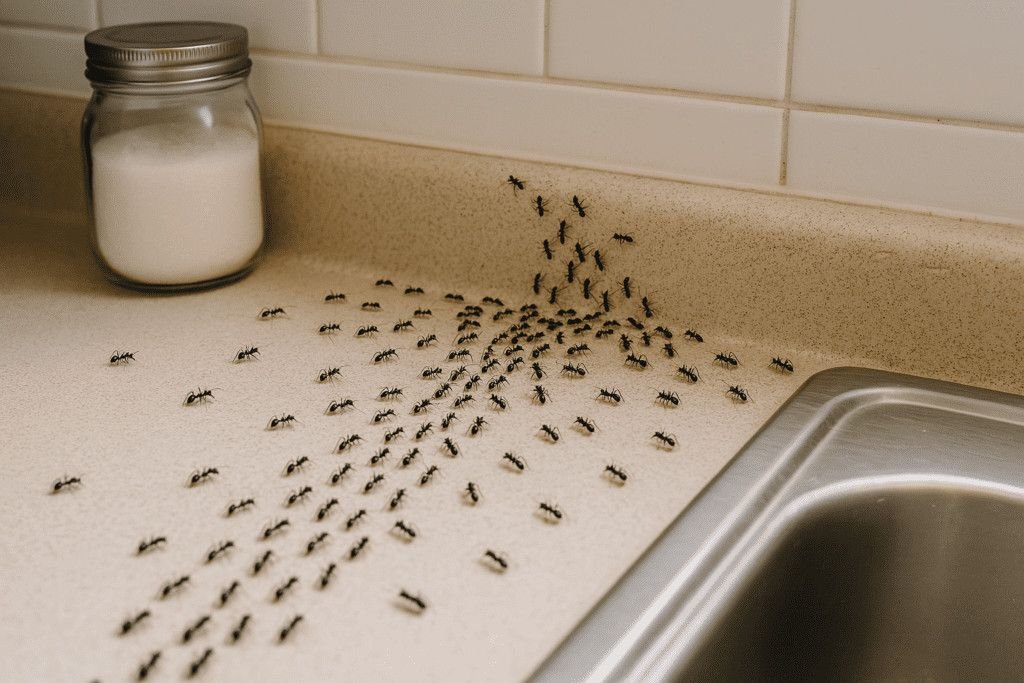
You set your coffee mug down at 6:30 a.m. and a single ant was already climbing the rim, observes the Harcourts Avanti team. By the time you looked at the counter, ten more were weaving through the fruit bowl, and a thin dark line stretched from the backsplash to the honey jar.
You wiped the counter with spray cleaner. The ants were back by lunch.
Why Ants Choose Your Counter Over Every Other Surface in the House
Your kitchen counter is the richest food source in the entire house. Crumbs accumulate in the seam where the counter meets the backsplash. A single drop of juice dried behind the coffee maker three days ago is still sweet enough for an ant to detect and report back to the colony.
Ants navigate by scent gradient, not by sight. A forager that finds a crumb on your counter leaves a pheromone trail all the way back to the nest. That trail cuts through the gap under the window frame, across the sill, and down the face of the cabinet to the floor. Every ant that follows reinforces the trail. Within 24 hours, the path is chemically brighter than anything else in the room.
Spraying the counter with all-purpose cleaner kills the visible ants but does nothing to the pheromone trail. The chemical markers survive most household cleaners. Within hours, new ants from the same colony follow the intact scent path back to the exact same spot on the counter.
Kill the Trail Right Now — Before You Deal With the Colony
You need to break the pheromone trail immediately so no new ants can follow it while you set up bait. Vinegar is the tool for this, but only if you use it correctly.
Mix equal parts white vinegar and water in a spray bottle. Spray every inch of the counter surface, the backsplash, the window frame, and the cabinet face below the counter that the trail touched. Let it sit for two minutes. Wipe dry with a clean paper towel.
Do not use a sponge that has been sitting by the sink. A damp sponge carries food residue and your own scent, and wiping the counter with it after killing the ant trail can actually create new scent signals that confuse the next wave of foragers. Use a fresh paper towel. Throw it away immediately.
Vinegar works because the acetic acid denatures the proteins in the pheromone trail. Standard kitchen cleaners do not contain acid at the right concentration. Spraying vinegar over the trail and then wiping with a sponge soaked in dish soap cancels the effect. Vinegar first, paper towel second, nothing else.
Bait Placement on the Counter — Where and How
Once the old trail is erased, place bait directly on the counter where the ants were entering. You want the next forager that arrives to find bait instead of crumbs. Most people put bait on the floor near the baseboard, which is three feet away from where the ants are actually feeding. Put the bait at the point of entry on the counter itself.
Use a pre-filled liquid bait station like Terro. The enclosed plastic housing keeps the bait contained and prevents it from spilling onto your food preparation surface. If you make DIY bait with borax and sugar water, soak a cotton ball in the mixture and place it on a small square of wax paper or aluminum foil. Do not put liquid bait directly on the counter surface.
Place the bait along the edge of the backsplash exactly where you saw the ant trail. If the ants were entering from the window, place the bait on the sill where the trail crosses it. If they were climbing up the cabinet face from the floor, place a bait station on the counter edge directly above that climb point.
Expect ant activity at the bait station to increase dramatically over the next 12 hours. This is what you want. Each ant that visits takes poison back to the colony. The counter will look worse before it looks better. Do not clean the ants away during this window. Let them work.
Seal the Gap Where the Ant Trail Enters the Counter
The most common counter entry points are invisible unless you look for them. The gap between the backsplash and the countertop is often left uncaulked. Run your fingernail along that seam. If it catches, ants can fit through. The space behind the kitchen faucet baseplate is another highway. The seam where two countertop sections meet at a miter joint is a third.
After the bait has killed the colony, seal every gap you found with clear silicone caulk. For the backsplash-counter seam, run a thin bead of kitchen-grade silicone along the entire length of the joint and smooth it with a damp finger. For the gap behind the faucet, remove the baseplate if possible and fill the hole around the plumbing with copper mesh before replacing the plate.
Caulk alone is not enough if the ants are coming from inside the wall behind the backsplash. In that case, the colony is nesting inside the wall void, and bait must reach them before sealing makes sense. Seal only after 48 hours of zero ant activity.
Countertop edges that overhang cabinets are another overlooked entry zone. Ants climb the cabinet door, reach the underside of the counter overhang, and emerge through the gap between the counter and the cabinet frame. Run a line of clear caulk along the underside of the counter overhang where it meets the cabinet box.
How to Clean the Counter So Ants Never Come Back
Once the colony is dead and the gaps are sealed, the counter itself needs to become ant-proof. This means eliminating every residual food signal that could attract a scout from a new colony next month.
Remove everything from the counter. Every appliance, every jar, every utensil holder. Wipe the entire surface with the vinegar solution. Then, with a dry toothpick, clean the seam between the counter and the backsplash along its entire length. This seam collects crumbs, dried coffee drips, and cooking oil residue that normal wiping misses. The debris you scrape out will confirm why the ants found your counter in the first place.
Store sugar, honey, syrup, and flour in sealed containers with gasketed lids. A screw-top jar with a paper label is not sealed. Ants can walk across the threads of a honey jar and carry a microscopic amount of sugar back to the colony. Transfer everything sticky or powdery into containers with rubber-gasket seals.
Wipe the counter with the vinegar solution once a week for the first month after treatment. This is not about cleanliness. It is about degrading any pheromone fragment that a new scout might detect before it becomes a full trail again.
Counter Material Matters — What Works on Granite vs. Laminate
Granite and quartz counters are non-porous and tolerate vinegar without damage. Spray and wipe freely. Marble counters are calcium-based and will etch if vinegar sits on the surface for more than a few seconds. Spray a small section at a time and wipe immediately.
Laminate counters are fine with vinegar. Butcher block counters are porous wood that absorbs both vinegar and pheromones. Use a mild soap-and-water solution on butcher block instead of vinegar, then follow with a food-grade mineral oil to reseal the surface. Unsealed butcher block is one of the hardest surfaces to make ant-proof because food particles embed in the wood grain.
Stainless steel counters show every ant trail because the reflective surface makes the tiny dark bodies visible against the metal. The upside is you see the first scout immediately. The downside is that stainless steel shows every fingerprint and water spot, and the urge to wipe constantly is hard to resist during baiting. Leave the fingerprints for two days. The ants matter more than the smudges.
Frequently Asked Questions
What smell do ants hate that keeps them off counters?
Vinegar is the only scent with a proven disruption effect on ant trail pheromones. Cinnamon, peppermint oil, cayenne pepper, and coffee grounds are widely cited online, but controlled studies show they repel ants only at extremely close range (within one to two inches). They do not break existing pheromone trails. A cinnamon stick on the counter may deter a single scout from walking directly over it, but it will not stop the colony from sending foragers around it. Use vinegar to erase trails and bait to kill the colony. Skip the spice rack remedies.
Why are ants coming from behind my kitchen counter?
If ants are emerging from the gap between the backsplash and the counter, the colony is likely nesting in the wall void directly behind the backsplash. This is common in kitchens where the exterior wall has unsealed penetrations for plumbing or electrical conduits. The wall void provides darkness, stable temperature, and proximity to the food source on your counter. In this scenario, bait placement on the counter directly in front of the emergence point is critical. The bait must be close enough that foragers find it immediately upon exiting the gap.
Does bleach kill ants on kitchen counters?
Bleach kills ants on contact by oxidizing their exoskeleton, and it degrades pheromone proteins similarly to vinegar. However, bleach is corrosive to most countertop sealants and can discolor laminate, granite, and quartz with repeated use. It is also toxic if residue remains on a food preparation surface. Vinegar achieves the same pheromone disruption without the surface damage or toxicity risk. Use vinegar for trails. Reserve bleach for disinfecting the sink, not the counter where you prepare food.
Can ants live inside my dishwasher and come out onto the counter?
Yes. The dishwasher motor housing, the rubber seal around the door, and the space under the unit where warm moisture accumulates are all attractive nesting sites for odorous house ants. If you see ants on the counter exclusively near the dishwasher, pull the bottom access panel off and inspect underneath with a flashlight. If you find ant activity, place a bait station under the dishwasher, not on the counter. The colony is living below the counter level, and baiting above it will catch foragers but miss the nest.
How long does it take to get rid of ants on the counter completely?
Visible ant activity on the counter should stop within 24 to 48 hours of placing bait at the entry point. The trail disappears as foragers die and no new ones replace them. Full colony elimination takes five to seven days. Continue baiting until you see zero ants anywhere in the kitchen for 48 consecutive hours. The counter will be ant-free before the colony is dead. Do not mistake a clean counter on day two for a solved problem.
The Short Version
Ants on your counter are following a sign you cannot read. Vinegar erases the sign. Bait poisons the destination. Caulk closes the door.
Spray the trail with vinegar and wipe it with a clean paper towel, not the sponge. Place bait exactly where the ants were entering the counter. Wait two days without cleaning, then seal every gap along the backsplash. The counter is food. Stop making it taste like food and the ants stop coming.