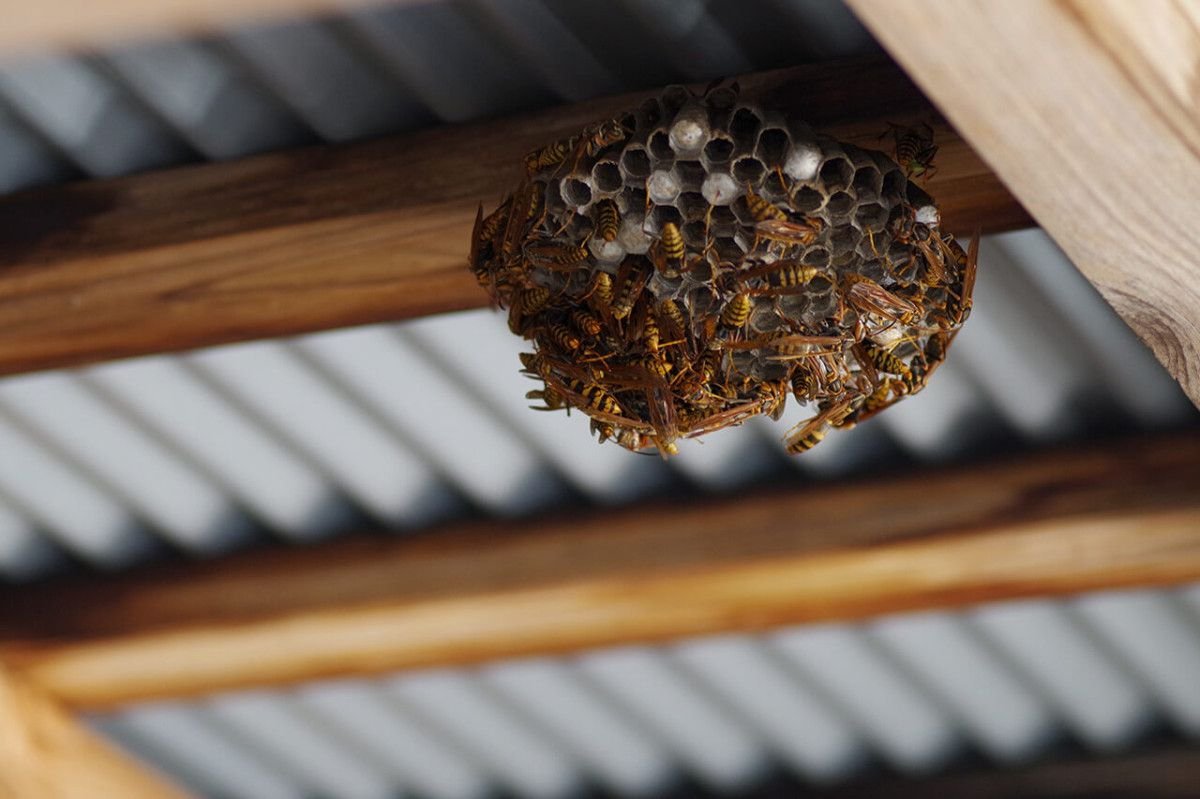
You found it on a Saturday afternoon while mowing the lawn. A gray paper nest the size of a football hanging from the eaves, with a steady stream of wasps entering and leaving through a single hole at the bottom. You backed away slowly, went inside, and opened your laptop, reports Dawson Property Management in Charlotte.
The first question was not how to kill them. It was how much someone else would charge to do it for you.
What Wasp Nest Removal Actually Costs
The national average for professional wasp nest removal is $212 to $875, with most single-nest removals falling between $150 and $400. The range is wide because the price depends entirely on three things: where the nest is, how large it is, and what species built it.
| Nest Location | Typical Cost | Why It Costs What It Costs |
| Eaves or soffit, ground level to 10 feet | $100–$250 | Accessible from the ground with a standard extension pole. One technician. Fifteen to thirty minutes of work. This is the cheapest scenario and the one most online estimates assume. |
| Eaves or gable, 10 to 20 feet | $200–$400 | Requires an extension ladder and a second technician to hold the ladder. The higher the nest, the longer the setup time and the greater the fall risk. |
| Inside a wall void | $400–$800 | Cannot be removed from outside. Technician must drill access holes into the wall, inject insecticidal dust, and patch the holes. Takes one to two hours. The nest remains inside the wall after treatment and decomposes over time. |
| Attic or crawlspace | $300–$700 | Confined space with limited visibility and multiple escape routes for the wasps. Requires full protective suit and a respirator. The technician is working in an enclosed space with agitated wasps. |
| Underground (yellow jackets) | $200–$500 | Yellow jacket nests are in the ground. Treatment requires injecting insecticidal dust into the nest entrance at night when all wasps are inside. The entrance hole may be hidden under vegetation and difficult to locate. |
| Tree or bush, high canopy | $250–$600 | Requires an articulating boom lift or climbing equipment if the nest is above 20 feet. Most pest control companies do not own boom lifts and subcontract the work, which adds a markup. |
The species matters because it determines the nest size and the level of aggression. Paper wasps build small open-comb nests with 20 to 30 adults and are the least aggressive. Their removal costs at the low end of every range. Yellow jackets build underground nests with 1,000 to 4,000 workers and are aggressively defensive. Their removal costs more because the technician needs more time, more insecticide, and more protective equipment.
Why Wasp Removal Costs More Than You Expect
The insecticide costs ten to fifteen dollars. The rest of the bill pays for three things that are not obvious from watching a YouTube video of someone spraying a nest in under three minutes.
The protective equipment and the risk premium account for roughly 40 percent of the bill. A technician treating a yellow jacket nest wears a full-body bee suit with a veiled hood, thick gloves, and rubber boots taped at the ankles. A sting through a bee suit is uncommon but possible, and anaphylaxis is a risk even for technicians who have been stung before without incident. Pest control companies carry workers’ compensation insurance premiums that reflect this risk, and those premiums are built into the price of every nest removal.
Ladder work above ten feet triggers a second-technician requirement at most companies. You are paying for two people because one person cannot safely hold an extension ladder, carry a spray rig, and treat an overhead nest simultaneously. The second technician is not standing around. They are holding the ladder and watching for wasps that have left the nest and are circling back to defend it.
Wall void and attic treatments require drilling, injecting, and patching. These are not extermination jobs. They are construction-adjacent work that requires tools, materials, and the skill to patch drywall or siding to a finished standard. The technician is acting as both an exterminator and a handyman, and the hourly rate reflects both skill sets.
DIY Wasp Nest Removal: What It Costs and When It Is Stupid
A can of wasp and hornet spray that shoots a stream 20 to 27 feet costs $5 to $15 at any hardware store. For a paper wasp nest smaller than a fist, located at eaves height, with a clear approach path and no obstructions, DIY removal at dusk when wasps are inside the nest is straightforward. Spray the nest opening for five seconds. Walk away. Check the nest the next morning. If no activity, knock it down with a broom handle.
The cost calculation changes when the nest is larger than your fist, higher than you can reach with both feet on the ground, or built by yellow jackets. An emergency room visit for multiple wasp stings costs $500 to $3,000 with insurance, more without. Anaphylaxis treatment costs $5,000 to $15,000. The professional removal fee of $200 to $400 is a bargain compared to either outcome.
Never treat a nest from a ladder. Wasps defending a nest do not fly randomly. They fly directly at the threat, which is your face on the ladder. If you get stung while standing on a ladder and your reflex is to swat or jerk away, you fall. The fall from a ten-foot ladder causes more injuries than the wasp stings do. Treat nests only from the ground with a spray that reaches the nest from a position where both feet are planted on solid ground.
Costs That Catch People Off Guard
The fee quoted over the phone is for removal of a single nest under standard access conditions. Here is what adds to the bill after the technician arrives.
Multiple nests on the same property do not simply double the price. The second and third nests are typically discounted by 30 to 50 percent because the technician is already on site with equipment set up. A single nest at $250 plus two additional nests at $125 each totals $500, not $750.
Emergency same-day or weekend service adds a surcharge of $50 to $150 depending on the company and the time of year. Wasp calls peak in July and August, and Saturday appointments in those months book a week in advance. Calling on a Saturday in July and demanding same-day service will cost you the premium rate.
Travel fees apply if you live outside a company’s standard service radius, typically more than 15 to 25 miles from their office. The fee is $25 to $75 and should be disclosed during the phone quote. If it is not disclosed and appears on the invoice, dispute it.
Wall repair after a wall-void treatment is sometimes included and sometimes not. Ask during the quote whether the price includes patching the drill holes. If it does not, expect to pay an additional $50 to $150 for a handyman to fill and paint over quarter-inch holes in drywall or siding.
Does Insurance Cover Wasp Nest Removal?
Homeowners insurance does not cover wasp nest removal. Insurance covers sudden and accidental damage to the structure, not pest control maintenance. If wasps build a nest in your wall and you ignore it for two years until the drywall collapses from the weight of the nest and honeycomb, the resulting structural damage may be covered. The removal of the nest is not.
If you rent, your landlord is responsible for wasp nest removal when the nest is in a common area or when it creates a safety hazard. Document the nest with dated photos, notify the landlord in writing, and reference the implied warranty of habitability in your state if the landlord does not respond within 48 hours. Most states consider an active wasp nest near an entry door or in a frequently used area a habitability issue.
Frequently Asked Questions
Can I remove a wasp nest by myself safely?
Yes, for a small paper wasp nest under six inches in diameter, located at ground-to-eaves height, with a clear approach path. Treat at dusk when wasps are inside and less active. Use a spray rated for 20-plus feet of range. Stand on solid ground, not a ladder. After spraying, leave the area immediately and do not return for at least two hours. If the nest is larger than your fist, higher than you can reach from the ground, or built by yellow jackets, hire a professional.
Why is wasp nest removal so expensive?
The insecticide costs under twenty dollars. The bill covers two people for ladder safety, a full protective suit, workers’ compensation insurance that reflects the real risk of anaphylaxis, and the skill to treat a nest without agitating the colony into attacking the technician, you, or your neighbors. Wall-void nests add drywall repair to the cost. The price reflects the risk, the labor, and the liability, not the chemical.
Does WD-40 kill wasps?
WD-40 kills wasps on contact by coating their exoskeleton and blocking their spiracles, similar to soapy water. It also dissolves the water-resistant coating on the paper nest, which can cause the nest to degrade. However, WD-40 is flammable and should never be sprayed near electrical fixtures, pilot lights, or any ignition source. It is not labeled as an insecticide and using it as one violates the product’s intended use. A $5 can of wasp spray is cheaper, safer, and legally labeled for the task.
What time of year is cheapest to remove a wasp nest?
Spring, specifically April and May, when nests are small and the queen is the only adult. A grape-sized nest in April costs $75 to $150 and takes ten minutes. The same nest in August with 3,000 workers costs $300 to $500. Early intervention is the single biggest cost lever you control.
Finding these colonies when they are small makes treatment much simpler and keeps the population from expanding into a larger property threat. Homeowners who want to secure long-term seasonal support often benefit from scheduling comprehensive pest control in Fayetteville, AR to handle problematic stinging insect populations before severe summer weather patterns peak.
If you see wasps repeatedly entering and leaving the same spot on your eaves in April, call immediately. Do not wait until the nest is visible from the street.
Can I just leave a wasp nest alone?
Yes, if the nest is in a location where no one walks, such as a high tree branch at the back of a large yard, and no one in the household has a known wasp allergy. Wasps abandon the nest in late fall when temperatures drop below 50°F. The nest will not be reused the following year. New queens overwinter in protected locations like woodpiles and attic eaves and build new nests in the spring. Leaving a nest in place does not prevent future nests on the same property.
The Short Version
Professional wasp nest removal costs $150 to $400 for most single nests. Ground-level eaves nests cost the least. Wall voids, attics, and high-tree nests cost the most. Yellow jackets cost more than paper wasps because the colonies are larger and more aggressive.
DIY removal with a $10 spray can works for small paper wasp nests you can reach from the ground at dusk. For everything else, the professional fee is cheaper than the emergency room copay. Call in April when the nest is the size of a grape. By August, you are paying for 3,000 wasps instead of one queen.