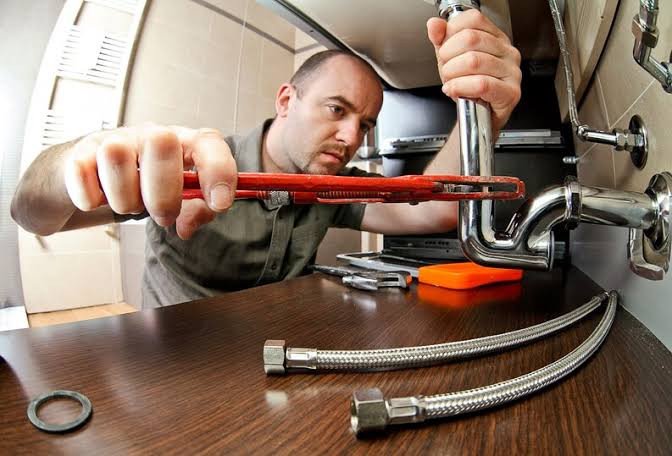
This guide covers common pipe repair problems and fixes — from pinhole leaks to frozen pipes. The most common pipe repair problem is a pinhole leak in a copper pipe — a tiny puncture, smaller than the head of a pin, that sprays a fine mist of water onto everything within a two-foot radius. The pinhole is caused by internal corrosion — pitting corrosion from chemicals in the water, turbulence at a fitting, or electrolysis from contact with a dissimilar metal. The pinhole is the first sign that the pipe is corroding from the inside. The pipe looks fine from the outside. The pipe is perforated from the inside. The pinhole is the warning. The warning is that the pipe has a thin spot. The thin spot will become another pinhole if the underlying cause is not addressed. The repair is a temporary clamp to stop the spray and a call to a plumber to assess whether the affected section needs replacement. The clamp costs $10. The pipe replacement costs $200 to $800. The clamp buys time. The replacement buys permanence.
Pipe problems announce themselves through water, sound, pressure, and color. A dripping joint, a banging noise when a faucet closes, low pressure at a single fixture, or rusty water from the hot tap — each problem has a specific cause and a specific fix. The cause determines whether the fix is a DIY $5 repair or a professional $2,000 pipe replacement. Here are the most common pipe problems, their causes, and their fixes.
Pinhole Leaks in Copper Pipe
| Cause | Symptom | Fix | Cost |
| Pitting corrosion from water chemistry | Fine spray from a tiny hole in pipe wall | Repair clamp (temporary); cut out and replace section (permanent) | $10 temporary; $200–$800 permanent |
| Turbulence at elbow or tee fitting | Pinhole near a fitting | Replace the fitting and the affected pipe section | $200–$500 |
| Electrolysis — contact with dissimilar metal | Corrosion at point of metal contact | Isolate metals with dielectric union; replace corroded section | $200–$600 |
| Flux residue from original soldering | Pinhole near a solder joint | Cut out and replace the affected section | $200–$500 |
Frozen Pipes — Prevention, Thawing, and Repair
A frozen pipe is a burst pipe waiting to happen. Water expands by roughly 9% when it freezes. The expansion creates pressure inside the pipe. The pipe can withstand the pressure, up to a point. That point is typically reached at the weakest section of the pipe, a joint, an elbow, or a section that was already stressed. The pipe bursts. The burst is not discovered until the ice thaws and water flows through the split. The water flows at full pressure. The water fills the wall cavity, the floor cavity, or the basement. The water damage costs $5,000 to $20,000. The burst pipe repair costs $300 to $1,000. The water damage is the expensive part. The burst pipe is the cause.
The fix for a frozen pipe is to thaw it before it bursts. Turn off the main water shutoff, if the pipe bursts during thawing, the water can be stopped quickly. Open the faucet served by the frozen pipe, the open faucet relieves pressure and allows water to flow out as the ice melts. Apply heat to the frozen section, a hair dryer, a heat lamp, a heating pad, or towels soaked in hot water. Do not use an open flame, a propane torch on a frozen pipe can boil the water inside the pipe and cause a steam explosion. The explosion bursts the pipe and burns the house. The hair dryer is safe. The torch is not. The hair dryer thaws the ice. The torch burns the house. Start at the faucet end of the frozen section and work back toward the shutoff. The faucet end is where the water has a place to go when the ice melts. Thawing the pipe from the shutoff end traps water behind the ice plug, the water cannot expand toward the shutoff, so it expands toward the weakest point in the pipe and bursts it. The direction of thawing is important. Thaw toward the shutoff, not away from it.
The Environmental Protection Agency (EPA) recommends insulating pipes in unheated areas, basements, crawl spaces, attics, and garages, to prevent freezing. Pipe insulation costs $1 to $3 per linear foot and prevents the $10,000 water damage from a burst pipe. The insulation is the cheapest freeze protection available. The insulation is the prevention. The burst pipe is the consequence of skipping the insulation.
Water Hammer, Banging Pipes When Faucets Close
Water hammer is the loud bang or series of bangs that occurs when a faucet or a valve closes suddenly. The water that was flowing at full velocity stops instantly. The kinetic energy of the moving water has nowhere to go. The energy creates a pressure spike that travels backward through the pipe at the speed of sound. The pipe bangs against the framing or against adjacent pipes. The bang is the sound of the pressure spike. The pressure spike can eventually weaken joints, crack fittings, and cause the same damage as a frozen pipe, without the ice.
The fix for water hammer is a water hammer arrestor, a small device installed at the fixture or the appliance that causes the hammer. The arrestor contains a piston or a diaphragm separated from an air chamber. The water pressure spike compresses the air. The air absorbs the energy. The pipe does not bang. The arrestor costs $20 to $50 and can be installed by a DIYer with basic plumbing skills, it screws onto the shutoff valve at the washing machine or the dishwasher, or onto the supply stop at the sink. The arrestor is the cushion. The cushion absorbs the spike. The spike is the energy. The energy is dissipated. The pipes are quiet. The quiet is the result. The arrestor is the $30 solution. The damaged fitting from years of water hammer is the $500 repair. The arrestor is cheaper.
Low Water Pressure at a Single Fixture
Low water pressure at one faucet, other faucets in the house have normal pressure, is a localized problem. The most common cause is a clogged aerator. The aerator is the small screen at the tip of the faucet spout. It mixes air with the water to create a smooth stream. It also traps sediment, rust particles, and mineral deposits. Unscrew the aerator, it may require pliers, wrapped in a cloth to prevent scratching the finish. Rinse the screen. Reinstall the aerator. The pressure returns. The fix costs nothing. The time is 2 minutes.
If cleaning the aerator does not restore pressure, the problem may be a kinked supply line, a partially closed shutoff valve, or a clogged cartridge inside the faucet. Check the supply line, a flexible braided line that is bent sharply can restrict flow. Straighten the line. Check the shutoff valve, it may have been partially closed accidentally during cleaning or maintenance. Open it fully. If neither of these restores pressure, the faucet cartridge is clogged with sediment. The cartridge replacement costs $10 to $50 for the part and $150 to $300 for a plumber to replace it. The cartridge is the internal valve. The cartridge directs water and controls temperature. The cartridge that is clogged restricts flow. The cartridge that is replaced restores flow. The flow is the pressure. The pressure is the function. The function is the faucet doing its job.
Leaking Pipe Joints and Fittings
A leaking threaded joint, a fitting that screws onto a pipe, is usually caused by insufficient or deteriorated thread sealant. Teflon tape, white for standard plumbing, yellow for gas, or pipe dope, a paste sealant, must be applied to the male threads before the fitting is screwed on. A joint that was assembled without sealant will leak. A joint that was assembled with sealant that has degraded over 10 to 15 years will eventually leak. The fix is to disassemble the joint, clean the threads, apply new sealant, and reassemble. The fix costs $5 in sealant and takes 15 minutes for an accessible joint. The fix for an inaccessible joint, inside a finished wall, under a concrete floor, requires access and costs $500 to $2,000.
A leaking solder joint, a copper joint that was heated and filled with solder, can sometimes be repaired by re-sweating the joint. The water must be completely drained from the pipe. The joint is heated with a torch until the existing solder melts. Additional solder is applied to fill any gaps. The joint cools and the solder hardens. The repair is only possible if the water can be fully drained, a single drop of water inside the pipe will turn to steam when the pipe is heated and blow a hole through the solder. The steam is the enemy of the solder repair. The pipe must be bone-dry. The pipe that has even a trickle of water running down from a fixture above cannot be soldered. The water will find the joint. The steam will ruin the repair. The alternative is a push-fit fitting, a SharkBite or similar fitting that seals with an O-ring and does not require soldering. The push-fit fitting costs $10 to $25 and replaces the leaking solder joint without a torch. The push-fit fitting is the DIY-friendly alternative to soldering. The push-fit fitting is code-compliant for accessible locations. The push-fit fitting is the solution when the pipe cannot be fully drained.
Frequently Asked Questions
Can I temporarily fix a pinhole leak in a copper pipe myself?
Yes, a repair clamp, a rubber gasket and a metal clamp that wraps around the pipe, stops the leak temporarily. The clamp costs $10 and installs in 5 minutes with a screwdriver. The clamp is temporary. The pipe around the pinhole is thin and will eventually develop another pinhole. Schedule a permanent repair, cut out the affected section and replace it with new pipe. The permanent repair costs $200 to $800.
How do I safely thaw a frozen pipe in my house?
Turn off the main water shutoff. Open the faucet served by the frozen pipe. Apply heat to the frozen section with a hair dryer, a heating pad, or towels soaked in hot water. Start at the faucet end and work back toward the shutoff. Never use an open flame. If you cannot find the frozen section or cannot access it, call a plumber. The plumber has commercial pipe-thawing equipment and can locate the frozen section without cutting into the wall.
Why do my pipes bang when I turn off a faucet or the washing machine stops filling?
Water hammer, a pressure spike caused by the sudden stop of flowing water. The fix is a water hammer arrestor installed at the fixture that causes the bang. The arrestor costs $20 to $50 and absorbs the pressure spike. The bang stops. The pipes are quiet. The arrestor is the permanent fix for water hammer.
Can I use a push-fit fitting as a permanent repair on a copper pipe?
Yes, push-fit fittings such as SharkBite are code-compliant for accessible locations, basements, crawl spaces, utility rooms, and under sinks. They are not code-compliant for inside finished walls or under concrete slabs. The push-fit fitting uses an O-ring to seal against the pipe and stainless steel teeth to grip the pipe. The fitting is permanent. The fitting can be removed with a special tool. The fitting is the DIY alternative to soldering. The fitting works. The fitting is permanent.
Why is my hot water rusty but the cold water runs clear?
Rusty hot water indicates corrosion inside the water heater tank. The glass lining has cracked or worn through. The steel tank is rusting. The rust is suspended in the hot water. The cold water runs clear because it bypasses the tank. The fix is water heater replacement, the tank cannot be repaired. The replacement costs $900 to $2,500.
How do I find a hidden pipe leak inside a wall or under a floor?
Use the water meter test: turn off every fixture, note the meter reading, wait 30 minutes, check again. If the meter moved, there is a leak. If the leak is not at any exposed pipe or fixture, it is hidden. Call a plumber with acoustic leak detection equipment. The plumber uses a sensitive microphone to hear the sound of water escaping from the pipe and can locate the leak to within a few feet without cutting into walls. The detection costs $300 to $800. The exploratory holes in the drywall cost more.
The Pipe That Stops Leaking
A pinhole leak: repair clamp for the temporary fix, plumber for the permanent fix. A frozen pipe: hair dryer, patience, and the correct thawing direction. Water hammer: a $30 arrestor at the fixture. Low pressure at one faucet: clean the aerator first, then check the supply line and the cartridge. A leaking joint: Teflon tape and pipe dope for threaded joints, push-fit fittings for leaking solder joints, when the pipe can be drained. A hidden leak: the water meter test and a plumber with acoustic detection.
Each of these problems has a fix. The fix is either a $10 part and 15 minutes of time, or a $500 plumber visit and a few hours of work. The difference is the accessibility of the pipe and the skill required to repair it. The exposed pipe in the basement is the DIY repair. The pipe inside the finished wall is the plumber’s repair. The pipe under the concrete slab is the plumber’s repair with a jackhammer. The location determines the fix. The fix determines the cost. The cost determines the decision. The decision is either you or the plumber. The pipe does not care who fixes it. The pipe only cares that the fix holds. Ever heard that faint drip-drip-drip from behind the bathroom wall — the sound you convinced yourself was just the house settling or the wind — and then noticed the paint bubbling on the baseboard a month later? The drip was a pinhole leak. The pinhole had been there for a month. The $10 repair clamp would have stopped it on day one. The $10 was not spent. The water traveled down the inside of the wall cavity for a month. The drywall absorbed the water. The baseboard swelled. The paint bubbled. The mold spore count rose. The $10 repair became a $2,000 remediation. The $10 was the bridge between day one and the plumber. The bridge was not crossed. The leak crossed the wall. The leak won. The $10 repair clamp in a drawer would have won. The drawer was closed. The pipe was open. The $10 was the difference. The $10 is still the difference for the next pinhole. Buy the clamp. Keep it in the drawer. The next drip will come. The clamp will be ready.