Recognizing the signs you need roof repair early can save a homeowner thousands of dollars and prevent a manageable patch job from spiraling into a full replacement. Most roof damage announces itself indoors before you ever climb a ladder. A brown water stain on the bedroom ceiling, a musty smell in the upstairs hallway, a patch of shingle granules collecting in the gutter downspout — these are the quiet signals a roof sends before a small repair turns into a five-figure replacement, notes JGE Management.
The trick is knowing which signs mean “patch it this weekend” and which ones mean “start calling contractors before the next storm.” Missing that window is expensive. Catching it early is not.
The Signs You Can Spot From Inside the House
The earliest indicators of roof trouble rarely show up on the roof itself. Water travels down before it travels out, which means your ceiling, walls, and attic give you more useful information than a visual scan of the shingles ever will.
Water Stains on Ceilings and Walls
A yellow, brown, or copper-colored stain on a ceiling or upper wall is the most common red flag. The stain forms when water penetrates the roofing layer, soaks through the decking, and pools against the drywall. By the time the stain is visible from your couch, the leak has probably been active for weeks.
A single isolated stain might mean a punctured shingle or a loose flashing boot around a vent pipe — a $300 to $600 fix. Multiple stains spread across different rooms, especially when they darken after rain, suggest widespread underlayment failure. That is a different conversation entirely.
One detail most guides skip: not all water stains are brown. Older leaks that have dried and re-wet repeatedly can leave gray or black rings that look like mold. If the stain changes size or color between dry weeks and rainy ones, the leak is still active regardless of how old the mark looks.
Daylight Visible Through the Roof Boards
Go into the attic on a sunny afternoon and turn off the light. If you can see pinpoints of daylight through the roof deck, water can get through those same gaps. This check takes thirty seconds and costs nothing.
Small holes around nail pops are common in older roofs and are usually repairable. Long cracks or gaps wide enough to fit a pencil tip mean the decking itself is compromised. That is structural, not cosmetic.
Musty Odors and Peeling Paint
Trapped moisture in an attic breeds mildew long before the ceiling below shows a stain. A persistent musty smell upstairs, especially in closets that back up to attic knee walls, is often the first sensory clue of a slow roof leak.
Peeling or bubbling paint on exterior-facing upper walls can also point to moisture intrusion from the roof edge. Paint fails for plenty of reasons, but when the peeling is concentrated near the ceiling line or around bathroom exhaust fan housings, a roof leak should be high on your list of suspects.
What a Damaged Roof Looks Like From the Outside
Exterior signs are easier to check — you can see most of them from the ground with a pair of binoculars — but they are also easier to misinterpret. A shingle that looks fine from the curb can be failing at the sealant strip where it bonds to the course below.
Missing, Cracked, or Curling Shingles
Shingles that are visibly cracked, curled at the edges, or completely missing are the most obvious sign you need repair. Curling happens when the asphalt in the shingle dries out and the mat contracts — a natural aging process accelerated by poor attic ventilation. Cracked shingles usually follow impact damage from hail or wind-blown debris.
A few missing shingles after a storm is a straightforward repair: $150 to $500 depending on how many need replacing and whether the underlying felt is intact. But if shingles are missing across multiple slopes or the exposed area spans more than a few square feet, check the attic before you call anyone. The decking underneath has been taking direct weather for however long those shingles have been gone.
Granule Loss and Bald Spots
Asphalt shingles shed their ceramic granules over time. A small amount in the gutters is normal, especially on a new roof. But if you are emptying handfuls of granules from the downspout elbows every season, the protective layer is eroding faster than it should.
Bald spots, patches where the black asphalt substrate is visible through the granule surface, mean the shingle has lost its UV protection. Once exposed, the asphalt bakes and cracks within one to two summers. A roof with widespread balding is not repairable in sections. You are looking at replacement.
Sagging or Uneven Rooflines
A roof ridge that dips in the middle or a slope that looks wavy from the street is a structural warning. Sagging usually means the decking underneath has absorbed enough moisture to lose its rigidity, or that a rafter or truss has been compromised.
This is not a DIY situation. A sagging roof can collapse under the weight of a person walking on it. Call a licensed contractor for an assessment, specifically one who does not also sell roofing materials on commission, so the recommendation is about safety and not about upsizing the job.
The Age Factor, When the Calendar Decides for You
An asphalt shingle roof lasts 20 to 30 years under normal conditions. Architectural shingles push toward the high end of that range. Three-tab shingles rarely make it past 20. If your roof is past the 18-year mark and you are seeing any of the signs above, repairs become a temporary measure, not a solution.
The National Roofing Contractors Association (NRCA) recommends a professional inspection at least once every two years once a roof passes the midpoint of its expected lifespan. What looks stable from the ground can hide fasteners backing out and sealant strips separating, small failures that compound into large ones once water finds a path.
Metal and tile roofs age differently. A standing-seam metal roof can last 50 years or more with minimal maintenance, but the fasteners, flashings, and sealants around penetrations have much shorter service lives. The panel might be fine while the flashing around the chimney is silently failing.
After a Storm, Signs That Demand Immediate Attention
High winds, hail, and falling branches create damage that worsens by the hour. After a major storm, walk the perimeter of the house and check for these specific signs before you do anything else.
Shingle fragments in the yard or driveway mean wind uplift tore pieces off the roof, not just loosened them. Check the ridge cap too. A damaged ridge cap lets water enter the highest point of the roof, where it can travel down rafters and spread across multiple rooms before anyone notices.
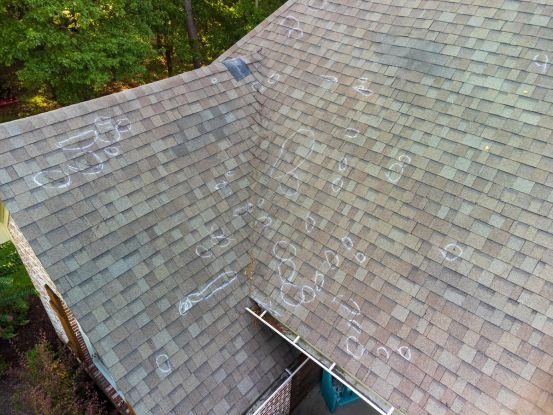
Dents or dimples in metal flashing, gutters, and downspouts are hail indicators. If the soft metal took a beating, the shingles probably did too, even if the damage is not immediately visible from the ground. Hail impact bruises the shingle mat without always breaking the surface. The failure shows up months later as a circular patch where granules have sloughed off.
If a tree limb punched through the roof deck, cover the hole with a tarp secured at the edges and call your insurance company before you call a contractor. The adjuster needs to document the damage before any repair work begins, or the claim can be denied.
What a Five-Minute DIY Inspection Can Catch
You do not need a ladder for most of this. Binoculars from the ground will show you shingle condition, flashing integrity, and ridge alignment across the entire roof in less time than it takes to set up an extension ladder safely.
Check the gutters while you are at it. Granules collect in the bottom of the gutter channel and at the mouth of the downspout. If the accumulation looks like coarse black sand, the shingles are shedding at an accelerated rate. More importantly, if you find pieces of shingle themselves, not granules, but actual fragments of asphalt mat, wind damage has already occurred.
Inside the attic, look at the underside of the roof deck with a flashlight. Water stains on the wood, darkened areas around nails, or white mineral deposits where water evaporated are all signs of past or active leaks. Touch the wood if you can reach it safely. Soft or spongy decking means rot, and rot means the repair just got structural.
When the Signs Point to Replacement, Not Repair
Some damage patterns cross a line from fixable to full replacement regardless of your budget, and fighting that reality costs more than accepting it. Here is where the repair-or-replace line sits for the most common scenarios.
If more than 30% of the roof surface shows visible damage, missing shingles, curling, balding, or granule loss, replacing the entire roof usually costs less per year than chasing individual repairs. A roofer patching a roof that is already failing in multiple zones is fighting a rearguard action. Every repair creates a watertight seam against an aging surface that is actively degrading around it.
If the decking in more than two areas is soft or rotted, you are already past the point where repair makes sense. The roofer has to pull up shingles, replace the decking, re-felt, and re-shingle those sections. The labor involved in doing that for scattered patches across the roof is nearly the same as doing it everywhere at once.
The most expensive mistake homeowners make is delaying replacement by two or three years of incremental repairs. A $500 patch now, a $900 flashing fix next spring, a $2,200 decking replacement the year after, suddenly you have spent $3,600 on a roof that still leaks and still needs a full $12,000 replacement. The numbers do not lie. Neither does the water stain spreading across the ceiling. Sound familiar?
Frequently Asked Questions
How do I know if I need roof repair or a full replacement?
If the damage covers less than 30% of the roof surface and the roof is under 15 years old, repair is usually sufficient. If more than 30% of shingles show curling, balding, or granule loss, or the roof is past 20 years old, replacement is the better financial decision. A professional inspection can confirm which category you are in.
Can a water stain on the ceiling mean something other than a roof leak?
Yes. Water stains near bathrooms can come from leaking supply lines or shower pan failures. Stains around HVAC vents may be condensation. Stains directly under the roofline that appear or darken after rain are almost certainly roof-related. Trace the stain upward, if it aligns with a roof penetration like a vent pipe, chimney, or valley, the roof is the likely source.
What should I do if I see daylight through my attic roof boards?
Mark the spots with tape or chalk so a contractor can find them from above. Small pinholes around nail pops are usually repairable. Gaps larger than a quarter-inch or cracks running along the grain of the plywood indicate decking failure and require a contractor to assess whether the structural layer needs replacement.
How often should I inspect my roof?
Do a visual check from the ground twice a year, once in spring and once after fall leaf drop, and check the attic with a flashlight annually. After any storm with winds above 50 mph or hail larger than a dime, inspect within 48 hours. Professional inspections are recommended every two years for roofs older than 10 years.
Does homeowners insurance cover roof repair for these signs?
Insurance covers sudden, accidental damage from storms, hail, wind, and falling objects. It does not cover gradual deterioration from age, lack of maintenance, or normal wear. If a storm ripped shingles off last week, that is a claim. If the roof is 25 years old and the shingles are curling at the edges, that is on you.
Can I do a roof inspection myself, or do I need a professional?
You can do a ground-level visual check and an attic inspection yourself safely. Climbing onto the roof is not recommended, falls are the leading cause of roofing-related injuries among homeowners. If you see warning signs from the ground or attic, call a licensed contractor for the on-roof assessment.
When to Stop Looking and Start Calling
A roof that is quietly failing looks fine from the street until the day it does not. The signs are there, in the attic, in the gutters, in the paint on the upstairs walls, but they do not shout. They whisper. For a while.
Water stains, granule buildup, curling shingles, spongy decking: any one of these is a reason to make the call. All of them together is a reason to make it today.