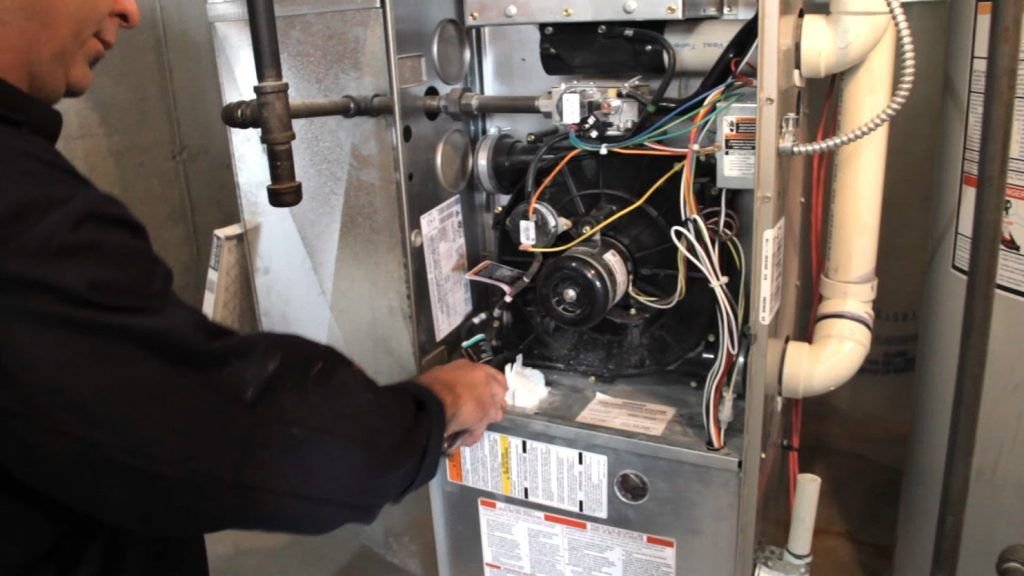
According to 33 Property Management experts, a condensing furnace is a heating system that extracts so much heat from its combustion gases that the water vapor inside those gases condenses into liquid water before exiting the house. The furnace deliberately cools its own exhaust below the dew point to capture the latent heat released when steam turns back into water — the same physics that makes a glass of ice water sweat on a summer day, applied inside a steel heat exchanger at 130°F.
A standard furnace vents combustion gases at 300°F to 400°F and achieves roughly 80% efficiency. A condensing furnace vents those same gases at 100°F to 120°F and achieves 90% to 98.5% efficiency. The 10% to 18.5% gain is the energy that was previously escaping up the chimney as hot water vapor — energy that the condensing furnace recovers by forcing a phase change.
What Makes a Furnace “Condensing”: The Secondary Heat Exchanger
The feature that distinguishes a condensing furnace from every other type is the secondary heat exchanger. A standard furnace has one heat exchanger: combustion gases pass through a set of metal tubes, the blower pushes air across the outside of those tubes to warm the house, and the gases exit at 300°F to 400°F. At that temperature, all the water vapor produced by burning fuel stays in vapor form and goes out the chimney.
A condensing furnace adds a second heat exchanger downstream of the first.
The combustion gases, already cooled to roughly 350°F by the primary exchanger, enter a stainless steel secondary exchanger where the blower pulls additional heat out of the stream.
The gases cool below roughly 135°F (the dew point of natural gas combustion products), and the water vapor undergoes a phase change from gas to liquid.
For every pound of water that condenses, the furnace captures approximately 970 BTU of latent heat that a standard furnace loses.
The condensed water is mildly acidic (pH 3.5 to 5.0) because the combustion of natural gas produces trace amounts of nitrogen oxides and sulfur compounds that dissolve into the water.
This condensate drains through a PVC pipe to a floor drain, a condensate pump, or outdoors. The exhaust gases, now cool enough that you could hold your hand in the stream without injury, are pushed out through PVC or CPVC pipe rather than a metal chimney.
Why PVC instead of metal? The exhaust from a condensing furnace is too cool to rise up a chimney by natural buoyancy. It needs a fan to push it out. And because the exhaust is wet and acidic, it would corrode a standard metal flue in a few heating seasons. PVC is immune to the acid and handles the low temperature without issue.
AFUE: The Number That Tells You How Much Fuel Becomes Heat
Every furnace sold in the United States carries an AFUE rating — Annual Fuel Utilization Efficiency. The Federal Trade Commission mandates the label. An AFUE of 95% means that over a typical heating season, 95% of the energy in the fuel becomes useful heat delivered to the home, and 5% is lost (mostly as warm exhaust). The Department of Energy groups furnaces into three tiers based on AFUE and the technology that achieves it.
| Efficiency Class | AFUE | Heat Exchanger | Exhaust Temp | Venting | Condensing?
|
| Low-efficiency | 56-70% | 1 (primary) | 400-600°F | Masonry chimney | No |
| Mid-efficiency | 80-83% | 1 (primary, improved) | 300-400°F | Metal B-vent | No |
| High-efficiency (condensing) | 90-98.5% | 2 (primary + stainless secondary) | 100-120°F | PVC through wall | Yes |
The DOE estimates that replacing a 56% AFUE furnace with a 90% condensing unit reduces CO2 emissions by 1.5 tons per year for natural gas and 2.5 tons per year for oil. That reduction is roughly equivalent to driving a gasoline car 3,300 fewer miles annually.
Gas vs. Oil Condensing Furnaces: The Same Physics, Different Fuels
Condensing technology is most common in natural gas furnaces, but it is also available for oil-fired systems. The physics are identical: cool the combustion gases below the dew point, capture the latent heat from condensing water vapor, and drain the acidic condensate. The differences are in the fuel chemistry and the practical challenges.
| Characteristic | Natural Gas Condensing | Oil Condensing
|
| AFUE range | 90-98.5% | 90-95% |
| Condensate pH | 3.5-5.0 (mildly acidic) | 2.0-3.5 (more acidic) |
| Condensate volume | ~5-10 gallons/day | ~3-6 gallons/day |
| Sulfur in fuel | Negligible (pipeline gas) | 0.05-0.5% (produces sulfuric acid in condensate) |
| Heat exchanger material | Stainless steel (304 or 316) | High-grade stainless (316L or AL-6XN) |
| Installed cost | $4,000-$8,500 | $5,500-$10,000 |
| Market availability | Widely available | Limited models (Adams, Granby, some Buderus) |
Oil condensing furnaces are rare in North America. The higher sulfur content in heating oil produces sulfuric acid in the condensate, which requires a more corrosion-resistant heat exchanger and a condensate neutralizer that can handle the lower pH. The additional manufacturing cost, combined with the smaller oil-heat market, means fewer manufacturers offer condensing oil furnaces. For most homeowners with oil heat, the upgrade path is either a high-efficiency non-condensing oil furnace (85-87% AFUE) or a conversion to natural gas or a heat pump.
Sealed Combustion: The Other Defining Feature
Nearly every condensing furnace sold today uses sealed combustion. Instead of drawing combustion air from inside the house — which is what a standard 80% furnace does — a sealed-combustion furnace pulls outside air directly into the burner through a dedicated PVC intake pipe. The exhaust goes out through a second PVC pipe. The combustion loop is completely isolated from the indoor air.
The DOE specifically recommends sealed combustion for high-efficiency furnaces. The benefits extend beyond efficiency. A sealed-combustion furnace cannot backdraft, which is the condition where negative pressure inside the house pulls combustion gases — including carbon monoxide — down the chimney and into the living space. Backdrafting kills roughly 400 people per year in the United States from CO poisoning, and sealed combustion eliminates the mechanism entirely.
Sealed combustion also avoids the energy penalty of the standard furnace design. An 80% furnace draws heated indoor air into the burner, consumes its oxygen, and vents the combustion products outside. That air has already been warmed to room temperature by the furnace itself, and now it is being sent up the chimney. A sealed-combustion furnace never touches conditioned indoor air — it pulls cold outside air, burns it, and vents it. The DOE estimates that sealed combustion saves an additional 3% to 5% beyond what the AFUE number measures, because AFUE does not account for the energy penalty of using conditioned air for combustion.
Why Condensing Furnaces Exist: The Regulatory History
Condensing furnace technology emerged in the early 1980s, driven not by consumer demand but by federal energy policy. The National Appliance Energy Conservation Act of 1987 authorized the DOE to set minimum efficiency standards for residential furnaces. In 1992, the DOE established a two-tier standard: 78% AFUE minimum for furnaces in southern states and 90% minimum for northern states.
The 90% standard for the northern zone could not be met without a secondary heat exchanger. No amount of incremental improvement to the primary heat exchanger would push efficiency past roughly 84% — the physics of combustion gas temperature simply did not allow it. The 1992 rule effectively mandated condensing furnace technology for the northern third of the United States. Manufacturers had roughly five years between the 1987 authorizing legislation and the 1992 rule to develop reliable condensing designs, and they largely succeeded.
Today, condensing furnaces account for roughly 80% of all new furnace installations in the U.S., even in southern states where 80% units are still legal. The price gap between condensing and non-condensing has narrowed over three decades of manufacturing refinement, and the variable-speed ECM blowers and communicating thermostats that accompany modern condensing furnaces have made the efficiency gain secondary to the comfort improvement for many buyers.
Condensing Furnace Cost and Savings
A condensing furnace costs more to buy and install than a standard 80% unit. The price gap ranges from $1,500 to $3,000 depending on the brand, the installer, and whether the installation requires running new PVC vent pipes through a finished wall.
| Furnace Type | Installed Cost | Yearly Fuel (Cold Climate) | Annual Savings vs 80% | Payback
|
| Standard 80% AFUE | $2,500-$3,800 | $1,200-$1,400 | Baseline | Baseline |
| Condensing 92% AFUE | $4,000-$5,500 | $950-$1,150 | $250 | 6-8 years |
| Condensing 95% AFUE | $4,500-$6,500 | $850-$1,000 | $350-$400 | 4-6 years |
| Condensing 98.5% AFUE (modulating) | $5,500-$8,500 | $650-$800 | $550-$600 | 5-7 years |
Federal tax credits under the Inflation Reduction Act cover condensing furnaces with AFUE of 97% or higher, up to $600 through 2032. State-level rebates can add $500 to $1,250 depending on location. The net installed cost of a qualifying condensing furnace, after credits and rebates, often equals or beats the cost of a standard 80% furnace in states with aggressive efficiency programs.
FAQ: Common Questions About Condensing Furnaces
Is a condensing furnace worth the extra cost?
In a cold climate with a natural gas heating bill above $800 per year, yes — the fuel savings recover the price premium in 4 to 8 years. In a mild climate where the annual heating bill is under $500, the payback stretches past 15 years, and a standard 80% furnace or a heat pump may be a better financial choice.
What happens if the exhaust pipe freezes in winter?
The exhaust pipe on a properly installed condensing furnace does not freeze. The exhaust gases are 100°F to 120°F — warm enough to prevent ice formation in the pipe. The white plume visible on cold days is water vapor condensing after it exits, not ice forming inside. The condensate drain line can freeze if routed through an unheated space, and that will shut down the furnace on a safety float switch.
My old house does not have a floor drain near the furnace. Can I still get a condensing furnace?
Yes. A condensate pump (a small electric pump in a shoebox-sized reservoir) pushes the condensate through ¼-inch vinyl tubing to a laundry sink, washing machine drain, or outside. The pump adds $60 to $150 to the installation and requires a nearby electrical outlet.
Condensing furnace vs. heat pump: which is better?
In a cold climate (Zone 4 or higher), a condensing gas furnace is generally the better primary heat source because a standard air-source heat pump loses capacity as outdoor temperatures drop. In a moderate or warm climate, a cold-climate heat pump can match or beat a condensing furnace on operating cost and eliminates the gas connection entirely. Dual-fuel systems that pair a heat pump with a condensing furnace for backup offer the lowest annual operating cost in most climates but carry the highest installed cost ($9,000 to $14,000).
Does a condensing furnace need more maintenance than a standard one?
The condensate drain and trap should be cleaned annually — a 10-minute job — to prevent clogs from dust, debris, or algae. The secondary heat exchanger should be visually inspected for corrosion every 2 to 3 years. Beyond those two items, the maintenance schedule is the same as a standard furnace: filter changes every 1 to 3 months and a professional inspection every 1 to 2 years.
A Condensing Furnace Wrings Every Possible BTU Out of the Flame
The name is literal: the furnace forces water vapor in the exhaust to condense into liquid, and in doing so, it captures heat that would otherwise warm the outdoors. The secondary stainless steel heat exchanger, the PVC vent pipes, and the condensate drain are the three physical manifestations of that single idea.
The 1992 DOE efficiency standards made condensing furnaces mandatory in the northern U.S. and drove three decades of refinement that brought the price down and the reliability up. Today, for most homeowners in cold climates replacing a furnace, a condensing unit is not an upgrade — it is the default, and the only question is which AFUE tier and which brand fit the budget.