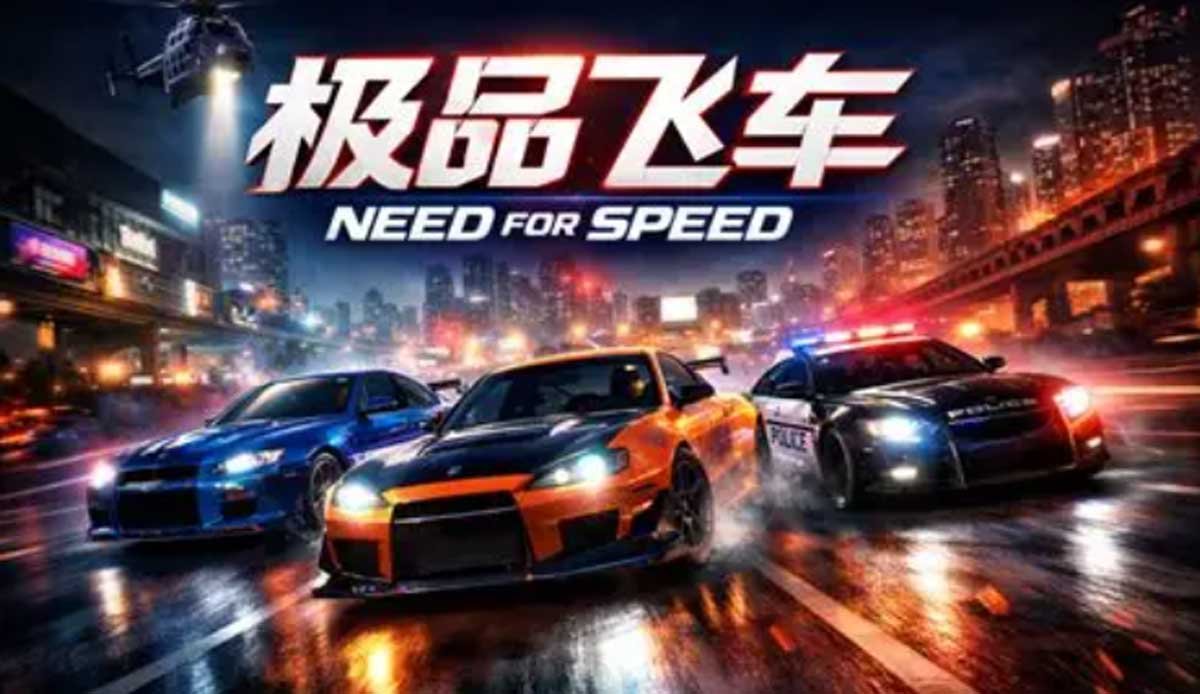
Jipinfeiche usually refers to 极品飞车, the Mainland Chinese title for Electronic Arts’ Need for Speed racing game series. The word is not a separate car brand, secret racing technology, or new mobile app.
The useful answer is simple: when you see “jipinfeiche” online, you are probably looking at a no-tone pinyin version of the Chinese name for Need for Speed. That tiny spelling detail matters, because several English pages now treat the term as if it were a standalone idea.
What Jipinfeiche Actually Means
Jipinfeiche is the plain-letter pinyin form of 极品飞车, often represented in numeric tone notation as ji2 pin3 fei1 che1. In gaming contexts, it points to Need for Speed, the long-running racing series published by Electronic Arts.
The phrase can be broken into two parts. 极品 roughly means “top grade” or “premium,” while 飞车 literally suggests a fast or flying car, though nobody should read the title as a technical phrase.
| Form | What It Means | When You See It |
|---|---|---|
| 极品飞车 | Mainland Chinese title for Need for Speed | Chinese game pages, forums, wikis, stores |
| ji2 pin3 fei1 che1 | Pinyin tone-number notation | Language learning, dictionaries, romanization notes |
| jipinfeiche | No-tone pinyin spelling | Search snippets, URLs, transliterated pages |
| Need for Speed | English franchise name | EA pages, global game stores, reviews |
That is the part many thin explainers miss. The word does have a literal translation, but the title’s real job is branding: it is the Chinese name attached to a known game franchise.
Why the Word Points to Need for Speed
The strongest reading of jipinfeiche is not metaphorical. It is a romanized path back to Need for Speed, a racing franchise that began in the 1990s and became one of Electronic Arts’ best-known game brands.
EA’s own Need for Speed hub presents the series under its English name, while Chinese-language reference pages use 极品飞车 for the same franchise. The Chinese Wikipedia entry for 极品飞车系列 identifies it as the Need for Speed series from Electronic Arts.
So if a page says “jipinfeiche download,” “jipinfeiche series,” or “jipinfeiche versions,” read it as a clumsy or simplified reference to Need for Speed. It may be machine-translated, written for Chinese users, or generated from a slug that strips Chinese characters out of the URL.
Not always. A few new pages use the term as a broad symbol for speed, precision, and racing culture, but that reading is weaker unless the page clearly defines its own concept.
Literal Translation vs. Game Title
A literal translation of jipinfeiche can sound dramatic: something like “premium flying car” or “top-class speed car.” That translation is useful for language curiosity, but it is not how players normally understand the phrase.
Game titles often change shape across languages. They need to sound punchy, fit local expectations, and stay memorable on a store shelf or forum thread.
In practice, 极品飞车 works because it carries the feeling of extreme speed and desirable cars without trying to mirror “Need for Speed” word for word. The title is more like a localized identity than a direct translation.
| Question | Better Reading | Weak Reading |
|---|---|---|
| Is jipinfeiche a Chinese phrase? | Yes, it is pinyin for 极品飞车. | It is not standard English gaming terminology. |
| Does it literally mean Need for Speed? | No, but it is the localized Chinese title. | A word-for-word translation misses the point. |
| Is it a separate game? | Usually no, it points to the franchise. | Do not assume it names a new release. |
| Can it be used symbolically? | Sometimes, if the writer defines it that way. | Most search results still lean toward the game name. |
The Need for Speed Context Behind Jipinfeiche
Need for Speed is a racing game franchise built around high-speed driving, police pursuits, street racing style, exotic cars, and arcade-friendly handling. The first game, The Need for Speed, was released in 1994.
Across the series, the tone has shifted several times. Some entries focus on police chases, some on underground street-racing culture, and others on more polished car collecting, customization, and open-world driving.
That variety is why a bare mention of jipinfeiche can feel vague. One person may mean the whole franchise, while another may mean a specific entry such as Underground, Most Wanted, Hot Pursuit, Heat, or Unbound.
| Era | Representative Focus | Why Players Remember It |
|---|---|---|
| 1994 to early 2000s | Sports cars, tracks, police pursuit roots | The series established its arcade-racing identity. |
| 2003 to 2006 | Underground tuning and street racing | Customization, city nights, and car-culture style became central. |
| 2010 to 2013 | Hot Pursuit, Most Wanted, Rivals | Police-vs-racer structure returned with faster modern presentation. |
| 2015 to 2022 | Reboots, Heat, Unbound | Open-world racing, style systems, and visual identity kept changing. |
The most recent mainline reference point commonly listed on EA’s official pages is Need for Speed Unbound, released on December 2, 2022 for PlayStation 5, Xbox Series X|S, and PC. Because game catalogs can change, release claims should be checked against EA or platform store pages before treating them as current.
Common Misreadings When You See Jipinfeiche Online
The biggest mistake is treating jipinfeiche as a mysterious English keyword. It looks unfamiliar only because Chinese characters have been converted into plain Latin letters.
This often happens in URLs. A Chinese title may become pinyin so the address stays readable to systems that dislike non-Latin characters, and then an English reader meets the pinyin without the original Chinese context.
- It is probably not a car model.
- It is probably not a racing team or motorsport league.
- It is probably not a cheat engine, mod tool, or launcher.
- It is often a Chinese-language reference to Need for Speed.
- It can occasionally be used by a writer as a loose metaphor for racing performance.
Small annoyance, real consequence: once the Chinese characters disappear, the term becomes easy for low-quality pages to inflate into something grander than it is. A plain title turns into a fake philosophy if nobody checks the source language.
Which Need for Speed Game People May Mean
When a page uses jipinfeiche without an English subtitle, the safest assumption is the full Need for Speed series. To identify the exact game, look for a number, year, subtitle, cover art, or platform listing near the term.
Chinese game portals often list entries by number, such as 极品飞车9 for Most Wanted 2005 or 极品飞车21 for Heat. That numbering can be convenient, but it is not always how EA markets the games globally.
| Chinese Clue | Likely English Context | What To Check |
|---|---|---|
| 极品飞车9 | Need for Speed: Most Wanted from 2005 | Release year and Blacklist references |
| 地下狂飙 | Underground era | Night racing, tuning, urban style |
| 热力追踪 | Hot Pursuit | Police pursuit focus |
| 热度 | Need for Speed Heat | Day-night reputation system |
| 桘骜不驯 | Need for Speed Unbound | Stylized effects and Lakeshore setting |
This is where context saves time. A download page, a wiki entry, and a fan discussion can all use the same Chinese franchise name while pointing to different games.
Why This Keyword Became Confusing
Jipinfeiche is confusing because it sits between Chinese naming, pinyin romanization, and English-language SEO pages, so each layer removes a little context from the original game title.
Chinese readers see 极品飞车 and recognize the game name. English readers see “jipinfeiche” and may assume it is a fresh concept, especially when pages avoid showing the original characters.
There is also a second problem. Some articles describe jipinfeiche as a performance philosophy, mixing racing, business strategy, and technology language, but they do not prove that the term is used that way outside the article itself.
A careful reading should start with the known entity first. The known entity is Need for Speed.
Quick Answer for Readers
Jipinfeiche means 极品飞车 in no-tone pinyin, and 极品飞车 is the Mainland Chinese title for Need for Speed. Treat it as a Chinese gaming title unless the page gives a clear reason to read it differently.
If you are checking a game listing, match the Chinese subtitle to an English release name before downloading anything, quoting it, or assuming it is a new game. That one check prevents most of the confusion.
FAQ
Is jipinfeiche the same as Need for Speed?
Yes, in most gaming contexts jipinfeiche refers to 极品飞车, the Chinese title for Need for Speed. It is the pinyin spelling, not a separate franchise.
What language is jipinfeiche?
Jipinfeiche is pinyin, the romanization system used to write Mandarin Chinese sounds with Latin letters. The Chinese characters are 极品飞车.
Does jipinfeiche name a new game?
No, the word usually points to the Need for Speed series or one of its Chinese-listed entries. Check nearby subtitles, years, and platform names to identify the exact game.
Why do some pages call jipinfeiche a racing philosophy?
Some English pages use the word loosely as a symbol for high-performance racing, but that is not the strongest sourced meaning. The more reliable meaning is the Chinese Need for Speed title.
How do you pronounce jipinfeiche?
A rough pronunciation is jee-pin fay-chuh, though Mandarin tones matter. For plain text notes, ji2 pin3 fei1 che1 is a practical tone-number form.
Final Take
Read jipinfeiche as a language clue before treating it as a new thing. The word leads back to 极品飞车, and 极品飞车 leads back to Need for Speed.
That is enough. Once the Chinese title is restored, the mystery mostly disappears.