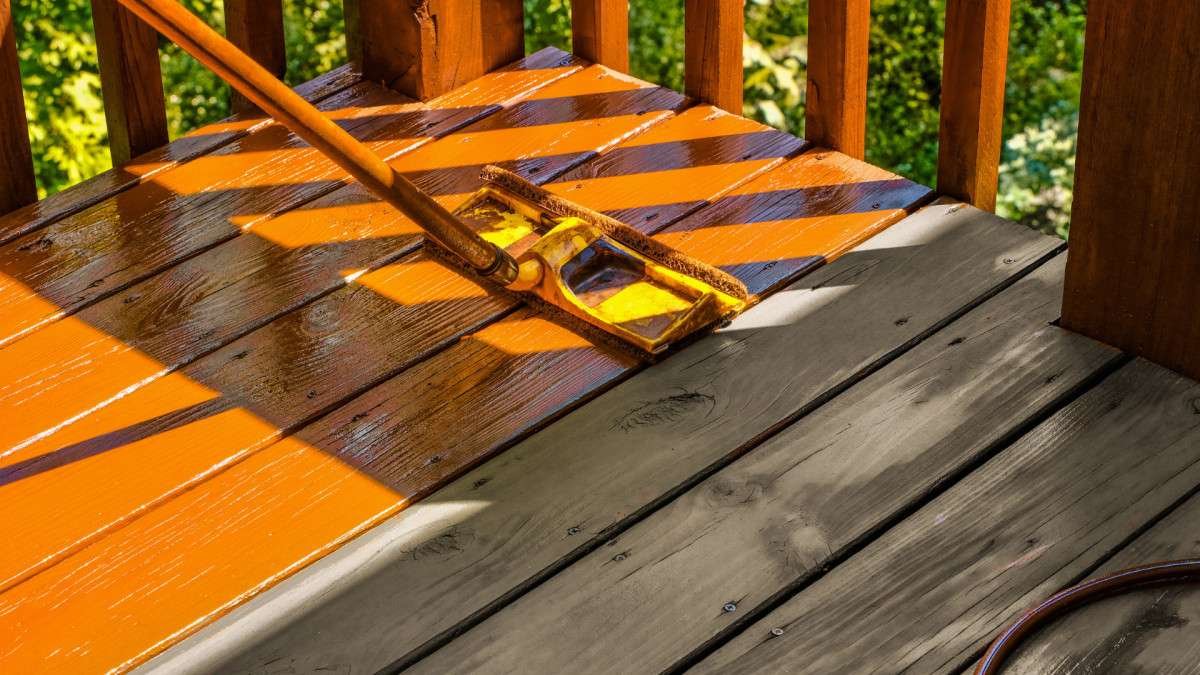
Pressure-treated lumber needs three to six months to dry before staining. Cedar and redwood need two to four weeks. Staining too early traps moisture inside the wood, and the stain peels off within a season. The calendar is a rough guide. The water droplet test is the real answer. If water beads on the surface, the wood is still too wet. If it absorbs within 10 minutes, the wood is ready, reports Spectrum Property Management company.
Here is why new wood rejects stain, how to tell when it is dry enough, and what happens if you ignore the waiting period.
Why New Wood Cannot Be Stained Immediately
New pressure-treated lumber is saturated with water and chemical preservatives from the treatment process. The treatment forces preservatives deep into the wood fibers under pressure, which leaves the wood wet. When the lumber leaves the treatment facility and arrives at the lumber yard, it is still wet. When it is delivered to your house and installed as a deck, it is still wet. The moisture must evaporate before stain can penetrate the wood fibers. Stain applied to wet wood sits on the surface because the wood pores are full of water. The stain cannot soak in. It dries as a film on top of the wood. That film peels within months.
Cedar and redwood are not pressure-treated, but they contain natural oils and moisture from the tree. Fresh-milled cedar is wet from the sawing process and has a surface layer of crushed wood fibers called mill glaze. Mill glaze is a burnished, almost polished surface created by the planer blades at the mill. It seals the wood and prevents stain from penetrating. Cedar and redwood must weather for two to four weeks for the mill glaze to break down and the surface moisture to evaporate.
Synthetic decking and composite materials do not need stain. They are non-porous and will not absorb it. If your deck is composite, the answer to when to stain is never.
The Water Droplet Test: How to Know the Wood Is Ready
Wait for a stretch of at least three dry days with no rain. Pour a small amount of water, about a tablespoon, onto the deck surface in several locations. Watch what happens. If the water beads up and sits on the surface for more than 10 minutes, the wood is too wet. Wait and test again in two weeks. If the water absorbs into the wood within 10 minutes, the wood is ready to stain. If the water absorbs immediately within seconds, the wood is very dry and will absorb stain well.
Test multiple areas of the deck. Sun-exposed areas dry faster than shaded areas. The top of the decking boards dry faster than the sides and ends. Horizontal surfaces dry faster than vertical surfaces like railings and stair risers. The entire deck does not dry at the same rate. Test the slowest-drying area, not the fastest. If the shaded corner absorbs water but the sunny middle does not bead, wait until the slowest area passes.
A moisture meter is more precise than the water droplet test. A pin-type moisture meter with two probes that press into the wood costs $25 to $50 at any hardware store. Pressure-treated wood is ready to stain when the moisture content reads 12 percent or lower. Cedar and redwood are ready at 15 percent or lower. Take readings in multiple locations and average them. A single wet spot from a recent rain can skew a single reading.
Wait Times by Wood Type
| Wood Type | Minimum Wait | Typical Wait | Test Before Staining |
| Pressure-treated pine (sunny, dry climate) | 2 months | 3–4 months | Required |
| Pressure-treated pine (shaded, humid climate) | 3 months | 4–6 months | Required |
| Cedar or redwood | 2 weeks | 3–4 weeks | Required |
| Kiln-dried pressure-treated (KDAT) | Same day | Within 1 week | Recommended |
| Composite or PVC decking | Never | Never | Do not stain |
Kiln-dried after treatment lumber, labeled KDAT, is pressure-treated wood that has been dried in a kiln after the chemical treatment. It is ready to stain immediately. It costs 15 to 25 percent more than standard wet pressure-treated lumber. The premium buys you the ability to stain right away instead of waiting months. If you are building a deck and want to stain it before using it, KDAT lumber is worth the extra cost.
Climate and Season Affect Drying Time
Heat and low humidity speed drying. A pressure-treated deck built in July in Arizona dries in two to three months. The same deck built in November in Seattle takes four to six months. Sun exposure is the largest variable. A deck on the south side of a house with no shade dries faster than a deck on the north side under trees. Air circulation matters. A deck with open space underneath dries faster than a deck built close to the ground with poor airflow underneath.
Rain resets the drying clock. A week of rain saturates the wood again. After heavy rain, wait at least 48 hours of dry weather before testing or staining. The surface may feel dry after a day of sun, but the wood beneath the surface is still wet. The stain must penetrate the wood, not just coat the surface. The moisture content below the surface is what matters.
What Happens If You Stain Too Early
Stain applied to wet wood cannot penetrate. It dries on the surface as a film. Within weeks to months, the film begins to peel in sheets. The stain did not fail because the product was bad. It failed because the wood was not ready. The peeling stain must be stripped or sanded off before the deck can be restrained. A deck that is stained too early costs more in the long run than a deck left unstained for an extra month while the wood dries.
Stain applied to wood with mill glaze, which is the polished surface on new cedar and redwood, has the same failure mode. The stain sits on top of the glaze and peels off. The fix is to let the wood weather for two to four weeks, or to sand or power wash the mill glaze off before staining. Cedar and redwood that have weathered naturally develop a slightly rough, gray surface that absorbs stain readily.
Stain applied to wood that is dry on the surface but wet underneath traps the subsurface moisture. The trapped moisture eventually pushes the stain off from underneath as it migrates to the surface. This failure takes longer to appear than the immediate peeling of stain on wet wood, but the result is the same. The water droplet test or moisture meter prevents this by confirming that the wood is dry below the surface, not just on top.
Preparation Before Staining After the Wait
Clean the deck before staining even if it is new. A deck that has sat for three to six months has accumulated dirt, pollen, bird droppings, and possibly mildew. Use a deck cleaner or a mixture of oxygen bleach and water. Scrub with a stiff brush or a push broom. Rinse thoroughly with a garden hose. Do not pressure wash at high pressure. A pressure washer set above 1,500 PSI or held too close to the wood shreds the soft grain and leaves the hard grain raised, creating a rough surface called furring that must be sanded before staining.
Let the deck dry completely after cleaning. Wait at least 24 hours of dry weather. Test the moisture content again after cleaning. The cleaning process adds water to the wood, which must evaporate before staining.
Sand any rough spots, splinters, or areas where the grain has raised. A pole sander with 60-grit to 80-grit sandpaper covers the large flat surfaces. A random orbital sander handles the edges and railings. Vacuum or sweep away all sanding dust before staining.
Apply the stain on a day when the temperature will stay between 50 and 90 degrees Fahrenheit for at least 24 hours, no rain is forecast for at least 24 hours, and the deck is not in direct sun, which causes the stain to dry too fast and leaves lap marks. Stain in the morning or late afternoon when the deck is in shade. Follow the product instructions for application method, drying time between coats, and cleanup.
Frequently Asked Questions
Is one coat of stain enough on a new deck?
Yes, for most penetrating oil-based and water-based deck stains, one coat is correct. A second coat of penetrating stain sits on top of the first coat instead of penetrating the wood. It creates a film that peels. Some solid-color stains and deck resurfacing products are designed for two coats. Follow the manufacturer’s recommendation on the can. If the label says one coat, apply one coat. Adding a second coat because you think more is better ruins the finish.
I just bought a house with an unstained deck that is several years old. Do I still need to wait?
No. The waiting period applies only to new wood. An older deck that has never been stained is dry enough. Clean it thoroughly, let it dry for 24 to 48 hours, and stain it. The wood may be grayed and weathered, which actually improves stain absorption. A weathered deck absorbs stain better than a new deck. The surface preparation is more important than the moisture content for an older deck.
What is the best season to stain a deck?
Spring and fall, when temperatures are moderate and the deck is not in direct sun for extended hours. Summer heat causes stain to dry too fast, which prevents even penetration and leaves lap marks. Winter temperatures below 50 degrees prevent proper curing. In most climates, April through June and September through October are the ideal staining windows. In hot southern climates, February through April and October through November are better than the peak summer months.