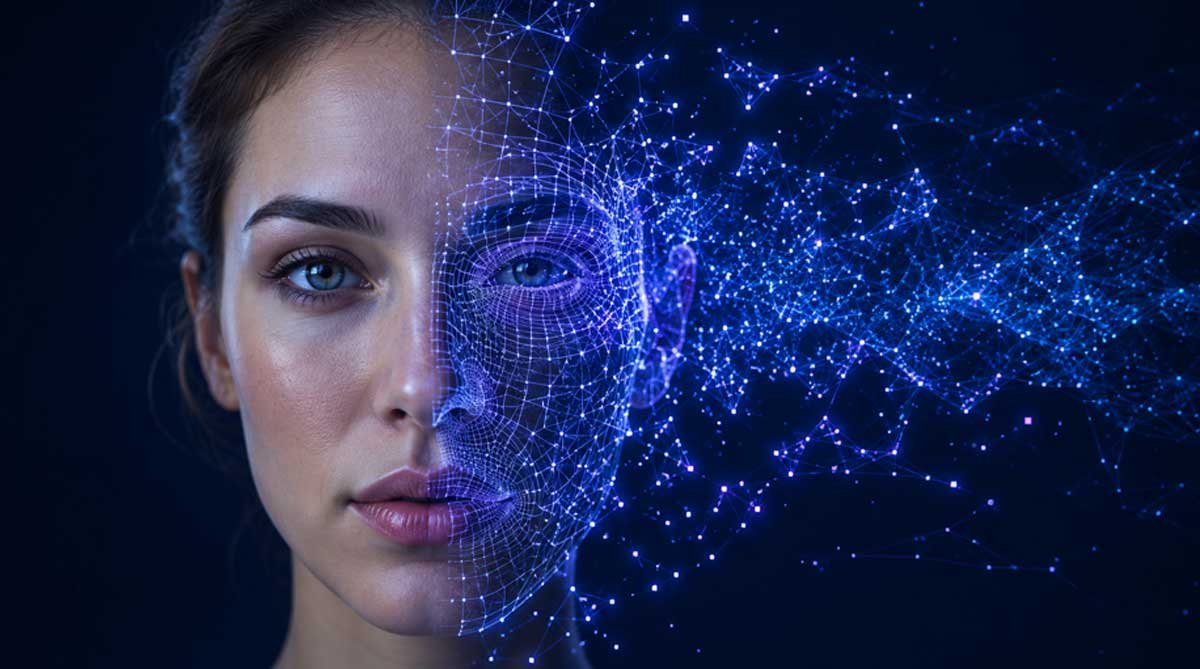
Face swap videos used to take weeks of manual rotoscoping. Today, a single source image can replace a face in a 90-second clip in under a minute. That leap didn’t happen because computers got faster. Researchers learned to compress faces into mathematics.
The machinery behind that compression (latent spaces, GANs, and diffusion models) sounds intimidating. It isn’t. Each piece solves a specific problem, and once you see what each does, the whole system clicks.
This guide explains how face swap AI actually works, from the first encoder pass to the final blended frame.
What Is Latent Space and Why Does It Matter?
A 1080p image contains over two million pixels. Working in raw pixel space is slow, noisy, and computationally expensive. You need a smarter representation. That’s exactly what latent space is.
A latent space is a compressed mathematical representation of data. Think of it as a coordinate system: each face maps to a numeric point, and similar faces land near each other. Very different faces sit far apart.
The encoder is the network that does the compression. It takes a face image and outputs a compact latent vector. The decoder is the inverse: it takes a latent vector and reconstructs an image.
Together, they form an autoencoder, and autoencoders are the beating heart of face swap AI. What makes latent space especially powerful is that it can be semantic. You can move in specific directions inside it to change individual facial attributes like age, expression, and lighting independently of each other.
This property is called disentanglement. It’s what makes controlled, attribute-specific face manipulation possible in the first place.
StyleGAN, released by NVIDIA, pushed this further with its richly structured W+ latent space. Researchers discovered direction vectors inside it: a “smile vector,” an “age vector,” each independently controllable. StyleGAN’s expressive latent space became the backbone of many early face-swap systems.
How GANs Power Classic Face Swapping
Generative Adversarial Networks, introduced by Ian Goodfellow in 2014, are the architecture that made photorealistic synthetic faces possible. The idea is elegant: train two networks against each other. One creates fakes; the other tries to catch them.
The generator creates synthesized faces. The discriminator evaluates each output and decides: real or fake? The generator gets better at fooling the discriminator; the discriminator gets better at catching fakes.
After thousands of training iterations, the generator produces images that fool even humans. In face swapping, the generator doesn’t start from random noise; it starts from the target face and learns to replace one identity while preserving everything else.
The Early Autoencoder Approach
The first widely-used deepfake method used a shared encoder and separate decoders. One encoder learned to compress any face into a common latent code. Two separate decoders learned to reconstruct either Face A or Face B from that same code.
To swap faces, you run Face A through the shared encoder, then through Face B’s decoder. Face B’s decoder learned to produce B-shaped reconstructions from whatever latent input it receives. The result: Face B’s identity appearing with Face A’s expression and pose.
Tools like DeepFaceLab used this approach and produced impressive results. But it had a fatal limitation: you had to train a separate decoder per identity. Swap ten people and you need ten trained decoders.
SimSwap and the One-Shot Breakthrough
SimSwap, published in 2020, cracked the identity-generalization problem. Instead of training per-identity, it separates the problem into two streams: identity and attributes.
The identity stream uses ArcFace, a face recognition network, to extract a compact 512-dimensional identity vector. This vector captures who the person is without encoding their current expression or lighting.
The attribute stream encodes everything about the target except identity: pose, expression, skin texture, background. An Identity Injection Module (IIM) then fuses the source identity vector into target attribute features using Adaptive Instance Normalization (AdaIN).
AdaIN works by adjusting the mean and variance of feature maps. It keeps the structural geometry of the target face but recalibrates its statistics to carry the source person’s identity. The decoder then reconstructs a face that belongs to the source identity but wears the target’s expression and pose.
One model. Any face pair. From a single source image. That was SimSwap’s core contribution.
InsightFace: Scaling with StyleGAN2
InsightFace’s InSwapper extended the idea by pairing ArcFace identity embeddings with a StyleGAN2-based encoder-decoder. StyleGAN2’s decoder is exceptional at producing sharp, photorealistic faces at high resolution. Conditioning it on an ArcFace identity vector produces both high fidelity and broad generalization.
InSwapper runs at near real-time on consumer GPUs and handles partial occlusions reasonably well. It became the backbone of many commercial face-swap tools in use today. Its output quality set the benchmark that diffusion-based methods later aimed to beat.
Consumer platforms like Magic Hour AI face swap build on this foundation to make high-quality face swapping accessible without any technical setup. A user uploads a source image, selects a target video, and the pipeline handles detection, identity extraction, and blending automatically. The underlying architecture is the same; the interface abstracts it away.
The Full Pipeline: What Actually Happens Per Frame
Understanding individual components is useful. But face swapping is a pipeline, not a single step. Here’s what actually happens between input image and output frame.
Step 1: Face Detection and Landmark Alignment
Face detection runs first, finding every face in the frame and returning a bounding box. Models like RetinaFace detect five landmark keypoints: the two eye centers, nose tip, and two mouth corners. Alignment normalizes each face to a standard 112×112 or 256×256 crop.
This step is critical. Even small misalignments cause the identity transfer to land in the wrong place, producing ghosting artifacts or asymmetric blending along the face boundary.
Step 2: Identity Extraction from the Source
The source face passes through a face recognition encoder. The output is a 512-dimensional identity vector. This vector encodes the geometric and textural statistics that make the person recognizable: eye spacing, jawline shape, and nose structure.
Step 3: Attribute Encoding from the Target
The target face goes through a separate encoder capturing everything except identity. Expression, gaze direction, head pose, skin tone, and ambient lighting all live in the attribute feature maps. These must be preserved in the final output.
Step 4: Identity Injection and Decoding
The identity vector modulates the attribute feature maps via AdaIN or a similar conditioning mechanism. The decoder synthesizes the swapped face from the combined representation, producing an image with the source person’s identity wearing the target’s expression.
Step 5: Blending and Post-Processing
The synthesized face must be composited cleanly back onto the original frame. Face parsing networks generate per-pixel segmentation masks, separating face skin from hair, accessories, and background. Poisson blending then smooths color gradients at the mask boundary, handling skin tone and lighting differences between source and target.
Super-resolution networks sharpen the composited region afterward. Encoder-decoder processes tend to blur fine details; the super-resolution step recovers them. The final output is a face that looks like it was always there.
Diffusion Models: The New Generation of Face Swapping
GAN-based methods dominated face swapping from 2018 to 2022. Then diffusion models arrived. The quality ceiling rose sharply.
Diffusion models work on a completely different principle. Instead of a generator-discriminator adversarial game, they learn to reverse a noise-addition process. During inference, the model starts with pure noise and iteratively denoises it, guided by a conditioning signal, until a realistic image emerges.
For face swapping, the conditioning signal carries two things: identity features from the source face and structural attributes from the target. The model learns to satisfy both constraints simultaneously through the denoising chain.
DiffSwap: Masked Diffusion in Latent Space
DiffSwap (CVPR 2023) reframed face swapping as conditional inpainting. The face region of the target image is masked out. A diffusion model fills in the masked area, conditioned on source identity features and 3D facial geometry data.
Working in latent space, with a pre-trained VAE compressing images first, dramatically reduces compute. The diffusion process operates over compressed latent vectors, not raw pixels, cutting both memory use and inference time.
The 3D-aware component is significant. By conditioning on a 3D facial mesh, the model enforces geometric consistency across the synthesized region. Lighting normals and perspective stay coherent between the new face and the surrounding scene.
DiffSwap++ and Continued Advances
DiffSwap++ extended the framework with richer 3D latent conditioning during training. It uses multi-step DDIM sampling to reinforce identity and perceptual similarity across the denoising chain. The result is stronger identity preservation, especially under challenging poses, extreme angles, and varied expressions.
DiffFace goes further by adding explicit facial guidance signals at multiple scales. This gives the model finer control over which features to transfer and which to preserve. Attribute leakage between source and target is reduced as a result.
Why Diffusion Models Often Win on Quality
GANs can suffer from mode collapse, where the generator produces a narrow output range regardless of input. They also require careful, often fragile balancing of generator and discriminator loss schedules. Diffusion models sidestep both problems with a simpler, more stable training objective.
The tradeoff is speed. A GAN generates an image in a single forward pass; diffusion requires dozens of steps. Modern techniques like DDIM and consistency models have cut that to as few as 4–8 steps, closing much of the gap.
Hybrid systems are now emerging. Some pipelines use a GAN-based model for rapid identity transfer, then apply a diffusion refinement step to clean up artifacts and recover fine skin texture detail.
The Challenges That Remain
Face swapping looks solved from the outside. It isn’t.
Identity leakage is a persistent problem. When the target’s facial geometry differs greatly from the source, some target identity bleeds through in the output. Fixing this without erasing the target’s expression is an active research problem with no clean solution yet.
Temporal consistency in video is another challenge. Frame-to-frame variations in a synthesized face (called flickering) are an easy giveaway to trained observers. Methods like DynamicFace address this with 3D facial priors that enforce consistency across the temporal dimension, but the problem isn’t fully solved.
Complex lighting remains a weak spot. Most models are trained on studio-style headshots, so outdoor, backlit, or neon-lit scenes expose distribution limits quickly. The generated face often looks lit differently from the rest of the frame.
Cross-domain generalization is a subtler problem. A model trained primarily on certain demographics can underperform on underrepresented ethnic backgrounds, producing inaccurate skin tone mapping or distorted geometry. Several research groups have flagged this as both a technical failure mode and an equity concern.
The Detection Side of the Arms Race
As generation improves, so does detection. Modern deepfake detectors look for statistical fingerprints that generators leave behind: subtle frequency artifacts that are invisible to the human eye but detectable to a trained classifier.
Methods like FSD-GAN train adversarially: the detector and generator compete directly, forcing the generator to minimize its detectable noise fingerprint. This adversarial dynamic has driven detection capability forward at roughly the same pace as generation quality.
Digital watermarking embeds invisible markers in AI-generated images at creation time. Platforms like Meta and Google have committed to C2PA content provenance standards, which cryptographically sign the origin of synthetic media and make it auditable downstream. Detection and provenance together form the practical defense layer.
Ethics and the Legal Landscape
The technology is neutral. Its application is not.
Non-consensual deepfakes, particularly those involving sexual content created from real likenesses, cause serious, documented harm. In the U.S., the DEFIANCE Act (2025) gives victims a federal civil cause of action with damages up to $250,000. The NO FAKES Act targets the non-consensual use of a person’s face or voice in generative AI.
Responsible deployment requires explicit consent from every person whose face is used. Content must be disclosed as AI-generated and watermarked to preserve provenance. The ethical line isn’t about what the technology can do; it’s about whether the person agreed.
Frequently Asked Questions
What’s the difference between a deepfake and a face swap?
“Deepfake” is the umbrella term for AI-generated synthetic media. Face swapping is one specific technique: replacing one person’s face with another’s in an image or video. Other deepfake techniques include voice cloning, lip-sync manipulation, and full-body reenactment.
Does face swap AI need lots of source images?
Modern one-shot methods like SimSwap and InSwapper need only a single source image. Earlier autoencoder methods required hundreds of training frames per identity. The one-shot breakthrough made the technology far more broadly accessible, for better and for worse.
Why do some face swaps still look fake?
Common giveaways include mismatched lighting, temporal flickering in video, unnatural eye movement, and visible seam artifacts at the face boundary. Each failure traces to a specific pipeline weakness: poor Poisson blending, no temporal consistency enforcement, or a model trained on data that didn’t cover the target’s illumination conditions.
Are diffusion models always better than GANs for face swapping?
Not always. GANs are faster and sufficient for real-time video applications. Diffusion models win on fidelity for challenging cases: extreme head poses, low-quality targets, and complex lighting. Most high-end production pipelines now use both: a GAN for speed, a diffusion step for refinement.
How do face swap detectors work?
Most detectors are binary classifiers trained on known-generated and real images. They learn to spot statistical artifacts that models leave behind: frequency anomalies, blending boundary patterns, and generative fingerprints. Adversarial training against active generators forces them to generalize beyond any single architecture.
What stops misuse of this technology?
Detection tools, watermarking, and legislation are the three main defenses. The DEFIANCE Act and NO FAKES Act create concrete legal risk. C2PA provenance standards give platforms a mechanism to identify AI-generated content at scale. None of these is foolproof, but together they raise the cost of misuse significantly.
Conclusion: The Math Underneath the Magic
Face swap AI isn’t magic. It’s a well-understood chain of components. An encoder compresses a face into a latent vector. An identity injection mechanism fuses source identity into target attributes, and a blending pipeline composites the result seamlessly onto the original frame.
GANs built the foundation, proving that adversarially trained generators could produce photorealistic faces at scale. Diffusion models raised the ceiling by replacing the fragile GAN training dynamic with stable iterative denoising. Latent space is the medium both paradigms operate in: the structured coordinate system that makes semantic, controlled face manipulation possible at all.
Temporal consistency, complex lighting, and identity leakage are all active research fronts. Understanding how the machinery works is the first step toward using it responsibly. It’s also the foundation for building the detection tools that keep the technology honest.