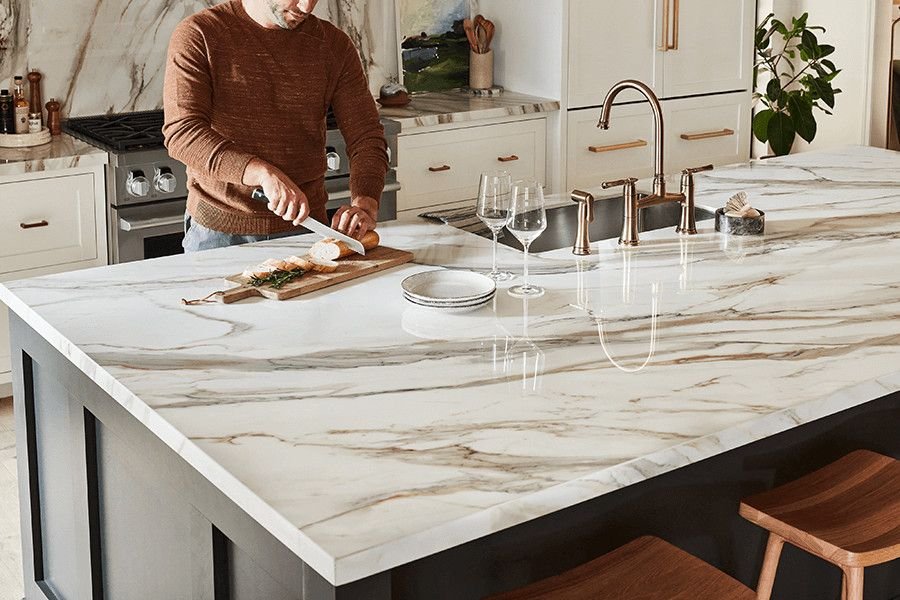
Just as understanding Texas Squatters Rights is critical for property owners, choosing the right kitchen countertop material is critical for homeowners. This guide compares seven surfaces on cost, durability, maintenance, and heat resistance. The best kitchen countertop material for most homeowners in 2026 is quartz — engineered stone that costs \$60 to \$120 per square foot installed, is non-porous and stain-resistant, requires no sealing, and looks like natural stone.
The countertop is the most visible, most used, and most abused surface in the kitchen. It holds hot pans, cold drinks, spilled coffee, raw chicken juice, and the weight of a stand mixer running at full speed. The material you choose must survive all of that and still look good when you are leaning on it at 7 a.m. waiting for the coffee to brew. Here is how the seven main countertop materials compare on cost, durability, maintenance, and appearance.
Countertop Material Comparison
The seven main kitchen countertop materials span a cost range of $20 to $200 per square foot installed, with quartz offering the best balance of durability and maintenance and laminate serving as the budget option. Here is how they compare.
| Material | Cost Per Sq Ft (Installed) | Durability | Maintenance | Heat Resistance |
| Quartz (engineered stone) | $60 – $120 | Excellent — non-porous, scratch-resistant | None — no sealing required | Moderate — use trivets for hot pans |
| Granite (natural stone) | $50 – $100 | Excellent — hard, heat-resistant | Annual sealing required | Excellent, hot pans directly OK |
| Laminate | $20 – $40 | Moderate, scratches, burns, delaminates | None, wipe clean | Poor, burns and delaminates |
| Marble | $70 – $200 | Poor, stains, etches, scratches | Frequent sealing, immediate spill cleanup | Excellent, hot pans directly OK |
| Butcher block (wood) | $40 – $80 | Moderate, scratches, stains, water damage | Monthly oiling, sanding every few years | Poor, burns and scorches |
| Soapstone | $70 – $120 | Excellent, non-porous, heat-proof | Monthly mineral oil for uniform patina | Excellent, hot pans directly OK |
| Concrete | $70 – $140 | Moderate, cracks, stains, etches | Annual sealing, waxing | Excellent, hot pans directly OK |
Quartz, the Best Material for Most Kitchens
Quartz is an engineered stone made from 90% to 95% ground natural quartz mixed with resin binders and pigments. The resin fills the natural pores of the stone, creating a non-porous surface that does not absorb liquids, does not harbor bacteria, and does not require sealing, ever. Quartz is harder and more scratch-resistant than granite. It will not stain from red wine, coffee, or cooking oil left on the surface overnight. It will not etch from lemon juice or vinegar, unlike marble. It looks like natural stone because it is 90% to 95% natural stone.
Quartz has one vulnerability: heat. The resin that binds the stone particles can discolor or crack when exposed to temperatures above 300 degrees. A hot pan placed directly on a quartz countertop can leave a yellow or white heat mark that cannot be removed. Use a trivet. The countertop will survive everything else the kitchen throws at it. It will not survive a hot pan straight from the burner. The trivet costs $10. The countertop costs $5,000. Use the trivet.
The National Association of Home Builders (NAHB) identifies kitchen countertops as one of the most scrutinized surfaces by home buyers. A dated or damaged countertop is one of the top triggers for a buyer to mentally budget a full kitchen remodel. Quartz is the material most likely to satisfy both the homeowner who lives with it daily and the buyer who inspects it during a showing.
Granite, the Original Natural Stone
Granite is natural stone, cut from quarries, polished, and fabricated into countertops. Each slab is unique, the pattern, the color variation, the veining are the result of geological processes that took millions of years and cannot be replicated. Granite costs $50 to $100 per square foot installed. It is extremely hard, highly heat-resistant, a hot pan placed directly on granite will not damage it, and scratch-resistant. It is porous and requires annual sealing to prevent stains from penetrating the stone. An unsealed granite countertop will absorb cooking oil, red wine, and coffee, leaving permanent dark stains.
Granite was the aspirational countertop material of the 1990s and 2000s. It has been largely displaced by quartz in new construction and remodels because quartz offers the look of stone without the maintenance. Granite remains an excellent material. The stone is beautiful. The maintenance is real. The annual sealing takes 15 minutes and costs $10 for a bottle of sealer. The homeowner who forgets to seal for three years will have a stained countertop that professional restoration may or may not be able to recover. Quartz removes that risk. Granite rewards the homeowner who remembers.
Laminate, the Budget Option That Has Improved Dramatically
Laminate countertops are made from layers of paper or plastic bonded to a particleboard core under heat and pressure. The top layer is a printed pattern, wood grain, stone, solid color, protected by a clear wear layer. Laminate costs $20 to $40 per square foot installed, roughly one-third the cost of quartz. It is lightweight, easy to clean, and available in a much wider range of patterns and finishes than it was 20 years ago. Modern laminate can convincingly mimic wood, stone, and concrete from a standing height. Up close, the lack of depth and the repetition of the printed pattern reveal that it is not the real thing.
Laminate’s weaknesses are heat and moisture. A hot pan placed on laminate will scorch and delaminate the surface, the plastic layer bubbles and separates from the particleboard core. Standing water at a seam or along the sink edge will eventually swell the particleboard, causing the laminate to bubble and peel. The seams between laminate sheets are visible and cannot be polished or filled the way stone seams can be. Laminate is the right choice for a rental property, a flip, or a budget kitchen where the countertops need to look clean and function for 5 to 10 years. It is not the right choice for a kitchen you plan to live in for 20 years.
Marble, Beautiful, Impractical, and Adored
Marble is the most beautiful countertop material available and the least practical. It is soft, a knife blade will scratch it. It is porous, red wine, coffee, and cooking oil will stain it if not wiped up immediately. It is chemically reactive, lemon juice, vinegar, and tomato sauce will etch the surface, leaving dull spots that cannot be cleaned away. Etching is not a stain. It is a chemical reaction that dissolves the calcium carbonate in the stone. The only fix is professional repolishing.
Marble is the right choice for a homeowner who values the appearance of the stone above its practicality, who will wipe up spills immediately, who will accept that the countertop will develop a patina of etching and staining over time, and who views that patina as character rather than damage. Marble in a kitchen is a lifestyle choice. It demands attention. It rewards with beauty. It punishes neglect. The baker who wants a naturally cool surface for rolling pastry will love marble. The family with two young children who spill orange juice every morning will not.
Butcher Block, Warmth and Maintenance
Butcher block countertops are made from strips of wood, maple, oak, walnut, cherry, glued together into a solid slab. They cost $40 to $80 per square foot installed and bring a warmth and organic texture that no stone or synthetic material can match. Wood is naturally antimicrobial, bacteria die on a wooden surface faster than on plastic or stone, which makes butcher block a hygienic choice for food preparation. The surface can be used as a cutting board, though knife marks will accumulate and become part of the patina.
Wood countertops require maintenance that stone countertops do not. They must be oiled monthly with food-grade mineral oil to prevent the wood from drying out, cracking, and absorbing water. They must be sanded and refinished every few years to remove knife marks and restore the surface. Standing water around the sink will turn the wood black with water damage within weeks. A butcher block countertop around a sink requires vigilance, wipe up water immediately, keep the wood oiled, and accept that the area around the faucet will darken over time. Butcher block is the right choice for a kitchen island, a baking station, or a countertop section dedicated to food preparation. It is the wrong choice for the main countertop surface in a kitchen where water, heat, and food stains are constant.
Frequently Asked Questions
What is the best countertop material for a kitchen?
Quartz is the best countertop material for most kitchens. It costs $60 to $120 per square foot installed, is non-porous and stain-resistant, requires no sealing, and looks like natural stone. It is more durable and lower-maintenance than granite, more practical than marble, and more permanent than laminate. Quartz combines the appearance of stone with the performance of an engineered surface.
What is the most durable kitchen countertop material?
Quartz is the most durable countertop material for resistance to scratching, staining, and impact. Granite is the most heat-resistant, a hot pan placed directly on granite will not damage it, while quartz requires a trivet. Soapstone is the most chemically resistant, it is impervious to acids, bases, and heat. No single material is the best at everything. Quartz is the best at the combination of properties that matter most in a kitchen.
How much do quartz countertops cost?
Quartz countertops cost $60 to $120 per square foot installed. A typical kitchen with 50 square feet of countertop costs $3,000 to $6,000 for quartz. The price varies with the brand, Cambria, Silestone, and Caesarstone are premium brands at the high end, the color and pattern complexity, and the edge profile. A simple eased edge costs less than a waterfall edge or a mitered edge.
Can you put a hot pan directly on a quartz countertop?
No. Quartz contains resin binders that can discolor, crack, or melt when exposed to temperatures above 300 degrees Fahrenheit. A hot pan placed directly on quartz can leave a permanent yellow or white heat mark. Use a trivet or a hot pad. The trivet costs $10. The countertop costs several thousand dollars. Use the trivet.
Does granite need to be sealed?
Yes. Granite is porous and must be sealed annually to prevent stains from penetrating the stone. Sealing takes 15 minutes, costs $10 to $20 for a bottle of sealer, and involves wiping the sealer onto the countertop, letting it absorb, and wiping off the excess. A granite countertop that is not sealed for several years will absorb cooking oil, wine, and coffee, leaving permanent dark stains.
What is the cheapest kitchen countertop material?
Laminate is the cheapest countertop material at $20 to $40 per square foot installed. A typical kitchen with 50 square feet of countertop costs $1,000 to $2,000 for laminate. Tile countertops, ceramic or porcelain tile set in thinset with grout joints, also cost $20 to $50 per square foot but have fallen out of favor because the grout lines trap dirt and are difficult to clean. Laminate is the better budget choice.
The Countertop You Will Live With
Quartz is the right answer for most kitchens. $60 to $120 per square foot. Non-porous. Stain-resistant. No sealing. No etching. No staining. The only rule is: use a trivet for hot pans. Follow that rule and the countertop will look the same in 15 years as it does on installation day.
Granite is for homeowners who want natural stone and are willing to seal it annually. Marble is for homeowners who value beauty above practicality. Laminate is for budgets that cannot stretch to stone. Butcher block is for sections of the kitchen that will be used for food preparation, not as the main countertop surface. The countertop is the surface you touch more than any other in the kitchen. You lean on it. You prep on it. You wipe it down a dozen times a day. Choose the material that handles the abuse and still makes you happy when you look at it. The countertop does not care what it cost. It only cares whether you use a trivet. Ever looked at a countertop in a rental kitchen and wondered how many meals, spills, and hot pans that surface has survived? The laminate is peeling at the seam. The butcher block is black around the faucet. The granite is stained where the olive oil bottle sat for three years without being moved. Each scar tells a story about the person who lived there before you. The next countertop is yours. Choose the one whose story you want to write.