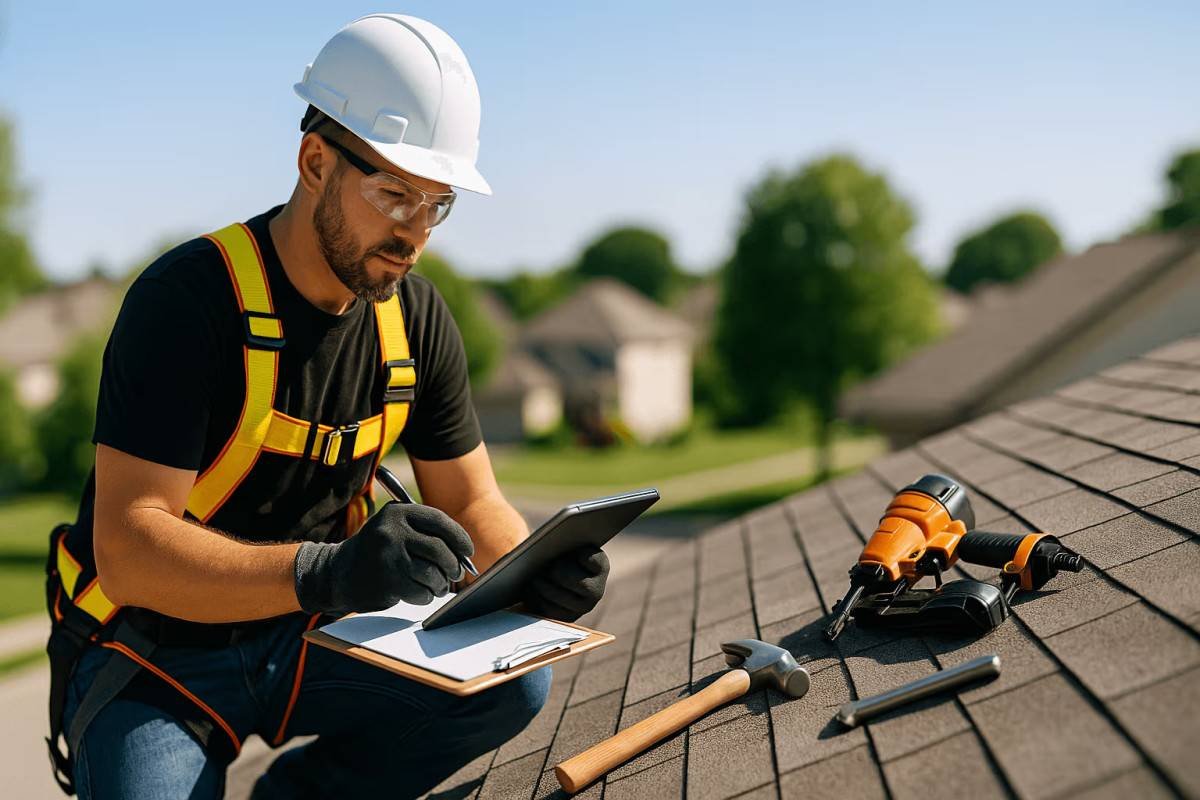
This roof repair cost guide for homeowners breaks down what you can expect to pay in 2026. Roof repairs run between $350 and $1,900 for most jobs, with a national average of about $1,150. Use this guide to understand what drives pricing before you pick up the phone. That range covers everything from swapping out a few blown-off shingles to sealing a persistent leak around a chimney flashing, notes Moore property management.
The catch is that two houses on the same street can get quotes $2,000 apart for what sounds like the same problem. What you are actually paying for — and what you can skip — is the part worth understanding before you make the call.
What Roof Repair Actually Costs in 2026
Most homeowners spend between $350 and $1,900 on a single roof repair. Per Modernize (2026) data, the national average sits at $1,150, with minor fixes starting around $150 and major structural work pushing past $5,000.
The number your contractor gives you depends almost entirely on what they find when they climb up there. A loose shingle and a rotted deckboard look the same from the ground but cost very different amounts to fix.
Many homeowners do not realize that the first quote they get is often a worst-case estimate. Contractors price for what they might uncover — not just what they can see from the ladder.
On paper, a “roof repair” sounds like one service with one price tag. Reality is messier. The same contractor might charge you $250 to replace three missing shingles on a Tuesday morning and $1,800 to fix a leak that has been quietly rotting your roof deck for two winters.
| Repair Tier | Typical Cost Range | What It Covers |
| Minor | $150 – $450 | Replacing a few missing shingles, resealing a small flashing gap, clearing a single clogged valley |
| Moderate | $400 – $1,200 | Fixing a persistent leak, replacing damaged vent boots, repairing sections of fascia or soffit |
| Major | $1,200 – $3,500 | Replacing rotted decking, repairing structural truss damage, addressing widespread water intrusion |
| Structural | $3,500 – $8,000+ | Sagging ridge repair, extensive rot across multiple rafters, chimney rebuild |
Emergency repairs — the kind you need at 2 a.m. during a storm — typically add a 25% to 50% premium on top of standard pricing. That is the cost of a crew climbing onto a wet roof in the dark.
What Each Type of Damage Costs to Fix
Roof repair costs vary from $150 for a few missing shingles to over $5,000 for structural repairs, depending entirely on what failed and whether the crew can reach it easily. Here is how each common damage type breaks down.
Leak Repair
Fixing a roof leak costs $300 to $1,200 in most cases. The price depends on whether the water entry point is obvious, a torn shingle, a cracked vent boot, or whether the crew has to play detective with a hose for an hour to trace it.
Leaks that have been running for months are more expensive by default. The visible stain on your ceiling is rarely directly under the actual hole in the roof. Water travels along rafters and sheathing before it drips, and by the time you see it, the damage underneath has usually spread.
Shingle Replacement
Replacing damaged or missing shingles runs $150 to $500 for a small section. Asphalt shingles are the cheapest to replace. Architectural shingles cost more for the material itself but the labor is roughly the same.
One thing most articles skip: if your shingles are more than 10 years old, matching the color is nearly impossible. Sun fading means new shingles will stand out as noticeably darker patches. Some homeowners end up replacing the entire slope just to avoid the checkerboard look.
Flashing Repair
Flashing, the metal strips sealing the joints around chimneys, skylights, and vents, costs $200 to $600 to repair or replace. This is the single most common failure point on an otherwise healthy roof.
The sealant between flashing and roofing material degrades faster than either surface on its own. A chimney flashing that looked fine three years ago can suddenly let water through after one freeze-thaw cycle too many.
Structural Repair
When the roof deck, rafters, or trusses are compromised, costs jump to $1,200 to $5,000 and beyond. These jobs require pulling up sections of the roof to access the framing underneath.
Structural issues rarely announce themselves with a drip. More often, you notice a slight sag in the ridge line or a door upstairs that suddenly sticks in its frame, small signs that the roof is shifting in ways it should not be.
| Damage Type | Cost Range | Typical Labor Time |
| Leak detection and patch | $300 – $1,200 | 1–3 hours |
| Shingle replacement (small area) | $150 – $500 | 1–2 hours |
| Flashing reseal or replace | $200 – $600 | 1–3 hours |
| Gutter repair or section replace | $150 – $800 | 2–4 hours |
| Vent boot / pipe collar replacement | $200 – $500 | 1–2 hours |
| Fascia and soffit repair | $600 – $2,500 | 4–8 hours |
| Decking replacement (per affected area) | $700 – $2,500 | 4–8 hours |
| Structural / truss repair | $1,200 – $5,000+ | 1–3 days |
What Drives the Price Up, and What Does Not
Four factors account for nearly all the variance between two quotes for the same job. Knowing them lets you spot which line items are legitimate and which are padding.
Roof Material
Asphalt shingle roofs are the cheapest to repair at $150 to $1,500 for typical jobs. Metal roofs run higher, $400 to $2,500, because the panels require specialized tools and fasteners. Tile and slate repairs start at $500 and routinely exceed $3,000, partly because the materials themselves are expensive and partly because walking on them without breaking more tiles is its own skill.
Wood shake and shingle roofs sit somewhere in the middle on materials but high on labor. Individual shakes must be hand-cut to fit, and the installer has to match the weathering pattern or the repair looks like a visible patch.
Roof Pitch and Accessibility
Anything steeper than a 6:12 pitch adds a safety premium to the labor rate. Crews need harnesses, roof jacks, and more time to move around. A repair that takes one hour on a walkable 4:12 roof might take three hours on a 10:12 pitch.
Access matters just as much as steepness. A chimney flashing on the back corner of a three-story house, surrounded by landscaping and a fence, costs more than the same repair on a single-story ranch where the crew can back the truck right up to the gutter line.
Where You Live
Labor rates for roofing vary sharply by region. Per Modernize (2026) data, the same shingle repair that costs $300 to $750 in Alabama might run $450 to $1,050 in Alaska. Coastal and high-cost metro areas consistently sit at the top of the range.
Permit requirements add another layer. Some municipalities require a permit for any roof repair beyond simple shingle replacement, and permit fees range from $50 to $500 depending on where you live.
Season and Urgency
Roofers are busiest in late spring through early fall. Calling in November after a storm puts you in line behind everyone else who waited, and the quote will reflect that demand.
Oddly enough, scheduling a non-emergency repair in January or February can save you 10% to 15%. Contractors have open calendars and are more willing to negotiate when the phone is not ringing off the hook.
Repair vs. Replacement, the Math That Decides
If your roof is past 75% of its expected lifespan and the repair estimate exceeds $3,500, replacing the roof often makes more financial sense than patching it. The rule of thumb among contractors: multiply the repair cost by the number of years you expect the patch to hold. If that number exceeds the cost per year of a new roof, replace.
A $4,000 repair on a 22-year-old asphalt shingle roof that might buy you three more years costs you $1,333 per year. A $10,000 replacement spread over 25 years costs $400 per year. The math is not complicated. The hard part is accepting that you are writing a five-figure check now to avoid writing smaller checks every six months.
I have seen homeowners patch the same roof four times in two years before finally replacing it. Every patch bought them just enough time to forget the last leak. By the end, they had spent $6,000 on repairs and still paid for the full replacement. That is the trap.
Insurance, Warranties, and the Money You Might Not Know You Have
Homeowners insurance covers roof repairs caused by sudden, accidental events, storms, falling trees, hail. It does not cover wear and tear, neglect, or a 25-year-old roof that finally gave up. That distinction matters when you are deciding whether to file a claim.
If the repair estimate is less than your deductible, do not involve insurance at all. Filing a claim you cannot collect on still counts as a claim in the insurer’s records. Enough of those and your premium rises or your policy gets non-renewed.
On the other end of the spectrum: if your insurance adjuster cuts a check for $12,000 and the actual repair costs $8,000, the difference is usually yours to keep, but confirm with your adjuster in writing before you spend it. Some policies require unused funds to be returned or applied to the mortgage balance.
Manufacturer warranties on shingles rarely cover labor. A “lifetime warranty” on asphalt shingles typically means the manufacturer will send you replacement shingles if the originals fail, but you are still paying a crew $4,000 to install them. Read the fine print before you lean on the warranty as your backup plan.
Getting an Honest Quote Takes Three Phone Calls
Get three written estimates from licensed, insured contractors. The National Roofing Contractors Association (NRCA) maintains a searchable member directory, a useful starting point if you do not already have a shortlist. Do not tell the second and third contractor what the first one quoted. If all three are within 10% to 15% of each other, the price is probably fair. If one is half the price of the other two, that is not a bargain, it is a red flag.
Evaluating local quotes carefully can help prevent unexpected project issues and ensure long-term repair durability. Homeowners looking to safeguard their property values often benefit from consulting established regional experts who understand specific local climate challenges. Engaging reliable residential roofers in Hanover PA helps ensure that subtle signs of wear are diagnosed correctly before minor structural concerns grow into expensive updates.
Ask each contractor to itemize the quote: materials, labor, disposal, and permit fees broken out separately. Contractors who refuse to break down their estimate are not necessarily dishonest, but you lose the ability to compare apples to apples across bids.
A common mistake is assuming the lowest bid is the one where the contractor is “hungry for work.” More often, the lowest bid comes from someone who has not accounted for something the other two saw, rotted decking under the shingles, or a section of flashing that needs replacement rather than resealing. When that surprise shows up mid-job, the price resets to whatever they want to charge.
Check that each contractor carries both liability insurance and workers’ compensation. Ask to see the certificates, not just hear that they have them. If a worker falls off your roof and the contractor has no workers’ comp, your homeowners policy is on the hook.
Frequently Asked Questions
How much does the average roof repair cost?
The average roof repair costs $1,150 nationally in 2026, with most homeowners paying between $350 and $1,900. Minor fixes like replacing a few shingles or resealing flashing start around $150 to $450. Major structural repairs can exceed $5,000.
Does homeowners insurance cover roof repairs?
Yes, if the damage is sudden and accidental, such as from a storm, falling tree, or hail. Insurance does not cover gradual wear, neglect, or damage from an old roof that has exceeded its service life. If the repair costs less than your deductible, skip the claim entirely.
How long does a roof repair take?
Most common roof repairs take between one and four hours on site. Leak patches and shingle replacements are often finished by lunchtime. Structural repairs involving decking or truss work can take one to three days, depending on the extent of the damage and weather conditions.
Should I repair or replace my roof?
Replace the roof if it is past 75% of its expected lifespan and the repair estimate exceeds $3,500. At that point, patching becomes more expensive per year than a full replacement. If the roof is under 10 years old and the damage is localized, repair is almost always the better call.
Can I do roof repairs myself?
You can handle simple shingle replacement and gutter clearing on a single-story home with a walkable pitch. Anything involving flashing, structural components, or a steep roof should be left to a licensed contractor. The hospital bill from a fall costs more than any roofer ever will.
Why are roof repair quotes so different?
Contractors price based on what they expect to find once they start working, not just what is visible from a ladder. One quote might assume the decking underneath is sound. Another might price in the cost of replacing a section of rotted sheathing just in case. The spread between worst-case and best-case assumptions is what creates the gap between bids. Sound familiar?
The Bottom Line
A roof repair is one of those expenses that feels like wasted money until the alternative, a full replacement or a collapsed ceiling, makes it look cheap. Get three quotes. Ask for line-item breakdowns. Do not let panic after a storm push you into signing the first estimate that lands in your inbox.
The roof over your head is not a subscription service. Spend the money where the damage is real, and let cosmetic imperfections live another season.