Woodwork is not the same as trim. Trim is the casing around a door and the baseboard along the floor. Woodwork is the crown molding at the ceiling, the chair rail at waist height, the picture rail a foot below the ceiling, the paneled wainscoting that covers the lower half of the dining room wall, and the built-in bookcase that has been there since 1923. Woodwork is trim with ambition, observes Real Property Management Partners experts. It has profiles, profiles within profiles, shadow lines, and details that collect dust in the crevices and reveal every shortcut in the preparation with a gloss finish that catches light from three different angles. Painting woodwork is painting trim with the difficulty turned up, and the rules are the same with one addition: you cannot paint what you cannot reach, and half the profiles in woodwork are designed to be beautiful and impossible to clean.
The key to painting woodwork is not the paint. It is the brush, the preparation, and the order of operations. You paint from the top down so drips fall onto unpainted surfaces. You use a brush small enough to reach into the details but large enough to lay off a smooth finish on the flat sections. You clean the woodwork more thoroughly than you clean baseboard because woodwork at eye level and above collects a different kind of dirt: fireplace soot, candle smoke, cooking grease that rises, and decades of furniture polish that leaves a residue nothing will bond to.
Cleaning Woodwork — The Grime You Cannot See Until the Paint Makes It Visible
Wash every surface with a degreaser or a solution of trisodium phosphate and warm water, using a scrub sponge to work the cleaner into the crevices and a toothbrush for the tightest profiles. The water in the bucket will turn brown even if the woodwork looks clean. That brown is the residue of decades of occupancy, and paint applied over it will fisheye, crater, and peel. Rinse with clean water and a sponge. Change the rinse water frequently. Let the woodwork dry completely, ideally overnight. Paint applied over damp wood will blister.
Sand every profile. This is the tedious part. Fold a piece of one hundred and twenty grit sandpaper into a wedge and use the edge to sand the V-shaped grooves between profiles. Wrap the sandpaper around your finger to sand the convex curves. Use a sanding sponge for the flat sections. The goal is to dull every surface, not to sand through the old finish. A surface that still has gloss after sanding will reject the new paint. A surface that has been sanded to a uniform dullness will accept it.
Fill any cracks, nail holes, or separated joints with wood filler. Woodwork in an old house has gaps where the miter joints have opened up over decades of seasonal movement. Fill the gaps with a flexible wood filler or paintable caulk. Caulk is better for joints that will continue to move. Wood filler is better for nail holes and surface defects that are static. After the filler dries, sand it flush. Vacuum every crevice with a brush attachment. Wipe every surface with a tack cloth. The preparation for woodwork takes longer than the preparation for flat trim because there is more surface area in the profiles than on the face, and every square inch of it must be clean, dull, and dust-free.
Brush Selection — The Right Tool for Each Profile
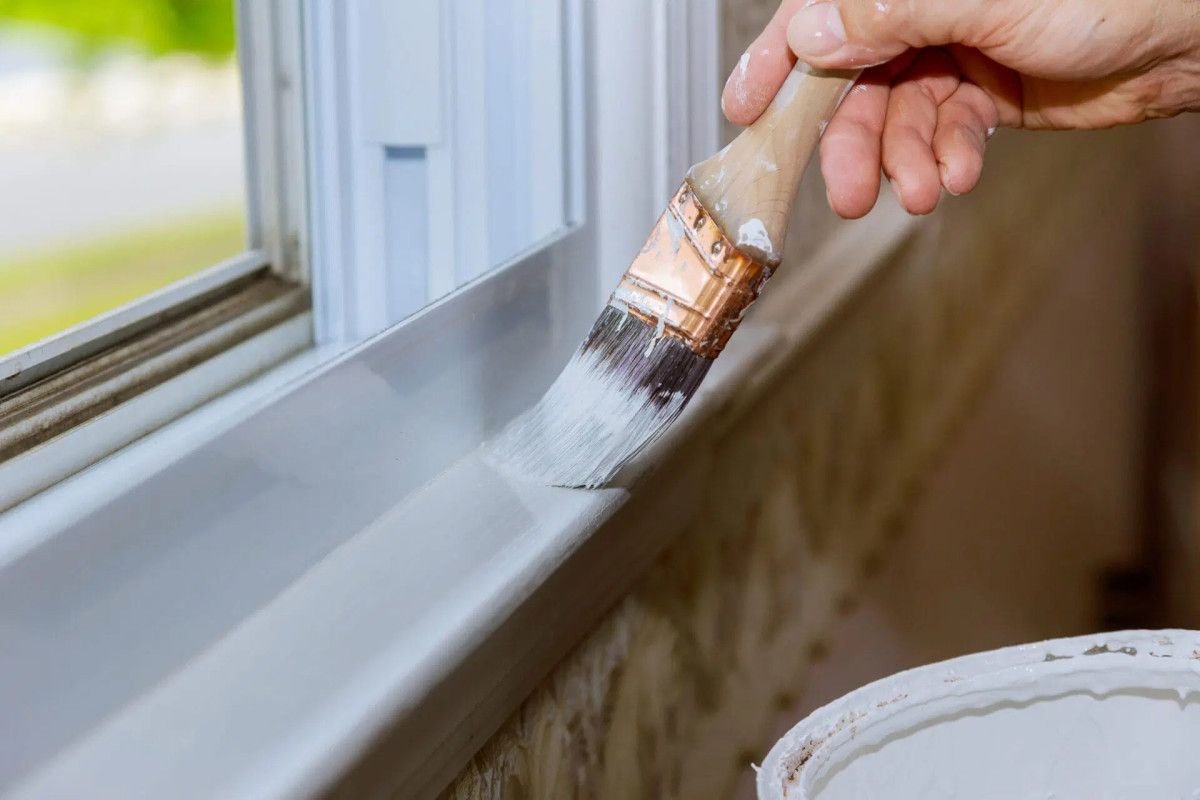
A two-inch angled sash brush is the workhorse for the flat sections of woodwork. A one-and-a-half-inch angled brush is for the narrower sections. A one-inch flat brush is for the tightest profiles and the inside corners where two pieces of molding meet. An artist’s brush, a small round or flat brush from the art supply store, is for touching up drips and filling pinholes without overpainting the surrounding area. Do not use a single brush for the entire job. The right brush for each section of the profile produces a professional finish. The wrong brush leaves paint ridges in the corners and brush marks on the flats.
Load the brush and tap off the excess. Too much paint floods the profiles and drips. Too little paint streaks and requires multiple passes. Paint the detailed profiles first, working the paint into the crevices with the tip of the brush. Then paint the flat sections, blending the wet paint from the profiles into the flat sections so there is no visible transition line. Work in sections of about two to three feet. Paint the profiles, paint the flats, lay off the entire section with a single light stroke from end to end, and move on. Do not go back. Paint that has begun to set drags when brushed again.
Order of Operations — Top Down, Inside Out
Paint the crown molding first because drips from the crown will fall onto the walls and the woodwork below. Paint the ceiling before the crown molding if the ceiling is being painted. The crown molding covers the seam between the wall and the ceiling, and the paint line at that seam is the most visible line in the room. Cut in the ceiling paint along the crown molding with a brush, then roll the ceiling. Cut in the crown molding paint along the ceiling with a brush. The two cut-in lines overlap slightly and produce a crisp transition even without tape.
Paint the chair rail and the picture rail next. Paint the wainscoting after the chair rail because the top edge of the wainscoting meets the bottom edge of the chair rail, and painting the chair rail first lets you overlap onto the wainscoting slightly. Paint the baseboard last because it is at the bottom, drips from above will land on it, and kneeling on the floor to paint baseboard after everything else is done means you are not stepping over wet baseboard to reach other surfaces.
Paint window and door casing in the same sequence as the rest of the room, from top to bottom. The casing around a window has a top horizontal piece and two vertical side pieces. Paint the top piece first, then the sides. Paint door casing from the top down. The sequence prevents brushing your arm against wet paint while you work.
Paint Selection and the Enamel Finish
Woodwork demands a higher sheen than walls. Semi-gloss is standard. High-gloss is traditional for formal rooms and produces a glass-like finish that highlights the profiles and shadows of the woodwork. High-gloss also reveals every surface imperfection. A surface that looks smooth under satin paint will look like a relief map under high-gloss. Choose the sheen based on the condition of the woodwork and the level of formality of the room. A dining room with original 1920s woodwork in excellent condition deserves high-gloss. A family room with painted MDF wainscoting that has been bumped by vacuum cleaners for ten years deserves satin.
Alkyd enamel paint, a water-based paint that mimics the hardness and leveling of old oil-based paint, is the premium choice for woodwork. It dries to a hard, smooth finish that resists yellowing and cleans up with water. It is more expensive than standard latex, about thirty to forty dollars a gallon, and it requires a high-quality brush to apply without brush marks. The extra cost is worth it for woodwork that will be touched, cleaned, and looked at every day. Standard latex paint on woodwork wears through at the edges and corners within a few years. Alkyd enamel lasts a decade or more.
Apply the paint in two thin coats with light sanding between them using three hundred and twenty grit sandpaper or a fine sanding sponge. The sanding between coats is not optional on woodwork. The first coat raises tiny fibers in the wood and leaves a slightly rough surface. Sanding knocks down the fibers and produces a surface that feels like glass after the second coat. Vacuum the sanding dust and wipe with a tack cloth before the second coat. The difference between two coats with sanding and two coats without sanding is the difference between a finish that looks painted and a finish that looks like it was always that color.
FAQ — Painting Woodwork Trim
The woodwork has a thick, glossy varnish from the 1950s. Can I paint over it?
Yes, but only after thorough sanding or deglossing. A thick varnish that has been curing for seventy years is harder than any modern paint and completely non-porous. Sand it with one hundred and twenty grit until the gloss is uniformly dull. If the varnish is thick enough that sanding through it to bare wood is impractical, which is almost always the case, apply a bonding primer after sanding, then paint. Do not use a chemical stripper on woodwork unless you are prepared to remove every trace of the stripper from the profiles. Stripper residue left in the crevices will react with the new paint and prevent it from curing.
How do I paint woodwork a different color than the walls without the line looking messy?
Paint the woodwork first, letting the paint extend slightly onto the wall. The woodwork paint creates a straight edge on the wall side. Then paint the walls, cutting in against the woodwork with a steady hand. The wall paint covers the overlap and creates a crisp line. The alternative is to paint the walls first, tape the woodwork, and paint the woodwork second. The tape method produces a straight line on the woodwork side but risks peeling the wall paint when the tape is removed. The woodwork-first method produces a straight line on the wall side and requires a steady hand. Both methods work. The woodwork-first method is faster because it eliminates the taping step.
The previous paint job filled in the detailed profiles. How do I restore the definition?
Scrape the excess paint out of the profiles with a dental pick, a putty knife sharpened to a point, or a profile scraper shaped to match the molding profile. This is slow, meticulous work. You are removing paint that has been there for decades from grooves that are a quarter inch deep. Once the profiles are clean, sand them smooth, prime any bare wood, and paint with thin coats so the new paint does not fill the profiles again. The goal is to coat the surface without bridging the grooves. A thick coat bridges. A thin coat follows the contour. If the profiles are completely filled with multiple layers of old paint and scraping them out would take days, consider replacing the woodwork with new molding of the same profile. The cost of new woodwork is sometimes less than the value of the time required to restore the old.