The toilet rocks when you sit on it. There is a faint sewer smell in the bathroom that comes and goes. A small dark stain is spreading on the ceiling of the room below, or on the concrete around the base of the toilet if the bathroom is on a slab. The wax ring has failed, and the reason the wax ring failed is that the toilet flange, the plastic or metal ring that anchors the toilet to the floor and connects it to the drain pipe, is broken, rusted, or sitting too low because new flooring was installed on top of the old floor. Replacing the flange on a concrete slab is substantially more work than replacing one on a wood subfloor because you cannot access it from below and you must drill into concrete to anchor the new flange, says Brentwood Square Management Inc.
A toilet flange on a concrete floor is typically set into the concrete when the slab is poured, or it is glued inside the drain pipe after the concrete is finished. The flange has four functions: it holds the toilet in place with closet bolts, it connects the toilet to the drain pipe, it supports the weight of the toilet and the person sitting on it, and it creates a smooth transition from the toilet outlet to the drain so waste flows downhill without catching on a ledge. When the flange fails at any of these functions, the toilet leaks, wobbles, or both. In a house on a concrete slab, a leaking toilet flange cannot drip onto a ceiling below because there is no below. It drips onto the concrete and seeps into the slab, and the smell is the first warning sign, points out Eugene property management.
Remove the Toilet and Assess the Damage
Shut off the water supply and flush the toilet to drain the tank and the bowl. Disconnect the supply line. Remove the caps covering the closet bolts at the base of the toilet and remove the nuts. If the bolts spin with the nuts because they are rusted, grip the bolt below the nut with locking pliers while you turn the nut with a wrench. If the bolts are too rusted to unscrew, cut them with a hacksaw blade between the nut and the toilet base. Lift the toilet straight up and set it on a towel or a piece of cardboard. Do not set a porcelain toilet directly on concrete. It will chip.
Scrape the old wax ring off the bottom of the toilet and off the flange with a putty knife. Stuff a rag into the drain opening to block sewer gas from entering the bathroom. The rag must be large enough that it cannot fall into the drain but not so large that it is wedged in and difficult to remove. A red shop rag tied in a loose knot with a corner hanging out is standard.
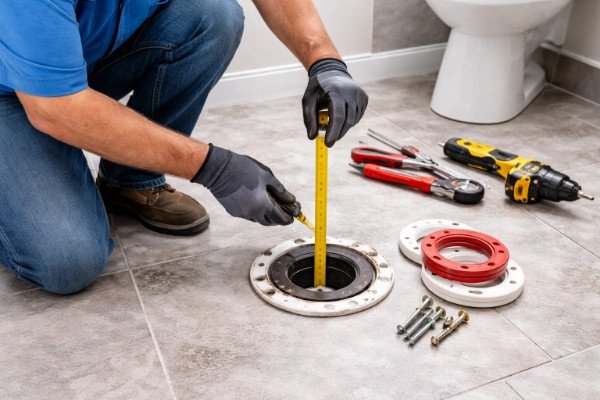
Assess the flange. If the flange is cast iron and one of the ears that holds the closet bolt is broken, you can install a repair ring over the existing flange instead of replacing the entire flange. If the flange is PVC and the ring is cracked in multiple places, or if the flange is rusted through, the entire flange must be replaced. If the flange is below the finished floor surface, which happens when new tile or laminate is installed over the old floor, a flange extender or a thicker wax ring may solve the problem without replacing the flange.
Removing the Old Flange From a Concrete Floor
A PVC flange that is glued inside the drain pipe must be cut out from the inside. The flange has a hub that fits inside the pipe or a collar that fits outside the pipe, and it is bonded with PVC cement. You cannot unglue PVC. You must cut it. Use an inside pipe cutter, a small circular saw blade that attaches to a drill, to cut through the flange from the inside, just above the point where the flange meets the pipe. Work slowly around the circumference, cutting a continuous groove. Do not cut into the concrete around the outside of the flange. The drain pipe is surrounded by concrete, and chipping the concrete away to access the outside of the flange is an hour of work with a hammer and chisel that may damage the pipe.
Once the flange is cut, pry the pieces out with a flathead screwdriver. If the flange was set into the concrete when the slab was poured, it may be surrounded by concrete that holds it in place even after it is cut internally. Chip the concrete around the outside of the flange carefully with a cold chisel until the flange can be pried out. A cast iron flange that is leaded into a cast iron pipe requires drilling out the lead and pulling the flange, which is a job for a plumber unless you have experience with cast iron and molten lead. A PVC flange that is glued inside a PVC pipe is a job for a homeowner.
Installing the New Flange on Concrete
Choose a replacement flange that fits inside the existing drain pipe. If the drain pipe is three-inch PVC, use a three-inch PVC flange with a hub that fits inside the pipe. If the pipe is four inches, use a four-inch flange that fits inside, or a three-inch flange with a reducing bushing. Dry-fit the new flange into the pipe to confirm the fit and to check the height. The bottom of the flange should sit flush on top of the finished floor. If the new flange sits above the floor, the toilet will rock and the flange will crack under the weight of a person sitting on it. If the flange sits below the floor, the wax ring will not compress enough to seal. The ideal flange height is flush on top of the finished floor or no more than a quarter inch above it.
If the new flange is too high because the drain pipe extends above the floor, cut the pipe down with an inside pipe cutter. If the new flange is too low because the pipe is recessed, use a flange extender or stack two wax rings, one with a plastic horn and one without, to build up the seal height.
Apply PVC primer and cement to the inside of the drain pipe and the outside of the flange hub. Push the flange into the pipe and rotate it a quarter turn to spread the cement. Align the flange so the closet bolt slots are perpendicular to the wall behind the toilet, not parallel. The closet bolts should slide into the slots from the sides, and the toilet should sit with the tank facing the wall and the bowl facing the room. A flange oriented with the slots parallel to the back wall means the toilet is facing the wrong wall.
Drill pilot holes through the flange mounting holes into the concrete using a hammer drill with a masonry bit. Wear safety glasses and a dust mask. Concrete dust is silica, which causes lung disease with repeated exposure. Drill the holes to the depth specified by the concrete anchor manufacturer. Insert the concrete anchors, typically Tapcon screws or lead anchors with stainless steel screws, and tighten them until the flange is firmly secured to the floor. Do not overtighten. A PVC flange will crack if the screws are driven too deep. The flange should be flush, level, and immobile.
The Wax Ring and Reinstalling the Toilet
Place a new wax ring on the bottom of the toilet, not on the flange. The wax ring has a flat side and a tapered side. The flat side goes against the toilet, and the tapered side faces down toward the flange. If you are using a wax ring with a plastic horn, the horn goes into the drain opening. The horn helps direct waste into the drain and prevents the wax from squishing inward and blocking the passage. If you are stacking two wax rings, put the one with the horn on the bottom and the plain one on top.
Remove the rag from the drain. Lower the toilet straight down onto the flange, aligning the closet bolts with the holes in the base of the toilet. Do not slide the toilet into position. Sliding smears the wax and breaks the seal. Lower it straight down with your body weight, pressing firmly but evenly until the toilet base contacts the floor. Install the washers and nuts on the closet bolts and tighten them alternately, a few turns at a time, until the toilet is secure. Do not overtighten the closet bolts. Overtightening cracks the porcelain base, and a cracked toilet base is a new toilet, not a new flange.
Reconnect the water supply, turn the water on, and flush several times. Check for leaks at the supply line, at the tank-to-bowl connection, and around the base of the toilet. A properly installed wax ring does not leak on the first flush or the thousandth. Run a bead of color-matched silicone caulk around the front and sides of the toilet base, leaving the back uncaulked. The gap at the back allows you to detect a leak before it rots the subfloor or soaks into the concrete slab. A fully caulked toilet base traps a leak underneath the toilet where it does damage for months before anyone discovers it.
FAQ — Replacing a Toilet Flange on Concrete
Can I use a repair ring instead of replacing the entire flange?
Yes, if the existing flange is solid except for a broken closet bolt ear. A repair ring is a metal or plastic ring that sits on top of the existing flange and provides new closet bolt slots. It is screwed into the concrete through the existing flange mounting holes. A repair ring adds about a quarter inch to the flange height, so confirm that the toilet still sits flush on the floor after the ring is installed. If the existing flange is cracked, rusted through, or loose, a repair ring will not fix the underlying problem. Replace the flange.
I do not own a hammer drill. Can I install the flange without drilling into concrete?
You can rent a hammer drill from any tool rental counter for about thirty dollars a day, and a masonry bit costs five dollars. It drills through concrete in seconds. A standard drill with a masonry bit will eventually drill through concrete, but it will take ten minutes per hole and may burn out the drill motor. For four holes in a concrete slab, rent the hammer drill. Alternatively, some replacement flanges are designed to be compression-fit inside the drain pipe without mechanical fasteners to the floor. The expansion gasket inside the pipe holds the flange in place. These flanges cost more, about twenty to thirty dollars, but eliminate the need for drilling entirely.
My new flooring raised the floor height and now the flange is recessed. Do I need to replace it?
Not necessarily. A flange that is recessed up to a quarter inch below the finished floor can usually be sealed with an extra-thick wax ring or a wax ring with a horn. A flange recessed between a quarter and a half inch below the floor needs a flange extender, which is a plastic ring that sits on top of the existing flange and raises the sealing surface. A flange recessed more than a half inch should be replaced with a flange that sits at the correct height. Stacking extenders beyond half an inch creates a joint that can separate under the weight of the toilet.