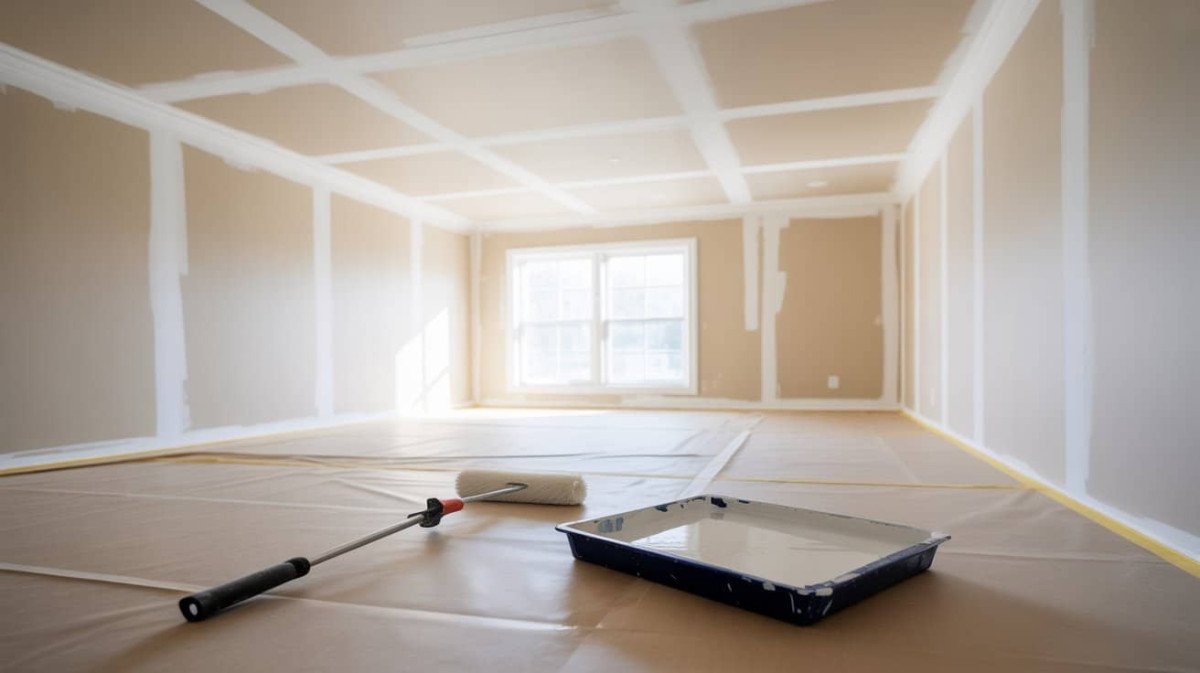
Per Ocean Realty Ponte Vedra Beach, a twelve-by-twelve bedroom with eight-foot ceilings and standard trim takes a homeowner working alone between eight and twelve hours of actual painting time, spread across at least two days, plus drying time between coats. The eight-hour estimate assumes the room is empty or the furniture is pushed to the center and covered, the walls are in good condition with no major repairs, the ceiling is being painted, the trim is being painted, and two coats are going on the walls with one coat on the ceiling and the trim. The twelve-hour estimate is the same room with a dark-to-light color change, extensive trim, or a first-timer who is learning to cut in as they go. A professional painter working alone can do the same room in about four to six hours. The homeowner is not three times slower. The homeowner is doing the same work while also moving the furniture, patching the nail holes, and figuring out which brush to use.
The time to paint a room is not one continuous block of work. It is a series of tasks separated by drying time. You paint the ceiling, wait two to four hours for it to dry, apply a second coat if needed, wait again, then cut in and roll the walls, wait two to four hours, apply the second coat, wait, then paint the trim, then wait until the next day to remove the tape and move the furniture back. The working time is about eight to twelve hours. The elapsed time from the moment you move the first piece of furniture to the moment you move it back is about a day and a half to two days. If you are painting on a weekend, you will start Saturday morning and finish Sunday afternoon.
The Hour-by-Hour Breakdown for a 12×12 Room
Furniture moving and room preparation takes forty-five minutes to an hour. Move the furniture to the center of the room, cover it with plastic sheeting, remove the outlet covers and switch plates, remove the curtain rod and the blinds if they will be in the way, and lay drop cloths on the floor. A canvas drop cloth stays in place and does not slide around like plastic sheeting. It costs about twenty dollars and is reusable.
Wall and trim preparation takes thirty minutes to an hour. Fill nail holes and small cracks with spackling compound. Let the spackling dry for about thirty minutes, then sand the patches smooth with a sanding sponge. Vacuum the baseboards and the tops of the door and window trim where dust collects. Wipe the walls with a damp rag if they are dusty. Tape along the baseboards, the ceiling line, and the window and door trim if you are not confident cutting in by hand. Taping a twelve-by-twelve room takes about thirty to forty-five minutes. Cutting in by hand takes no time before painting because the cutting in is done with the brush during the painting step. If you tape, you trade forty-five minutes of taping for not having to cut in. If you cut in, you trade the time spent cutting in for not having to tape. The total time is roughly the same.
Painting the ceiling takes about forty-five minutes to an hour for one coat. Cut in around the perimeter of the ceiling with a brush, then roll the ceiling with an extension pole. A ceiling that is being painted the same color it already is needs one coat. A ceiling that is being painted white over a previously colored ceiling may need two coats. Apply the second coat after the first coat is dry, adding another forty-five minutes of work and two to four hours of drying time. Painting the ceiling first is the correct sequence because drips from the ceiling will land on the walls, which have not been painted yet, and will be covered by the wall paint.
Painting the walls takes about an hour and a half to two hours per coat for a twelve-by-twelve room. Cut in along the ceiling line, the baseboards, the corners where walls meet, and around the window and door trim. Roll the walls in sections of about four feet wide, working from the top down and maintaining a wet edge so the cut-in paint and the rolled paint blend together. A second coat takes the same amount of time. The walls are the largest surface area in the room, and the cutting in is the slowest part of the wall painting.
Painting the trim takes about an hour to an hour and a half. The baseboard, the door casing, and the window casing in a standard bedroom total about sixty to eighty linear feet of trim. Paint the trim with a two-inch angled sash brush in long, smooth strokes. The trim must be painted after the walls because the wall paint overlaps slightly onto the trim during rolling, and the trim paint covers that overlap. Tape the wall above the baseboard if you are not confident cutting in the trim paint against the fresh wall paint. Fresh wall paint that is taped too soon will peel when the tape is removed. Wait at least twenty-four hours after painting the walls before taping over them.
| Task | Time (first coat) | Time (second coat) | Dry time between |
| Furniture and room prep | 45–60 min | N/A | N/A |
| Wall prep and taping | 30–90 min | N/A | N/A |
| Ceiling | 45–60 min | 45–60 min | 2–4 hours |
| Walls (cut and roll) | 90–120 min | 90–120 min | 2–4 hours |
| Trim | 60–90 min | 30–45 min (if needed) | 2–4 hours |
| Cleanup and furniture | 30–45 min | N/A | N/A |
The Three Things That Add Hours to a Standard Room Paint Job
A dark-to-light color change adds one to two coats of primer or an additional coat of paint, which adds two to three hours of work and another round of drying time. Painting a dark red or navy blue wall white may require a tinted primer plus two coats of white paint, effectively doubling the wall painting time. The extra coats are not optional. Dark colors bleed through white paint as a pink or blue shadow that deepens over several days as the underlying pigment migrates into the new paint film. Primer blocks the migration. Additional coats of paint without primer may not.
Extensive drywall repair adds time in proportion to the size and number of the repairs. Patching a dozen nail holes takes ten minutes. Patching a large crack or a hole from a doorknob takes thirty minutes for the patch and another thirty minutes for sanding after the compound dries. A room that needs extensive drywall repair should have the repairs done a day before painting begins so the compound can dry completely and be sanded before the first drop of paint is applied. Painting over wet spackling compound produces a rough, uneven surface that will crack as the compound shrinks underneath the paint.
French doors, multiple windows, or built-in shelving add cutting-in time. A standard bedroom has one door and one window. A room with two windows, a closet with louvered doors, and a built-in bookcase has significantly more edges to cut in around. Each additional window adds about fifteen to twenty minutes per coat. A built-in bookcase with shelves adds about thirty minutes per coat because each shelf must be cut in on three sides and the inside of the bookcase must be painted if it is visible.
How to Get Faster Without Getting Sloppy
Learn to cut in without tape. An angled sash brush held correctly cuts a line that is as straight as tape and takes no time to apply. Practice on a section of wall behind a door or in a closet where mistakes are hidden. The technique takes about an hour of practice to learn and eliminates the taping step from every painting project for the rest of your life.
Use an extension pole on the roller. Rolling walls and ceilings from a standing position with an extension pole is twice as fast as rolling from a ladder because you can cover a wider area with each stroke and you are not climbing up and down to move the ladder. An extension pole costs fifteen dollars and fits any standard roller frame.
Do not wash the roller between coats. Wrap the roller tightly in plastic wrap or aluminum foil and put it in the refrigerator. The roller stays wet and ready for the second coat hours later. Washing the roller between coats adds twenty minutes of cleanup time that is duplicated when you have to wash it again at the end of the job. The roller sleeve costs about five dollars. If you value your time at more than fifteen dollars an hour, throwing away the roller sleeve after the second coat and using a new one is the economically rational choice.
FAQ — Painting a 12×12 Room
Can I really paint a room in one day?
Yes, if the room is empty, the walls and ceiling are the same color they already are, you are applying one coat, you are not painting the trim, and you do not need primer. A single coat of paint on the walls and ceiling of an empty twelve-by-twelve room with no trim work takes about four to five hours. That is the scenario where painting a room in one day is realistic. Every additional variable adds time.
Do I really need to wait four hours between coats?
The drying time on the paint can is a guideline for ideal conditions. In a room with good ventilation, low humidity, and a temperature above seventy degrees, latex paint is dry enough to recoat in about two hours. In a cold or humid room, recoating before the recommended time produces a gummy surface that the roller pulls up, leaving streaks and texture. If you are not sure whether the paint is dry enough, touch it with your fingertip in an inconspicuous spot. If it feels cool or tacky, wait. If it feels dry and does not leave a fingerprint, you can recoat.
Should I cut in the entire room first and then roll, or cut and roll one wall at a time?
Cut and roll one wall at a time. Cutting in the entire room first means the cut-in paint will be dry by the time you start rolling, and the rolled paint will not blend with the dried cut-in paint, leaving a visible border around the room called a halo. Cut in one wall, roll that wall immediately while the cut-in paint is still wet, and move to the next wall. The wet edge blends the cut-in paint and the rolled paint into a seamless surface.