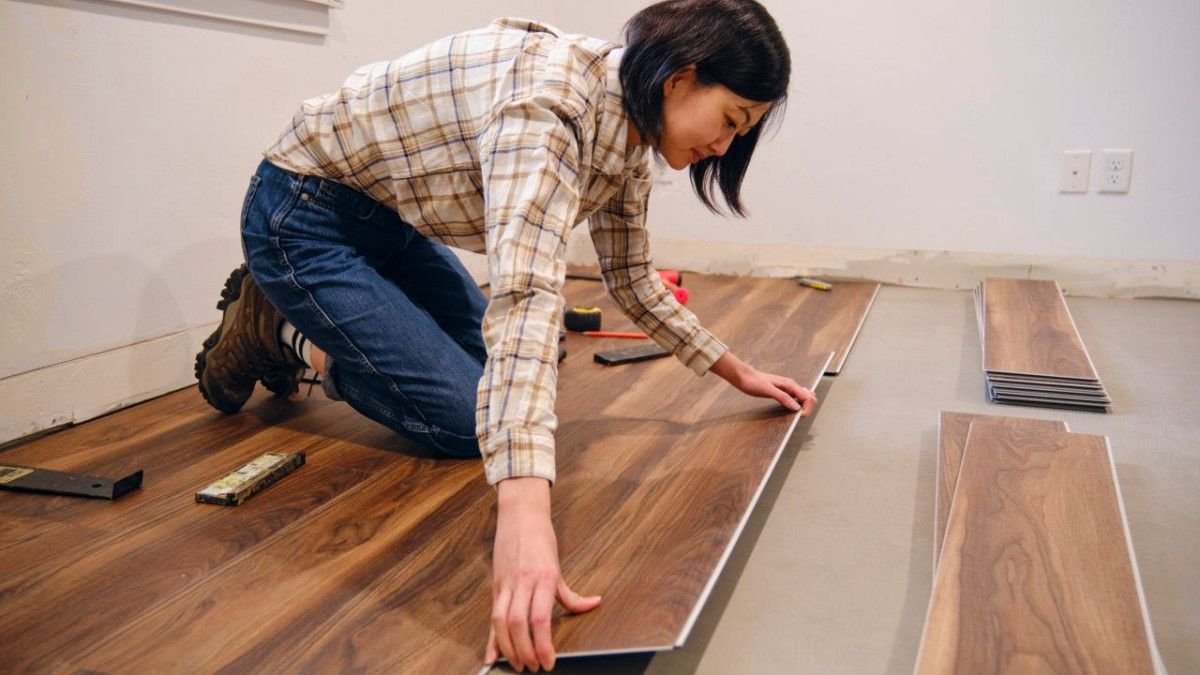
You bought thirty-seven boxes of laminate flooring that are now stacked in the living room, and you are trying to decide whether to spend the next two weekends on your knees with a tapping block or to pay someone else to do it. The labor cost to install laminate flooring ranges from two to eight dollars per square foot depending on where you live, who you hire, and what surprises the subfloor reveals when the old flooring comes up, shares Pillar Management Steinbach team. The material cost you already know because you bought the boxes. The labor cost is the number that determines whether this project costs eight hundred dollars or three thousand.
The national average for laminate flooring installation labor is about three to five dollars per square foot for a straightforward job in an empty rectangular room with a flat subfloor and no furniture to move. A three-hundred-square-foot living room at four dollars a square foot costs twelve hundred dollars in labor. The same room with stairs, a hallway, three doorways, furniture that needs to be moved, and old carpet that needs to be removed and disposed of can push the labor cost to six or seven dollars a square foot. The price per square foot is not a fixed number. It is a starting point that adjusts upward with every complication the installer encounters.
What the Labor Cost Actually Covers — It Is More Than Just Clicking Boards Together
Laminate flooring installation labor typically includes removing and disposing of the existing flooring, preparing the subfloor by cleaning, leveling minor imperfections, and installing an underlayment or moisture barrier, acclimating the flooring material to the room’s humidity for at least forty-eight hours before installation, cutting the planks to fit around doorways, corners, and obstacles, installing the flooring with the proper expansion gap around the perimeter, and reinstalling or replacing the baseboards and transition strips. Some installers charge separately for each of these tasks. Others quote an all-inclusive price. The quote should state exactly what is included.
The removal and disposal of existing flooring is the largest variable that separates one quote from another. Removing carpet and pad is fast and cheap, about fifty cents to a dollar per square foot. Removing glued-down vinyl or tile is slow and expensive, about one to two dollars per square foot, plus disposal fees. Removing glued-down hardwood is the worst case scenario, potentially two to three dollars per square foot in labor alone before a single laminate plank is laid. A quote that seems too low compared to others probably excludes removal or disposal. A quote that includes removal will state it explicitly.
| Task | Cost range (per sq ft) | Notes |
| Laminate installation only | $2.00–$4.00 | Empty room, flat subfloor |
| Remove carpet and pad | $0.50–$1.00 | Includes disposal |
| Remove vinyl or tile | $1.00–$2.00 | More if glued down |
| Subfloor leveling | $0.50–$1.50 | Self-leveling compound or patching |
| Underlayment installation | $0.30–$0.75 | Often included in installation price |
| Baseboard removal and reinstall | $1.00–$2.00 per linear ft | Or install new baseboard |
| Stairs (per step) | $30–$60 each | Stair nosing adds material cost |
The Five Factors That Change the Price More Than Anything Else
The condition of the subfloor is the first factor. Laminate requires a flat subfloor with no more than three-sixteenths of an inch of variation over a ten-foot span. A subfloor that dips in the middle, has a high seam between sheets of plywood, or has chunks of old adhesive stuck to it requires leveling before the laminate goes down. Self-leveling compound costs about thirty to fifty dollars a bag and adds a day of labor while it cures. The installer will charge for both the material and the time. A subfloor that is flat and clean saves hundreds of dollars.
The layout of the room is the second factor. A square room with no obstacles is fast to install. A room with multiple doorways, a fireplace hearth, floor vents, a curved wall, or a staircase landing requires measuring, cutting, and fitting around each obstacle, which adds time. Stairs are the most expensive feature to install laminate on per square foot because each step requires a separate stair nosing piece that costs twenty to forty dollars in materials and takes fifteen to thirty minutes to cut and install. A staircase with twelve steps can add four hundred to seven hundred dollars to the labor cost.
The installer’s business model is the third factor. A licensed, insured flooring contractor with a physical showroom charges more than a solo installer who works out of a truck. The higher quote buys you a warranty, insurance coverage if the installer damages your property, and a business address where you can find someone if the floor fails a year later. The lower quote saves money upfront and transfers the risk of a bad installation to you. For a floating laminate floor that clicks together and can be disassembled and reinstalled, the risk of a catastrophic installation error is low compared to tile or hardwood. For a floor that will be walked on every day for ten years, the difference between a meticulous installer and a fast one is visible in the gaps and the squeaks.
DIY vs Hiring a Professional — The Cost Difference in Real Numbers
Installing laminate flooring yourself eliminates the labor cost entirely. The only costs are the flooring material, the underlayment, the tapping block and pull bar kit which costs about twenty to thirty dollars, and the saw. A miter saw or a circular saw is helpful but a jigsaw works for cutting around doorways and a utility knife scores and snaps most laminate planks. A three-hundred-square-foot room with laminate at two dollars a square foot in materials costs about six hundred dollars in materials and a weekend of your time. The same room installed by a professional at four dollars a square foot in labor costs twelve hundred dollars in labor plus the six hundred in materials, for a total of eighteen hundred dollars. You are trading twelve hundred dollars in savings for two days of physical work and the risk that your seams are not quite as tight as a professional’s.
The decision is not purely financial. Laminate flooring is physically demanding in ways that are hard to appreciate until hour six. You spend the entire day on your knees. The tapping block sends a shock through your wrist with every strike. The constant up-and-down to the saw in the garage or the backyard becomes a workout by mid-afternoon. A twenty-year-old can install three hundred square feet in a day and feel fine the next morning. A fifty-year-old who does not regularly work on their knees will feel the installation for the next three days. The labor cost is partly the price of skill and partly the price of waking up without knee pain.
FAQ — Laminate Flooring Installation Cost
Should I pay per square foot or a flat fee for the whole job?
A flat fee for the entire job is better for you as the homeowner because it transfers the risk of an inaccurate estimate to the installer. A per-square-foot quote is fine if the square footage is measured accurately and the quote includes all the ancillary tasks like removal, disposal, and trim work. Request a flat-fee quote that lists exactly what is included and what is excluded. A flat-fee quote that excludes removal or baseboard work is not a flat-fee quote. It is a partial quote with undisclosed extras.
Is there a cheaper time of year to hire a flooring installer?
Flooring installation demand follows home sale season. Late spring through early fall is the busiest period, and installers charge premium rates and have less availability. Late fall and winter, particularly January and February, are slower, and installers are more willing to negotiate on price and schedule. The trade-off is that laminate flooring needs to acclimate to the home’s interior humidity before installation, and a house that is heated in the winter has low humidity. The flooring will expand slightly when humidity rises in the summer, and improper acclimation or insufficient expansion gaps will cause buckling when the seasons change.
What hidden costs should I budget for beyond the labor and materials?
Budget for the unexpected: a subfloor that needs patching, a piece of rotted subfloor under a window that leaked, a doorway that requires a custom transition strip because the new floor is a different height than the adjacent flooring, and the disposal fee for the old flooring if the installer’s quote does not include it. Add ten to fifteen percent to the total quoted price for contingencies. A three-thousand-dollar quote should have a three-hundred-to-four-hundred-fifty-dollar cushion in your budget. If nothing goes wrong, you saved the contingency. If something goes wrong, you do not have to stop the project halfway through while you figure out how to pay for a new sheet of plywood.