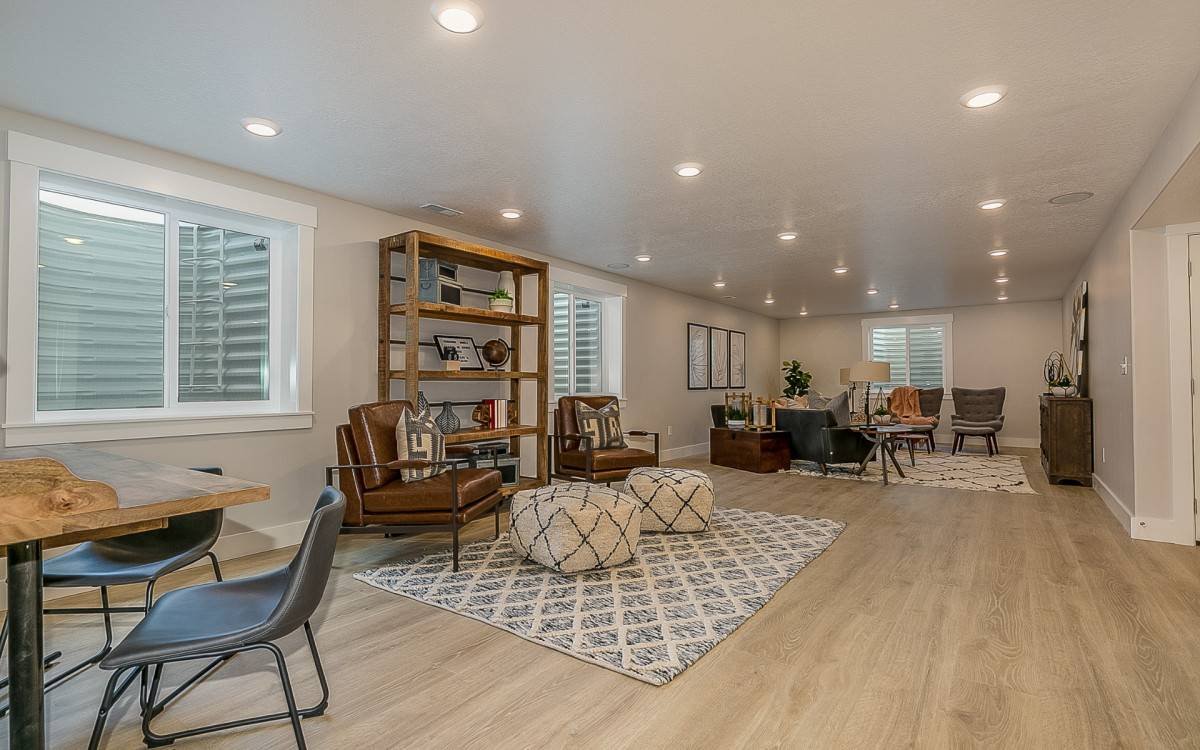
Finishing a basement costs between thirty and seventy-five dollars per square foot for a full build-out with framing, drywall, electrical, plumbing, flooring, ceiling, insulation, and trim, which means an eight-hundred-square-foot basement costs between twenty-four thousand and sixty thousand dollars, reports PMI Little Town Professionals. The range is wide because a basement with an existing bathroom rough-in, an open floor plan, and eight-foot ceilings at the low end costs about half as much per square foot as a basement with no plumbing, low ceilings, and a requirement for an egress window to be cut into the foundation wall. The square footage of the basement is the starting point for the estimate. The mechanical, structural, and code requirements are where the money goes.
The cost per square foot is higher for a small basement because the expensive items, the bathroom, the staircase, the electrical panel upgrade, and the egress window, cost roughly the same regardless of the total square footage, and they are spread across fewer square feet. A bathroom costs about ten to fifteen thousand dollars whether it is in a five-hundred-square-foot basement or a fifteen-hundred-square-foot basement. In the smaller basement, the bathroom alone is twenty to thirty dollars per square foot. In the larger basement, it is seven to ten dollars per square foot. The cost per square foot number is useful for comparing quotes. It is misleading for budgeting without understanding which costs are fixed and which scale with the size of the space.
Where the Money Goes — The Cost Breakdown by Component
Framing and drywall cost about eight to twelve dollars per square foot combined, including the lumber for the walls and the ceiling soffits, the drywall panels, the tape, the joint compound, and the labor to hang and finish. Framing a basement is standard wood stud construction with the walls held an inch away from the foundation walls to allow for moisture drainage and to prevent the wood from contacting the concrete. Metal studs cost about the same as wood and do not rot if they get wet, but they require different fastening techniques and are less familiar to DIY homeowners.
Electrical work costs about three to five dollars per square foot for a basement with standard lighting, outlets every twelve feet per code, and dedicated circuits for a bathroom and a home office or entertainment area. The cost includes running new circuits from the main panel to the basement, installing the outlets, switches, and light fixtures, and connecting the smoke detectors and the GFCI outlets that code requires. An electrical panel upgrade, which is required if the existing panel does not have capacity for the additional circuits, adds fifteen hundred to three thousand dollars to the project. An older house with a hundred-amp service that is already at capacity will need a two-hundred-amp panel upgrade before the basement can be wired. The panel upgrade is not optional if the existing panel cannot handle the additional load.
Plumbing costs are the most variable line item in a basement finishing budget. A bathroom rough-in, meaning the drain pipes for the toilet, the shower, and the sink are already stubbed up through the concrete floor, saves five to ten thousand dollars compared to a basement with no rough-in where the concrete slab must be cut open to install the drains. A basement bathroom with a rough-in costs about ten to fifteen thousand dollars for the plumbing, the fixtures, the tile, the vanity, and the labor. A basement bathroom without a rough-in costs about fifteen to twenty-five thousand dollars because of the concrete cutting and the drain installation. A wet bar or a kitchenette adds about three to five thousand dollars for the plumbing and the cabinetry.
Flooring costs about three to eight dollars per square foot installed, depending on the material. Luxury vinyl plank is the standard basement flooring because it is waterproof, it installs over concrete, and it costs about three to five dollars per square foot installed. Tile costs about five to eight dollars per square foot installed and is more durable but colder underfoot. Carpet costs about two to four dollars per square foot installed and is the warmest option but the most vulnerable to moisture. Engineered hardwood can be installed in a basement but requires a subfloor membrane to prevent moisture from the concrete from warping the wood, which adds about two dollars per square foot to the installation cost.
Ceiling costs depend on whether the ceiling is drywalled or dropped. A drywall ceiling costs about two to three dollars per square foot installed and painted, the same as the walls. A dropped ceiling with acoustic tiles costs about four to six dollars per square foot installed and provides access to the plumbing, electrical, and ductwork above the ceiling. The access is the reason dropped ceilings are standard in basements. A drywall ceiling that must be cut open to repair a leaking pipe costs more to repair than the initial savings over a dropped ceiling. A dropped ceiling that is opened and closed for a repair costs nothing beyond the plumber’s time.
| Component | Cost per sq ft | 800 sq ft basement | Notes |
| Framing and drywall | $8–$12 | $6,400–$9,600 | Includes ceiling if drywalled |
| Electrical | $3–$5 | $2,400–$4,000 | Excludes panel upgrade |
| Plumbing (with rough-in) | N/A (fixed) | $10,000–$15,000 | Bathroom only, per fixture |
| Flooring | $3–$8 | $2,400–$6,400 | LVP to tile range |
| Insulation | $1–$3 | $800–$2,400 | Required by code |
| HVAC | $2–$4 | $1,600–$3,200 | Extend existing or add mini-split |
| Trim, doors, paint | $3–$6 | $2,400–$4,800 | Includes interior doors |
| Permits and design | $1–$2 | $800–$1,600 | Required for electrical and plumbing |
The Big-Ticket Items That Inflate the Budget
An egress window is required by building code for any basement living space, including a bedroom, a family room, or a home office where people will spend significant time. An egress window is a window large enough for a person to climb through in a fire. It must be cut into the foundation wall, which requires a concrete cutting contractor and costs between three thousand and six thousand dollars for a standard egress window with a window well and a drain. A basement without an egress window cannot legally be finished as living space. A basement with a walkout, meaning a door that opens directly to the outside at grade level, does not require an egress window because the door serves as the emergency exit.
Moisture remediation must be completed before any finishing materials are installed. A basement with efflorescence on the walls, a musty smell, or visible water stains after heavy rain needs a drainage system, a sump pump, or exterior waterproofing before the drywall goes up. Interior waterproofing, meaning a perimeter drain and a sump pump, costs about five to ten thousand dollars. Exterior waterproofing, meaning excavating around the foundation and sealing the exterior walls, costs about fifteen to thirty thousand dollars. A basement that is finished without addressing the moisture problem will develop mold behind the drywall within a year or two, and the entire finish will need to be torn out and replaced. The moisture fix costs less than doing the finish twice.
Staircase upgrades may be required by code. A basement staircase that is too narrow, too steep, or lacks a handrail must be brought up to current code when the basement is finished. Rebuilding a staircase costs between two thousand and five thousand dollars depending on the extent of the modifications. The building inspector will flag the staircase if it does not meet code, and the finish cannot proceed until it is fixed.
DIY vs Contractor — What You Can Do Yourself and What You Should Not
Framing, insulation, drywall hanging, painting, trim installation, and flooring are within the skill set of a homeowner who has completed a few renovation projects. Drywall finishing, the taping and mudding that produces a smooth wall surface, is the most skilled of the DIY-possible trades and the one that produces the most visible imperfections if done by a first-timer. Electrical and plumbing work must be done by a licensed contractor in most jurisdictions, and even where it is legal for a homeowner to do their own work, the electrical and plumbing must be permitted and inspected. A basement finished without permits will be discovered when the house is sold, and the seller will be required to disclose the unpermitted work, which reduces the sale price and can kill a deal.
The cost of hiring a general contractor to manage the entire project adds ten to twenty percent to the total cost, which on a forty-thousand-dollar basement is four to eight thousand dollars. The general contractor’s value is in coordinating the trades, scheduling the inspections, and absorbing the delays and the surprises. A homeowner who acts as their own general contractor saves the markup and spends every evening and weekend for three to six months managing the project. Whether that trade is worth the savings depends on how much you value your evenings and weekends.
FAQ — Basement Finishing Costs
How much do permits add to the cost?
Building permits for a basement finish typically cost between five hundred and fifteen hundred dollars, depending on the scope of the work and the jurisdiction. The permit cost includes the plan review and the inspections for framing, electrical, plumbing, and final occupancy. The cost of the permit is a fraction of the cost of doing the work without one and having to tear it out when the lack of permits is discovered.
Can I finish half the basement now and the rest later to spread out the cost?
Yes. Finishing the basement in phases is common and practical. Finish the main living area and the bathroom first, leaving the storage area and the utility room unfinished. The framing, electrical, and plumbing for the unfinished portion can be roughed in during the first phase so they are ready when the second phase begins. Roughing in the future areas during the first phase adds about ten to twenty percent to the first phase cost, which is less than the cost of opening walls later to run new wiring and plumbing.
Will finishing the basement increase the home’s resale value by more than it costs?
A finished basement typically recoups about seventy to seventy-five percent of its cost in increased home value, which means a forty-thousand-dollar basement finish adds about twenty-eight to thirty thousand dollars to the home’s value. The return is lower than a kitchen or bathroom renovation because a basement is below grade and is valued less per square foot than above-grade living space. If you are finishing the basement primarily to increase resale value, the return is negative in purely financial terms. If you are finishing the basement to use it as living space for the years you will live in the house, the return includes the value of that use, which is not captured in the resale calculation.