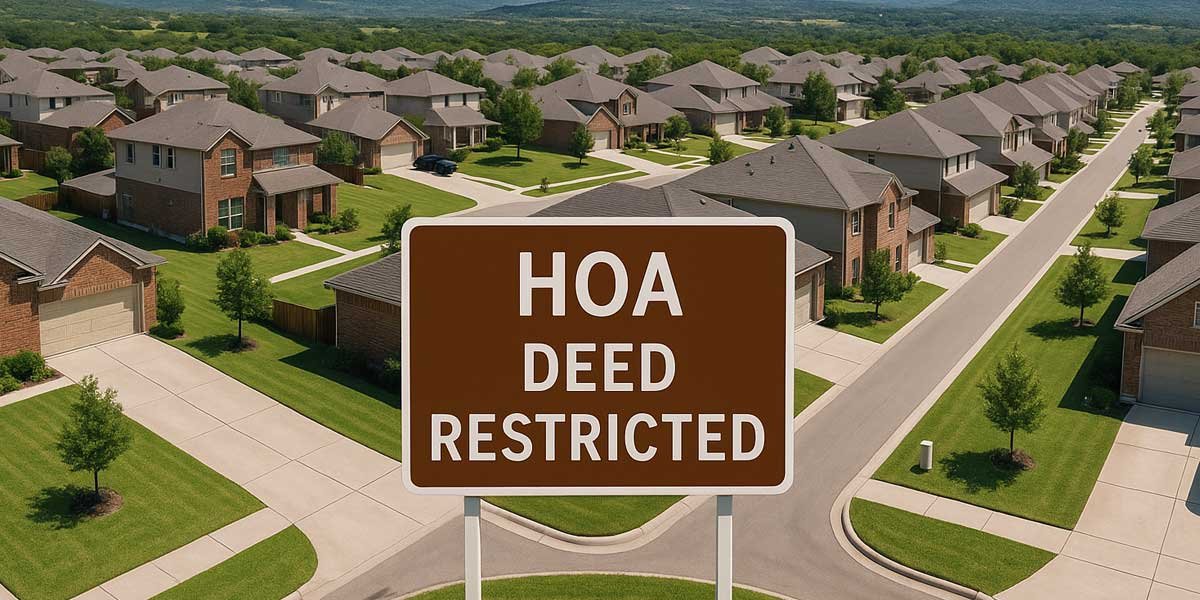
Deed restrictions are legally binding clauses written directly into a property’s deed that limit how the land or structure can be used. They transfer automatically with every sale, often for decades or permanently. The house changes hands; the restriction does not. Understanding what is a deed restriction before buying a property is one of the few due-diligence steps that cannot be undone after the fact, emphasizes Premier Property Management Pottstown.
You find the house. You make the offer. Then your real estate attorney flags something on page 14 of the deed — a clause saying no commercial vehicle may be parked on the property, no second dwelling may be added, no business may be operated from the address. Not a HOA bylaw. Not a municipal ordinance. The deed itself. That clause will be there for the next buyer, and the buyer after that. That is the weight of a deed restriction: it is older than your ownership, and it intends to outlast it.
What Exactly Is a Deed Restriction?
A deed restriction is a private legal agreement — recorded in a county’s public land records — that restricts the use or development of a property in a specified way. Courts have consistently held that restrictions created by prior owners bind subsequent buyers who take title with notice of the restriction, meaning the recording itself constitutes legal notice.
The formal legal term is restrictive covenant. In planned communities and subdivisions, deed restrictions commonly travel under the umbrella abbreviation CC&Rs — Covenants, Conditions, and Restrictions. The distinction between a “covenant” and a “condition” matters legally: violating a covenant typically triggers the right to seek a court injunction or damages, while violating a “condition” can trigger a right of re-entry by the original grantor. Courts today apply the injunction remedy far more often, treating conditions as covenants to avoid the extreme consequence of title forfeiture.
Per the legal doctrine of restrictive covenants, a restriction “runs with the land” — binding all future owners, when it meets three classic property law requirements: it must be in writing, the original parties must have intended it to bind successors, and it must “touch and concern” the land itself. All three elements must be present for the restriction to legally transfer to a buyer who was not a party to the original agreement.
That third element, touching and concerning the land, is what distinguishes a deed restriction from a personal contract. A seller can promise privately never to paint their fence purple, and that promise binds the seller. Only when the restriction goes into the deed and is recorded does it bind the seller’s successor who never made any promise at all.
How Deed Restrictions Work, and Why They Follow the Property
When a developer builds a subdivision, they can record a Declaration of Restrictions against every lot in the development before selling a single home. That declaration gets written into each lot’s deed. Every buyer who purchases a lot takes title subject to the restrictions, whether or not they are prominently disclosed, and whether or not the buyer reads the document thoroughly before closing.
Private individuals can also create deed restrictions independently of any HOA or development scheme. A seller who wants to preserve the rural character of land they are conveying can write a clause into the deed prohibiting future subdivision. A family selling property to a church might include a restriction limiting future use to religious purposes. A landowner who cares about open space can sell a conservation easement to a land trust, permanently preventing development on the property while retaining ownership of the land itself.
The mechanic that makes all of this work: deed restrictions are recorded with the county recorder’s office, making them part of the searchable chain of title. Title companies pull this chain before every closing. A buyer who purchases property without discovering a deed restriction, because a title search was skipped, or because their attorney missed it, is still legally bound by it. Recorded notice is constructive notice. The law assumes you knew. This is a useful rule for title systems. It is an unpleasant one to learn for the first time at a post-closing letter from an HOA attorney.
This is why the due diligence window before closing exists. A restriction found after the deed is signed becomes your problem to solve, at your expense, with no recourse against the seller who may have been equally unaware of it.
Common Types of Deed Restrictions
Most residential deed restrictions fall into four main categories, architectural controls, land use limitations, subdivision and lot size constraints, and occupancy rules. Two additional categories appear less often in typical residential transactions but carry significant consequences: conservation easements and affordable housing deed restrictions.
| Category | What It Restricts | Common Example |
|---|---|---|
| Architectural Controls | Appearance and structure of improvements | No fence taller than 4 feet; exterior paint must come from an approved color list; no metal roofing |
| Land Use | Permitted activities on the property | No commercial activity; no short-term vacation rentals; no livestock; no vehicle repair as a business |
| Subdivision / Lot Size | How land can be divided or built upon | Minimum lot size of 1 acre; no more than one primary dwelling per parcel |
| Occupancy | Who may use the property and in what configuration | Single-family residential use only; no multi-unit conversion; no rentals under 30 days |
| Conservation Easement | Development rights and land alteration | No clearing of wetland buffers; no structures within 100 feet of the creek bank; no commercial timber harvest |
| Affordable Housing | Resale price and buyer income eligibility | Property may only be sold to buyers earning below 80% of area median income; resale price capped by formula |
The affordable housing category is worth a specific note. Many municipalities and state housing authorities use deed restrictions as a long-term subsidy tool: when public funding helps a buyer purchase a home at below-market cost, a deed restriction ensures that subsidy stays with the property rather than converting to private equity at the next sale. The restriction keeps the unit affordable through future transactions, not just the first one.
Conservation easements represent the other end of the spectrum. A landowner who transfers an easement to a land trust typically receives a charitable tax deduction based on the value of development rights surrendered. The easement is then recorded against the deed and enforced by the land trust in perpetuity. Land sold after the easement conveys with the restriction attached; the new owner cannot develop what the easement covers, regardless of what they paid or what zoning allows.
Deed Restrictions vs. Zoning Laws vs. HOA Rules
These three regulatory layers are distinct in origin, enforcement, and flexibility, yet they can all apply to the same property at the same time. When they conflict, the outcome is not obvious without knowing how each layer operates.

| Deed Restriction | Zoning Law | HOA Rule | |
|---|---|---|---|
| Source | Private agreement recorded in deed | Municipal ordinance enacted by local government | Contract between homeowner and homeowners’ association |
| Who Enforces | Benefiting property owners; HOA; courts | Local zoning board, building department | HOA board; courts via civil action |
| Runs With Land? | Yes, binds all future owners | Yes, applies to whoever owns the parcel | Generally yes, when recorded as part of CC&Rs |
| Can Be Changed? | Requires consent of all parties with benefit; sometimes court order | Requires formal rezoning through public process | Via HOA vote, often majority or supermajority required |
| What Governs When They Conflict | Whichever is more restrictive governs. Both a zoning law and a deed restriction can apply simultaneously, you must comply with the stricter of the two. | ||
The practical implication: a municipal zoning code might permit a home business in a residential district, but a deed restriction can still prohibit it. You must comply with whichever rule imposes the greater limitation. Conversely, a deed restriction that allows something zoning forbids is irrelevant, the zoning prohibition still applies. The two systems do not cancel each other out; they stack.
HOA rules operate somewhat differently. Rules adopted by an HOA board can generally be changed by a vote without amending the underlying deed. But CC&Rs, the recorded declaration of restrictions for a development, carry the same legal weight as any other deed restriction and require the same formal process to modify. Buyers sometimes confuse HOA policies with deed restrictions. They are not the same, and the distinction matters when you want to push back on a rule.
The History: When Deed Restrictions Were Used to Segregate Neighborhoods
For much of the early and mid-20th century, deed restrictions in the United States routinely contained racial covenants, clauses explicitly prohibiting the sale, lease, or occupancy of a property to African Americans, Jewish families, Asian Americans, and other groups. These were not fringe documents from isolated sellers. They were standard practice in suburban developments across St. Louis, Detroit, Seattle, Chicago, Los Angeles, and hundreds of other cities.
The watershed moment came in 1948. The Supreme Court decided Shelley v. Kraemer, ruling that while private racial deed restrictions were not themselves unconstitutional, courts could not enforce them. Judicial enforcement of a racial covenant would constitute state action in violation of the 14th Amendment’s Equal Protection Clause. Racial covenants became judicially unenforceable that year, though they remained physically written in millions of recorded deeds.
The Fair Housing Act of 1968 completed the legal abolition, making it illegal to create discriminatory deed restrictions and prohibiting enforcement of any that remained. Several states have since passed laws allowing homeowners to formally renounce historic racial covenants from their deeds through a notarized process. The renunciation is largely symbolic, the covenant is already void, but it removes the language from public records that are still searched and still read.
The legacy maps almost exactly onto the residential segregation patterns visible in American cities today. A restriction that prevented a neighborhood from being open to non-white buyers in 1945 determined who could build wealth through homeownership in the postwar boom years. Those homeownership gaps, and the intergenerational wealth they represent, remain measurable in current income and asset data. A clause that occupied a single paragraph in a 1940s subdivision plat produced consequences still observable 80 years later.
Commercial Deed Restrictions, The Version That Creates Food Deserts
Most homebuyers associate deed restrictions with paint colors and fence heights. There is a different category, legal, common, and largely invisible to residential buyers, where the same instrument is used to control commercial markets.
When a major retailer closes or relocates a store, they frequently sell or lease the vacated property with a deed restriction prohibiting the next occupant from operating a competing business. A former Walmart location can carry a clause barring grocery retail. A vacated Stop & Shop can be legally blocked from becoming another supermarket, even if the surrounding neighborhood has no other food access for miles. The retailer’s market position is protected. Residents bear the cost.
“Walmart, Stop & Shop’s ‘Scorched-Earth’ Deed Restrictions Result in Food Deserts in Woonsocket”— r/RhodeIsland · View discussion, April 2026 (102 upvotes)
Rhode Island is currently working toward legislation to restrict this practice. The state’s Lieutenant Governor’s office has been collaborating with legislators to draft a bill limiting so-called “scorched-earth” deed covenants on commercial properties, arguing that when large retailers use deed restrictions to block grocery competition, low-income residents in the affected area face reduced food access and higher prices at whatever alternatives remain.
This commercial application of deed restrictions is entirely legal under current federal law. It also shares almost nothing in practice with the residential version, except the name and the fact that both are recorded instruments in a property’s chain of title. A buyer purchasing a commercial site without a title search that specifically flags restriction language on use could find themselves holding a property they cannot lease to the most obvious tenant category.
How to Find Out If a Property Has Deed Restrictions
Deed restrictions are part of the public land record and show up in any professional title search. Finding them before closing requires knowing where to look, and recognizing that the seller’s disclosure form is not the same thing as a title search.
- Order a title search. A licensed title company or real estate attorney will search the chain of title and flag recorded restrictions. This is standard practice before any purchase, confirm that deed restrictions are specifically in scope, not just liens and judgments.
- Read the title commitment. Before closing, the title insurer issues a commitment listing all exceptions to coverage. Deed restrictions appear as Schedule B exceptions. This document exists precisely to tell you what you are taking on.
- Search the county recorder’s office. Most county recorders now offer online document search by parcel identification number or property address. Recorded instruments, including declarations of restrictions and individual deed covenants, appear in that search.
- Request HOA documents. In communities with a homeowners’ association, request the CC&Rs, Declaration of Restrictions, and any recorded amendments. These contain the deed restrictions for the entire development, not just the individual lot.
- Read the deed itself. Many deeds contain or reference restrictions directly, with the recorded book and page number of the original declaration. Ask your agent or attorney for the current recorded deed, separate from the sales contract.
One consistent mistake: relying on the seller’s disclosure statement as a complete inventory of restrictions. Sellers may not know about restrictions that were created by a developer decades before their own purchase. The title search is the only reliable source, and it should happen before you remove contingencies, not at the closing table.
How Long Do Deed Restrictions Last?
Duration depends entirely on how the restriction was written. Some specify an expiration date, “this restriction shall expire on December 31, 2045”, and become automatically void on that date. Others are written to run “in perpetuity,” which means they have no built-in termination and theoretically survive indefinitely.
A number of states have enacted Marketable Title Acts that impose automatic sunset rules on old deed restrictions. In Florida, deed restrictions more than 30 years old may become unenforceable unless they are re-recorded or explicitly renewed before expiration. Texas has a similar 25-year sunset on certain residential restrictions, with renewal available by majority homeowner vote. Michigan, Connecticut, and several other states have comparable statutes with varying time limits. The rules differ substantially enough that state-specific legal advice is necessary before relying on a Marketable Title Act argument.
Even without a statutory sunset, deed restrictions can lose enforceability through a doctrine called abandonment. If the party holding the right to enforce a restriction has consistently allowed widespread violations without objection, a court may find the enforcement right has been waived. The bar is high, a single unenforced violation or even a few scattered ones typically do not constitute abandonment. But a pattern of tolerance over years, across multiple properties in the same development, can meet the threshold.
Can a Deed Restriction Be Challenged or Removed?
Removing or modifying a deed restriction is possible in the right circumstances, but rarely simple or fast. The process depends on who holds the benefit of the restriction and whether they are willing to agree to a change.
For restrictions in a planned community where an HOA holds enforcement rights, the standard path is a formal vote of the membership. Many HOA governing documents require a supermajority, 67% or 75% of homeowners, to amend a recorded restriction. Getting that vote across a large development takes time, money, and enough neighbors with the same complaint to move the process forward.
For restrictions created by an individual grantor, a clause that “the property shall not be subdivided,” for example, the legal holder of the benefit is often identifiable through the chain of title. That party, or their heirs and assigns, can execute a release, which gets recorded against the property and removes the restriction from the chain of title going forward.
When no identifiable holder exists, or when the holder refuses to release, a property owner can petition a court. Courts have authority to modify or extinguish deed restrictions when one of several grounds applies:
- The restriction’s purpose has been frustrated by how the surrounding area has actually developed over time
- The restriction violates current public policy, most directly applicable to historic racial covenants
- The restriction has been abandoned through widespread, consistent non-enforcement
- No party with a current, legitimate interest in enforcement can be identified
“Would this dog fence be against my deed restriction [DE] [TH]?”— r/HOA · View discussion, May 2026 (19 comments)
Litigation to extinguish a deed restriction is expensive, takes months to years, and carries no guaranteed outcome. A restriction that feels unjust today may still have been perfectly legal to create in 1963. For most property owners, the practical path is to work through HOA amendment processes rather than against restrictions in court, unless the restriction is clearly unlawful, abandoned, or legally expired.
When Deed Restrictions Become Unenforceable
Not every deed restriction on paper is enforceable in practice. Courts and title examiners recognize several grounds on which a restriction fails, and these grounds apply whether or not you ever reach a courtroom.
Violation of public policy. Any restriction that requires or facilitates illegal discrimination is void. Racial covenants, religious exclusions, and any post-Fair Housing Act attempt to limit buyers based on national origin, family status, sex, or disability are unenforceable by any court or tribunal. Writing one into a deed today would also expose the grantor to federal liability.
Vagueness. A restriction must be sufficiently clear that an ordinary person can determine what it prohibits without guessing. Courts apply a rule that ambiguous restrictions are construed narrowly, in favor of the free use of property. A restriction that is genuinely incomprehensible will not be enforced against a good-faith owner.
Expiration. Any restriction with a specified end date becomes void at that date, regardless of whether it has been actively enforced up to that point. State Marketable Title Acts may extinguish additional restrictions automatically based on age, without any action by the property owner.
Changed conditions. If the purpose behind a restriction is completely frustrated by how the surrounding area has developed, courts can find continued enforcement unreasonable. A restriction requiring single-family residential use on a parcel surrounded for 40 years by commercial development is a candidate for this doctrine, though courts apply it narrowly and require substantial evidence that the neighborhood character has truly changed throughout the area, not just on adjacent parcels.
Abandonment. Where the holder of a restriction has consistently allowed widespread violations without objection, the right to enforce may be found waived. This requires a genuine pattern, not a single overlooked violation, but a sustained history of non-enforcement across the development.
Frequently Asked Questions
Who enforces deed restrictions?
Buyers researching what is a deed restriction often assume local government enforces these rules, the way zoning codes are enforced. They are not. Deed restrictions are enforced by parties with a legally recognized interest in the restriction, typically a homeowners’ association, a neighboring property owner who benefits from the same restriction scheme, or a conservation organization holding an easement. Individual violations are most often flagged by neighboring owners or HOA boards, who can then pursue a court injunction or, in HOA communities, levy fines. Government entities enforce deed restrictions only when a specific public interest is written into the instrument.
Are deed restrictions the same as HOA rules?
No. HOA rules are bylaws or policies adopted by the association and can generally be changed by a board or membership vote. Deed restrictions are recorded instruments in the chain of title and require a formal legal process, often a supermajority vote plus re-recording, to modify. An HOA typically enforces deed restrictions, but the distinction matters: HOA policies that conflict with recorded deed restrictions are subordinate to the deed, and a deed restriction survives even if the HOA is dissolved.
Should I buy a home with deed restrictions?
Deed restrictions are common in most planned communities and many older neighborhoods, their presence does not make a property a bad purchase. The relevant question is whether the specific restrictions on the property align with how you plan to use it. Read the restrictions before removing contingencies. Ask your attorney to flag any clause that could affect short-term rentals, home businesses, outbuildings, vehicle storage, or any other use you anticipate.
Can you get a mortgage on a deed-restricted property?
Generally yes. Standard residential deed restrictions, architectural, land use, occupancy, do not typically affect conventional mortgage eligibility. Affordable housing deed restrictions that cap resale value or restrict buyer income can require specific loan programs and additional underwriting review, since they affect the property’s open-market value. Lenders evaluate the impact of restrictions on marketability; a restriction that severely narrows the future buyer pool may receive additional scrutiny.
What happens if you violate a deed restriction?
The consequences depend on who is enforcing and how. An HOA can issue fines, place a lien on the property, or seek a court injunction requiring the owner to correct the violation, such as removing a non-conforming fence or discontinuing a prohibited business. In communities without an HOA, an affected neighbor would need to file a civil lawsuit. In rare cases involving “condition” restrictions, the original grantor’s heirs could theoretically seek re-entry of the property, though courts today almost never permit that outcome.
How do you look up deed restrictions on a property?
To find what is a deed restriction on any given property, order a title search through a licensed title company or real estate attorney. You can also search most county recorder or register of deeds websites by parcel number to find recorded instruments, including declarations of restrictions. In HOA communities, request the CC&Rs and any recorded amendments directly from the association. The seller’s disclosure form is not a reliable substitute, it reflects only what the current owner knows, not what’s recorded in the chain of title going back decades.
The Rule You Did Not Write
Most buyers spend more time comparing countertop finishes than reading the deed restrictions attached to the property they are about to own. The question of what is a deed restriction tends to become urgent only after someone discovers one they did not expect. That is understandable, deed restrictions are legal instruments buried in documents written for attorneys, not homeowners. But they are often decades older than the house itself, written by developers, conservationists, retailers, or municipalities to shape a property’s future in ways no current owner controls.
The history of deed restrictions in the United States includes not just HOA paint disputes and suburban conformity battles, but racial segregation, commercial market manipulation, and entire neighborhoods shaped by clauses written in the 1940s. A deed restriction is a tool. The same mechanism that prevents someone from painting their garage door an unauthorized shade of grey once prevented entire groups of people from buying into a neighborhood at all.
Knowing what a deed restriction is, what it limits, how long it lasts, who enforces it, and when courts will refuse to, changes only one thing: when you find out. The difference between finding out before you sign and finding out after is the difference between a decision and a problem.